Gray Treefrog Species Complex

Gray Treefrog Species Complex

Dryophytes versicolor

Silhouette: Will Booker · PhyloPic

LCLeast ConcernNTVUENCR
Daily sighting probability ~10% · With luck
at Riding Mountain National Park

In 3 days ~30% in a week ~60%

9 Verified sightings at Riding Mountain National Park From 2019 to 2026
111 In all 4 parks
August Best month
☀️🌙 Day & Night When it's spotted

About the Gray Treefrog Species Complex

The gray treefrog (Dryophytes versicolor) is a species of small arboreal frog in the family Hylidae. The species is native to much of the eastern United States and southeastern Canada. It is sometimes referred to as the eastern gray treefrog, northern gray treefrog, common gray treefrog, or tetraploid gray treefrog to distinguish it from its more southern, genetically distinct relative, Cope's gray treefrog.

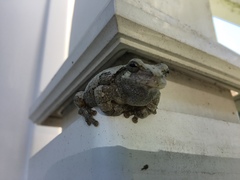
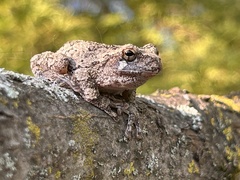
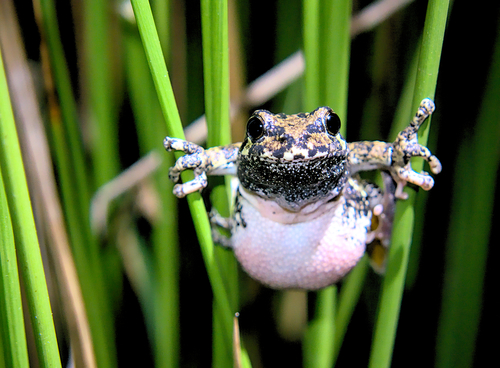
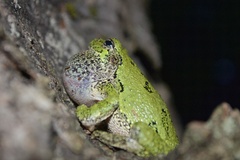
As the specific name versicolor implies, the gray treefrog is variable in color. This ability to vary its color provides it with the ability to camouflage itself from gray to green or brown, depending on the environment around it. Dryophytes versicolor can change from nearly black to nearly white. It changes color at a slower rate than a chameleon. A unique aspect of the appearance of the gray treefrog is that its legs feature a dark band-like pattern which then contrast sharply with the black-marked bright yellow or orange under the sides of its legs and arms. Dead gray treefrogs and ones in unnatural surroundings are predominantly gray. The female does not call; however, the male does call. The female gray treefrog is usually larger than its male counterpart... Wikipedia →

Sounds

Recording0:25

United States · 2021

© Scott Olmstead · XC1078487 · CC BY-NC-SA 4.0

Advertisement call0:13

United States · 2008

© Paul Driver · XC961790 · CC BY-NC-SA 4.0

Only at nightime sound0:31

United States · 2023

© Rich M · XC816554 · CC BY-NC-SA 4.0

Global Distribution

Parks Where Found

# Park Country Daily sighting probability
1 Voyageurs National Park 🇺🇸 United States
~20%
2 Acadia National Park 🇺🇸 United States
~20%
3 Shenandoah National Park 🇺🇸 United States
~10%
4 Riding Mountain National Park 🇨🇦 Canada
~10%

Cities Where Found

# City Country Daily sighting probability
1 Detroit 🇺🇸 United States
~10%
2 Philadelphia 🇺🇸 United States
~10%
3 Minneapolis [Saint Paul] 🇺🇸 United States
~10%
4 Boston 🇺🇸 United States
~10%
5 Toronto 🇨🇦 Canada
~10%
6 Montreal 🇨🇦 Canada
~10%
7 Houston 🇺🇸 United States
<5%
8 Washington 🇺🇸 United States
<5%
9 New York City 🇺🇸 United States
<5%

Zoos & Centres Where Found

# Zoo / Centre Country
1 National Zoological Park 🇺🇸 United States In captivity
2 Shedd Aquarium 🇺🇸 United States In captivity
3 Ecomuseum Zoo 🇨🇦 Canada In captivity
4 Toronto Zoo 🇨🇦 Canada In captivity
5 Squam Lakes Natural Science Center 🇺🇸 United States In captivity
6 Cape May County Park & Zoo 🇺🇸 United States In captivity
7 Louisville Zoo 🇺🇸 United States In captivity
8 Night Safari 🇸🇬 Singapore In captivity
9 Singapore Zoo 🇸🇬 Singapore In captivity
10 Philadelphia Zoo 🇺🇸 United States In captivity
11 Pittsburgh Zoo & Aquarium 🇺🇸 United States In captivity
12 Western North Carolina Nature Center 🇺🇸 United States In captivity
13 Lake Superior Zoo 🇺🇸 United States In captivity
14 River Wonders 🇸🇬 Singapore In captivity
15 Trailside Museum & Zoo 🇺🇸 United States In captivity
16 Blue Hills Trailside Museum Habitats 🇺🇸 United States In captivity
17 Ralph Perkins II Wildlife Center and Woods Garden 🇺🇸 United States In captivity
18 Wonders of Wildlife Museum & Aquarium 🇺🇸 United States In captivity
19 Dallas World Aquarium 🇺🇸 United States In captivity
20 Bird Kingdom 🇨🇦 Canada In captivity
21 Aquarium of Niagara 🇺🇸 United States In captivity
22 Belle Isle Nature Center 🇨🇦 Canada In captivity
23 Huntsman Fundy Discovery Aquarium 🇨🇦 Canada In captivity
24 Medicine Park Aquarium & Natural Sciences Center 🇺🇸 United States In captivity
25 Snake Discovery: A Reptile Experience 🇺🇸 United States In captivity

Before you go

What are the chances of seeing a Gray Treefrog Species Complex in Riding Mountain National Park?

With luck

About 10% of wildlife watchers report a Gray Treefrog Species Complex sighting in Riding Mountain National Park on a given day, based on 9 verified sightings from GBIF citizen-science data from 2019 to 2026. It is the 5th most-seen of the 6 amphibians we can rate there. Over three days the chance rises to about 30%, and over a week to about 60%, if each day is a fresh chance.

When is the best time to see a Gray Treefrog Species Complex in Riding Mountain National Park?

August

In that month about 20% of wildlife watchers report a Gray Treefrog Species Complex in Riding Mountain National Park on a given day, against under 5% in November to April, the lowest months. That is one of Riding Mountain National Park's wettest months, with about 70 mm of rain against 20 mm in February.

What time of day is best to see a Gray Treefrog Species Complex?

Between 11 am and 2 pm

Across all the parks we cover, that three-hour window holds the most Gray Treefrog Species Complex sightings with a recorded time, and about 6 in 10 of them come between 6 am and 6 pm: it is seen both by day and at night.

Is Riding Mountain National Park the best place to see a Gray Treefrog Species Complex?

4th of 4

Of the 4 parks where we can rate Gray Treefrog Species Complex sightings, Riding Mountain National Park ranks 4th at about 10%. The best odds are in Voyageurs National Park (United States, about 20%), Acadia National Park (United States, about 20%) and Shenandoah National Park (United States, about 10%).

Where does the Gray Treefrog Species Complex sighting chance come from?

GBIF citizen-science records

It is estimated from how often the Gray Treefrog Species Complex is recorded against all the amphibians logged in Riding Mountain National Park (9 verified sightings from 2019 to 2026), calibrated against known sighting rates. Figures are rounded to the nearest 10% because citizen-science data supports honest approximations, not decimals, and months with records from fewer than five people show "—". How it works.
← Back to Riding Mountain National Park