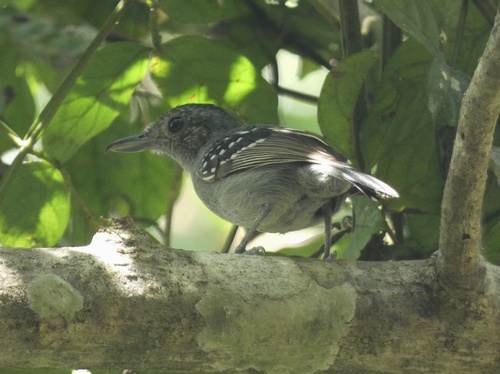
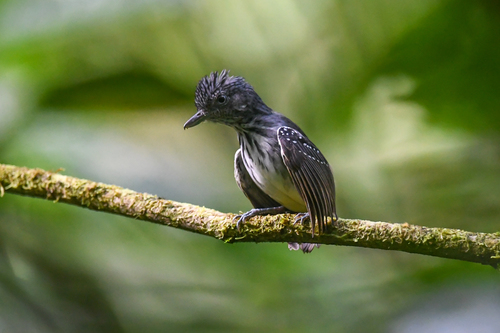
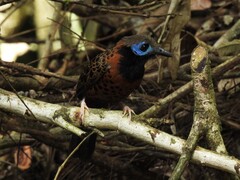
Ocellated Antbird

Ocellated Antbird

Phaenostictus mcleannani

Silhouette: Sheatherius · PhyloPic

LCLeast ConcernNTVUENCR
Daily sighting probability <5% · Rare
at Rincón de la Vieja National Park

In 3 days <5% in a week ~10%

16 Verified sightings at Rincón de la Vieja National Park From 2019 to 2026
2,381 In all 11 parks
May Best month
☀️ Diurnal When it's spotted

About the Ocellated Antbird

The ocellated antbird (Phaenostictus mcleannani) is a species of antbird in subfamily Thamnophilinae of family Thamnophilidae, the "typical antbirds". It is found in Colombia, Costa Rica, Ecuador, Honduras, Nicaragua, and Panama.

The ocellated antbird was formally described in 1861 by the American amateur ornithologist George Newbold Lawrence and given the binomial name Phlogopsis mcleannani (misspelled as Meleannani). The ocellated antbird is now placed in the genus Phaenostictus that was erected in 1909 by the American ornithologist Robert Ridgway. The genus name is derived from the Ancient Greek phainō meaning "to display" and stiktos for "spotted". The specific epithet honors James McLeannan, a railway engineer on the Panama Canal Railway, who had collected the type specimen in Panama. Ridgway considered that the species was related to the genus Phlegopsis (the bare-eyes) but that it differed in having a longer tail, rounded nostrils and a few other characters.

Molecular phylogenetic studies of the antbird family, Thamnophilidae, have found that the ocellated antbird sits in the tribe Pithyini and its closest relatives are in genus Pithys. The ocellated... Wikipedia →

Sounds

Call0:12

Ecuador · 2019

© rudy gelis · XC821976 · CC BY-NC-SA 4.0

Song0:24

Panama · 2019

© Kent Livezey · XC541049 · CC BY-NC-SA 4.0

Call0:37

Colombia · 2020

© Iván Lau · XC587397 · CC BY-NC-SA 4.0

Global Distribution

Parks Where Found

# Park Country Daily sighting probability
1 Darién National Park 🇵🇦 Panama
~10%
2 Soberanía National Park 🇵🇦 Panama
~10%
3 Chagres National Park 🇵🇦 Panama
~10%
4 Tenorio Volcano National Park 🇨🇷 Costa Rica
~10%
5 Arenal Volcano National Park 🇨🇷 Costa Rica
~10%
6 San Lorenzo Protected Forest 🇵🇦 Panama
<5%
7 Braulio Carrillo National Park 🇨🇷 Costa Rica
<5%
8 Rincón de la Vieja National Park 🇨🇷 Costa Rica
<5%
9 Farallones de Cali National Natural Park 🇨🇴 Colombia
<5%
10 Tapantí-Macizo de la Muerte National Park 🇨🇷 Costa Rica
<5%
11 Monteverde Cloud Forest Reserve 🇨🇷 Costa Rica
<5%

Before you go

What are the chances of seeing an Ocellated Antbird in Rincón de la Vieja National Park?

Rare

Under 5% of wildlife watchers report an Ocellated Antbird sighting in Rincón de la Vieja National Park on a given day, based on 16 verified sightings from GBIF citizen-science data from 2019 to 2026. It is the 258th most-seen of the 341 birds we can rate there. Over three days the chance rises to under 5%, and over a week to about 10%, if each day is a fresh chance.

When is the best time to see an Ocellated Antbird in Rincón de la Vieja National Park?

May

In that month about 10% of wildlife watchers report an Ocellated Antbird in Rincón de la Vieja National Park on a given day, against under 5% in June to April, the lowest months.

What time of day is best to see an Ocellated Antbird?

Between 9 am and noon

Across all the parks we cover, that three-hour window holds the most Ocellated Antbird sightings with a recorded time, and about 9 in 10 of them come between 6 am and 6 pm: it is a daytime animal.

Is Rincón de la Vieja National Park the best place to see an Ocellated Antbird?

8th of 11

Of the 11 parks where we can rate Ocellated Antbird sightings, Rincón de la Vieja National Park ranks 8th at under 5%. The best odds are in Darién National Park (Panama, about 10%), Soberanía National Park (Panama, about 10%) and Chagres National Park (Panama, about 10%).

Where does the Ocellated Antbird sighting chance come from?

GBIF citizen-science records

It is estimated from how often the Ocellated Antbird is recorded against all the birds logged in Rincón de la Vieja National Park (16 verified sightings from 2019 to 2026), calibrated against known sighting rates. Figures are rounded to the nearest 10% because citizen-science data supports honest approximations, not decimals, and months with records from fewer than five people show "—". How it works.

← Back to Rincón de la Vieja National Park