Powerful Owl

Powerful Owl

Ninox strenua

Silhouette: Rachel T Mason · PhyloPic

LCLeast ConcernNTVUENCR Endemic
Daily sighting probability <5% · Rare
at Royal National Park

In 3 days ~10% in a week ~30%

407 Verified sightings at Royal National Park From 2019 to 2026
686 In all 6 parks
October Best month
☀️ Diurnal When it's spotted

About the Powerful Owl

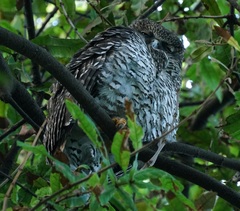
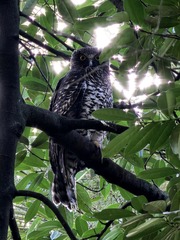
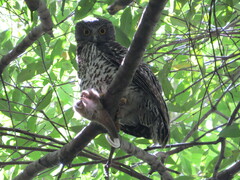
The powerful owl (Ninox strenua), a species of owl native to south-eastern and eastern Australia, is the largest owl on the continent. It is found in coastal areas and in the Great Dividing Range, rarely more than 200 km (120 mi) inland. The IUCN Red List of Threatened Species also refers to this species as the powerful boobook.

An apex predator in its narrow distribution, powerful owls are often opportunists, like most predators, but generally are dedicated to hunting arboreal mammals, in particular small to medium-sized marsupials. Such prey can comprise about three-quarters of their diet. Generally, this species lives in primary forests with tall, native trees, but can show some habitat flexibility when not nesting.

The powerful owl is a typically territorial raptorial bird that maintains a large home range and has long intervals between egg-laying and hatching of clutches. Also, like many types of raptorial birds, they must survive a long stretch to independence in young owls after fledging. Unlike most raptorial birds, however, male powerful owls are larger and stronger than females, so the male takes the dominant position in the mating pair, which extends to food distribution... Wikipedia →

Sounds

Song1:13

Australia · 2020

© Marc Anderson · XC1045858 · CC BY-NC-ND 4.0

Call0:40

Australia · 2017

© Eddy Smith · XC748160 · CC BY-NC-SA 4.0

Begging call0:20

Australia · 2019

© Trevor Speirs · XC513535 · CC BY-NC-SA 4.0

Global Distribution

Parks Where Found

# Park Country Daily sighting probability
1 Springbrook National Park 🇦🇺 Australia
~10%
2 Royal National Park 🇦🇺 Australia
<5%
3 Grampians National Park 🇦🇺 Australia
<5%
4 Great Otway National Park 🇦🇺 Australia
<5%
5 Lamington National Park 🇦🇺 Australia
<5%
6 Blue Mountains National Park 🇦🇺 Australia
<5%

Cities Where Found

# City Country Daily sighting probability
1 Sydney 🇦🇺 Australia
<5%
2 Melbourne 🇦🇺 Australia
<5%
3 Brisbane 🇦🇺 Australia
<5%

Zoos & Centres Where Found

# Zoo / Centre Country
1 Featherdale Sydney Wildlife Park 🇦🇺 Australia In captivity

Before you go

What are the chances of seeing a Powerful Owl in Royal National Park?

Rare

Under 5% of wildlife watchers report a Powerful Owl sighting in Royal National Park on a given day, based on 407 verified sightings from GBIF citizen-science data from 2019 to 2026. It is the 98th most-seen of the 178 birds we can rate there. Over three days the chance rises to about 10%, and over a week to about 30%, if each day is a fresh chance.

When is the best time to see a Powerful Owl in Royal National Park?

September to November

In those months about 10% of wildlife watchers report a Powerful Owl in Royal National Park on a given day, against under 5% in December to August, the lowest months.

What time of day is best to see a Powerful Owl?

Between 11 am and 2 pm

Across all the parks we cover, that three-hour window holds the most Powerful Owl sightings with a recorded time, and about 7 in 10 of them come between 6 am and 6 pm: it is a daytime animal.

Is Royal National Park the best place to see a Powerful Owl?

2nd of 6

Of the 6 parks where we can rate Powerful Owl sightings, Royal National Park ranks 2nd at under 5%. The best odds are in Springbrook National Park (Australia, about 10%).

Where does the Powerful Owl sighting chance come from?

GBIF citizen-science records

It is estimated from how often the Powerful Owl is recorded against all the birds logged in Royal National Park (407 verified sightings from 2019 to 2026), calibrated against known sighting rates. Figures are rounded to the nearest 10% because citizen-science data supports honest approximations, not decimals, and months with records from fewer than five people show "—". How it works.

← Back to Royal National Park