Gray Flycatcher

Gray Flycatcher

Empidonax wrightii

Silhouette: Emily Willoughby · PhyloPic

LCLeast ConcernNTVUENCR
Daily sighting probability <5% · Rare
at Saguaro National Park

In 3 days ~10%

151 Verified sightings at Saguaro National Park From 2019 to 2026
1,049 In all 12 parks
April Best month
☀️ Diurnal When it's spotted

About the Gray Flycatcher

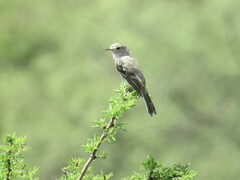
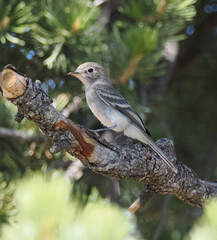
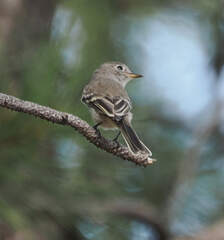
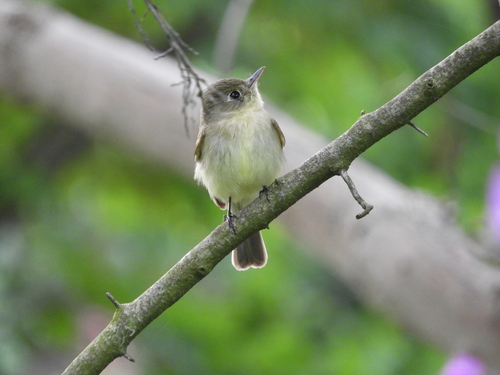
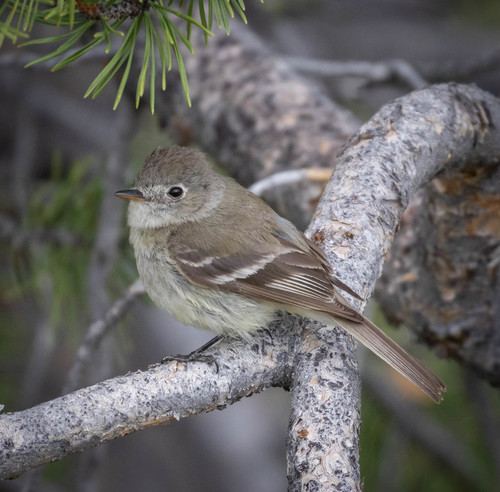
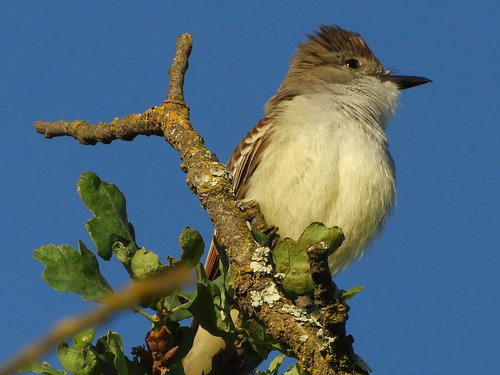
The American gray flycatcher, American grey flycatcher, or just gray flycatcher (Empidonax wrightii) as it is known in North America, is a small, insectivorous passerine in the tyrant flycatcher family. It is common in the arid regions of western North America, especially the Great Basin. From sagebrush steppes to pinyon-juniper woodlands and ponderosa pine forests, this flycatcher forages for insects from shrubs or low tree branches.

The American gray flycatcher is one of the many species in the genus Empidonax. These species are very similar in appearance and behavior, and they are notoriously difficult to differentiate. The best characteristics for distinguishing these species are voice, breeding habitat, and range. The American gray flycatcher, however, can be identified by a unique behavior, its downward tail wag. Other Empidonax species typically exhibit a rapid upward tail flick.

American gray flycatchers are small birds, but larger than most Empidonax flycatchers. A typical adult measures 15 cm (5.9 in) in length, 22 cm (8.7 in) in wingspan, and 12.5 g (0.44 oz) in mass. Adults have pale gray upperparts, darker on the wings and tail, with a faint olive tinge... Wikipedia →

Sounds

Call0:09

United States · 2025

© Greg Irving · XC1029978 · CC BY-NC-SA 4.0

Song0:27

United States · 2019

© Bruce Lagerquist · XC554603 · CC BY-NC-SA 4.0

Dawnsong0:57

United States · 2008

© Andrew Spencer · XC19082 · CC BY-NC-ND 2.5

Global Distribution

Parks Where Found

# Park Country Daily sighting probability
1 Cabo Pulmo National Park 🇲🇽 Mexico
~20%
2 Guadalupe Mountains National Park 🇺🇸 United States
~10%
3 Grand Canyon National Park 🇺🇸 United States
~10%
4 Bahía de Loreto National Park 🇲🇽 Mexico
~10%
5 Big Bend National Park 🇺🇸 United States
~10%
6 Death Valley National Park 🇺🇸 United States
<5%
7 El Vizcaíno Biosphere Reserve 🇲🇽 Mexico
<5%
8 Zion National Park 🇺🇸 United States
<5%
9 Saguaro National Park 🇺🇸 United States
<5%
10 Joshua Tree National Park 🇺🇸 United States
<5%
11 Cumbres de Monterrey National Park 🇲🇽 Mexico
<5%
12 Yosemite National Park 🇺🇸 United States
<5%

Cities Where Found

# City Country Daily sighting probability
1 Mexico City 🇲🇽 México
<5%
2 Las Vegas 🇺🇸 United States
<5%
3 Guadalajara 🇲🇽 México
<5%
4 Puebla 🇲🇽 México
<5%
5 Phoenix 🇺🇸 United States
<5%
6 Mesa 🇺🇸 United States
<5%
7 Salt Lake City 🇺🇸 United States
<5%
8 San Diego 🇺🇸 United States
<5%
9 Los Angeles 🇺🇸 United States
<5%
10 Sacramento 🇺🇸 United States
<5%

Before you go

What are the chances of seeing a Gray Flycatcher in Saguaro National Park?

Rare

Under 5% of wildlife watchers report a Gray Flycatcher sighting in Saguaro National Park on a given day, based on 151 verified sightings from GBIF citizen-science data from 2019 to 2026. It is the 98th most-seen of the 220 birds we can rate there. Over three days the chance rises to about 10%, if each day is a fresh chance.

When is the best time to see a Gray Flycatcher in Saguaro National Park?

April

In that month about 10% of wildlife watchers report a Gray Flycatcher in Saguaro National Park on a given day, against under 5% in May to March, the lowest months. That is one of Saguaro National Park's driest months, with about 5 mm of rain against 55 mm in July.

What time of day is best to see a Gray Flycatcher?

Between 8 and 11 am

Across all the parks we cover, that three-hour window holds the most Gray Flycatcher sightings with a recorded time, and about 9 in 10 of them come between 6 am and 6 pm: it is a daytime animal.

Where does the Gray Flycatcher sighting chance come from?

GBIF citizen-science records

It is estimated from how often the Gray Flycatcher is recorded against all the birds logged in Saguaro National Park (151 verified sightings from 2019 to 2026), calibrated against known sighting rates. Figures are rounded to the nearest 10% because citizen-science data supports honest approximations, not decimals, and months with records from fewer than five people show "—". How it works.

← Back to Saguaro National Park