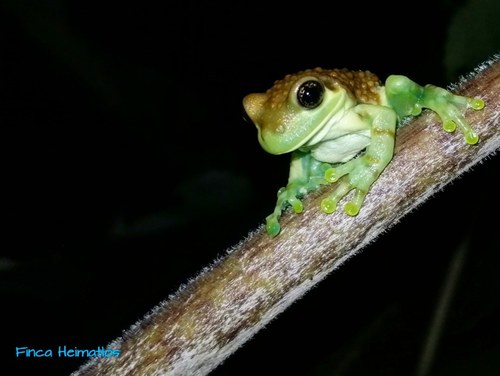
Boulenger's Snouted Tree Frog

Boulenger's Snouted Tree Frog

Scinax boulengeri

Silhouette: Dmitry Bogdanov (vectorized by T. Michael Keesey) · PhyloPic

LCLeast ConcernNTVUENCR
Daily sighting probability ~10% · With luck
at Santa Rosa National Park

In 3 days ~40% in a week ~60%

5 Verified sightings at Santa Rosa National Park From 2019 to 2026
133 In all 8 parks
June Best month
🌙 Nocturnal When it's spotted

About the Boulenger's Snouted Tree Frog

Scinax boulengeri (commonly known as Boulenger's snouted tree frog) is a species of frog in the family Hylidae. It is found in Colombia, Costa Rica, Nicaragua, Panama, and possibly Honduras. Its natural habitats are subtropical or tropical moist lowland forests, intermittent freshwater marshes, pastureland, plantations, rural gardens, and urban areas. It has been found as high as 600 meters above sea level.

The adult male frog measures 36 to 49 mm long in snout-vent length and the adult female frog 42 to 53 mm. This frog is gray, dull green, or light brown in color with darker brown marks and tuberculate skin on its dorsum. It has dark brown marks. It can have a triangle between its eyes. There are bars on its front and back legs. It has a white throat and white ventrum. Its middle is green. Its sides are yellow-green.

This frog is arboreal and nocturnal. When human beings see it, it is usually perching on a shrub or other mid-sized plant. Unlike other tree frogs, its breeding season is not closely linked to rainfall. The male frogs hide in vegetation near the edges of ponds. Then they sing for the female frogs for about four hours. The female frog lays eggs in shallow water, 600–700 per clutch. The eggs hatch after 1–1.5 days. The silver-yellow tadpoles grow into frogs in 40 to 88 days. Wikipedia →

Sounds

Advertisement call0:10

Costa Rica · 2023

© Chris Harrison · XC893966 · CC BY-NC-SA 4.0

Recording0:19

Panama · 2025

© Brian Gratwicke · iNaturalist · CC BY 4.0

Global Distribution

Parks Where Found

# Park Country Daily sighting probability
1 Piedras Blancas National Park 🇨🇷 Costa Rica
~40%
2 Tenorio Volcano National Park 🇨🇷 Costa Rica
~20%
3 Braulio Carrillo National Park 🇨🇷 Costa Rica
~20%
4 Santa Rosa National Park 🇨🇷 Costa Rica
~10%
5 Cahuita National Park 🇨🇷 Costa Rica
~10%
6 Manuel Antonio National Park 🇨🇷 Costa Rica
~10%
7 Soberanía National Park 🇵🇦 Panama
~10%
8 Corcovado National Park 🇨🇷 Costa Rica
~10%

Before you go

What are the chances of seeing a Boulenger's Snouted Tree Frog in Santa Rosa National Park?

With luck

About 10% of wildlife watchers report a Boulenger's Snouted Tree Frog sighting in Santa Rosa National Park on a given day, based on 5 verified sightings from GBIF citizen-science data from 2019 to 2026. It is the 13th most-seen of the 14 amphibians we can rate there. Over three days the chance rises to about 40%, and over a week to about 60%, if each day is a fresh chance.

When is the best time to see a Boulenger's Snouted Tree Frog in Santa Rosa National Park?

June

In that month about 40% of wildlife watchers report a Boulenger's Snouted Tree Frog in Santa Rosa National Park on a given day, against under 5% in February–May, July–September and November–December, the lowest months. That is one of Santa Rosa National Park's wettest months, with about 330 mm of rain against almost none in February.

What time of day is best to see a Boulenger's Snouted Tree Frog?

Between 7 and 10 pm

Across all the parks we cover, that three-hour window holds the most Boulenger's Snouted Tree Frog sightings with a recorded time, and about 9 in 10 of them come between 6 pm and 6 am: it is mostly seen at night.

Where does the Boulenger's Snouted Tree Frog sighting chance come from?

GBIF citizen-science records

It is estimated from how often the Boulenger's Snouted Tree Frog is recorded against all the amphibians logged in Santa Rosa National Park (5 verified sightings from 2019 to 2026), calibrated against known sighting rates. Figures are rounded to the nearest 10% because citizen-science data supports honest approximations, not decimals, and months with records from fewer than five people show "—". How it works.

← Back to Santa Rosa National Park