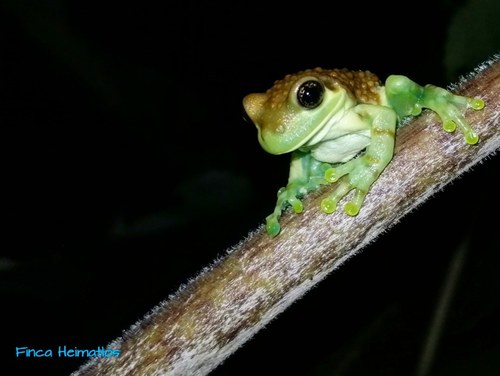
Yellow Treefrog

Yellow Treefrog

Dendropsophus microcephalus

Silhouette: Dmitry Bogdanov (vectorized by T. Michael Keesey) · PhyloPic

LCLeast ConcernNTVUENCR
Daily sighting probability ~20% · Possible
at Santa Rosa National Park

In 3 days ~50% in a week ~80%

14 Verified sightings at Santa Rosa National Park From 2019 to 2026
274 In all 13 parks
June Best month
🌙 Nocturnal When it's spotted

About the Yellow Treefrog

Dendropsophus microcephalus is a species of frog in the family Hylidae. It is found in southeastern Mexico (southern Veracruz and northern Oaxaca), Central America (Belize, Costa Rica, El Salvador, Guatemala, Honduras, Nicaragua, Panama), and northern South America in Colombia, Venezuela, Trinidad and Tobago, the Guianas (Guyana, Suriname, French Guiana ), and northern Brazil. This widespread species might actually be a species complex. Its common names include yellow treefrog, small-headed treefrog, and yellow cricket treefrog.

Males grow to about 25 mm (0.98 in) and females 31 mm (1.2 in) in snout–vent length. It is dorsally smooth and pale to bright yellow with two fairly distinct light brown lines that run in parallel down the length of the body. Upper surfaces of the thighs have dark markings. Ventrally it is pale cream or white, possibly with more yellowish throat. The iris is bronze. The D. microcephalus is commonly confused with D. ebraccatus, the hourglass treefrog. The D. microcephalus can be distinguished by its lack of hourglass pattern on its dorsum, and lack of a pale lip strip.

Dendropsophus microcephalus inhabits savanna... Wikipedia →

Sounds

Advertisement call0:12

Costa Rica · 2014

© Chris Harrison · XC890493 · CC BY-NC-SA 4.0

Recording0:21

Venezuela · 1978

© M.S. Hoogmoed · XC882754 · CC BY 4.0

Recording0:12

Mexico · 2024

© Daniel Durán Arceo · iNaturalist · CC BY-NC 4.0

Global Distribution

Parks Where Found

# Park Country Daily sighting probability
1 Pico Bonito National Park 🇭🇳 Honduras
~40%
2 Palo Verde National Park 🇨🇷 Costa Rica
~40%
3 Tayrona National Natural Park 🇨🇴 Colombia
~30%
4 Carara National Park 🇨🇷 Costa Rica
~30%
5 Santa Rosa National Park 🇨🇷 Costa Rica
~20%
6 Soberanía National Park 🇵🇦 Panama
~20%
7 Calakmul Biosphere Reserve 🇲🇽 Mexico
~20%
8 Arenal Volcano National Park 🇨🇷 Costa Rica
~10%
9 Piedras Blancas National Park 🇨🇷 Costa Rica
~10%
10 Tenorio Volcano National Park 🇨🇷 Costa Rica
~10%
11 Manuel Antonio National Park 🇨🇷 Costa Rica
~10%
12 Braulio Carrillo National Park 🇨🇷 Costa Rica
~10%
13 Monteverde Cloud Forest Reserve 🇨🇷 Costa Rica
~10%

Zoos & Centres Where Found

# Zoo / Centre Country
1 Slimbridge Wetland Centre 🇬🇧 United Kingdom In captivity

Before you go

What are the chances of seeing a Yellow Treefrog in Santa Rosa National Park?

Possible

About 20% of wildlife watchers report a Yellow Treefrog sighting in Santa Rosa National Park on a given day, based on 14 verified sightings from GBIF citizen-science data from 2019 to 2026. It is the 12th most-seen of the 14 amphibians we can rate there. Over three days the chance rises to about 50%, and over a week to about 80%, if each day is a fresh chance.

When is the best time to see a Yellow Treefrog in Santa Rosa National Park?

June and August

In those months about 40% of wildlife watchers report a Yellow Treefrog in Santa Rosa National Park on a given day, against under 5% in March–April, September and November–January, the lowest months. Those are among Santa Rosa National Park's wettest months, with about 300 mm of rain a month against almost none in February.

What time of day is best to see a Yellow Treefrog?

Between 7 and 10 pm

Across all the parks we cover, that three-hour window holds the most Yellow Treefrog sightings with a recorded time, and about 8 in 10 of them come between 6 pm and 6 am: it is mostly seen at night.

Which relatives of the Yellow Treefrog live in Santa Rosa National Park?

Same family: Hylidae

The closest relatives of the Yellow Treefrog that you can see in Santa Rosa National Park (family Hylidae, Hylid Tree Frogs) are Milk Frog (about 70%), Mexican Smilisca (about 50%) and Stauffer's Tree Frog (about 40%), with each one's daily chance of a sighting.

Where does the Yellow Treefrog sighting chance come from?

GBIF citizen-science records

It is estimated from how often the Yellow Treefrog is recorded against all the amphibians logged in Santa Rosa National Park (14 verified sightings from 2019 to 2026), calibrated against known sighting rates. Figures are rounded to the nearest 10% because citizen-science data supports honest approximations, not decimals, and months with records from fewer than five people show "—". How it works.

← Back to Santa Rosa National Park