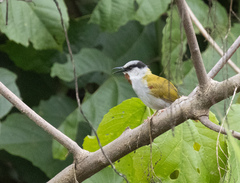
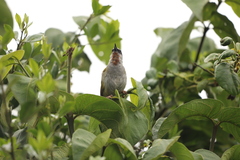
Gray-capped Warbler

Gray-capped Warbler

Eminia lepida

Silhouette: Sheatherius · PhyloPic

LCLeast ConcernNTVUENCR
Daily sighting probability <5% · Rare
at Serengeti National Park

In 3 days <5% in a week ~10%

32 Verified sightings at Serengeti National Park From 2019 to 2026
2,478 In all 15 parks
April Best month
🌅 Crepuscular When it's spotted

About the Gray-capped Warbler

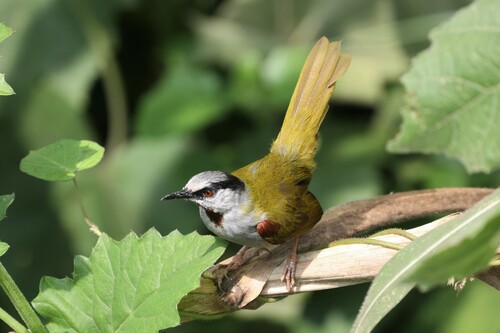
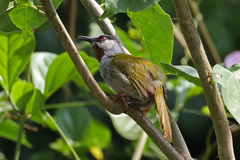
The grey-capped warbler (Eminia lepida) is a species of bird in the family Cisticolidae. It is monotypic (only species) in the genus Eminia. The grey-capped warbler is found in Burundi, Democratic Republic of the Congo, Kenya, Rwanda, South Sudan, Tanzania, and Uganda. It is a large, chunky, thin-tailed-warbler with a distinctive grey cap, a black band around its head, and a chestnut throat wrapping its neck. Grey-capped warblers maintain a diet of insects and other invertebrates, including caterpillars, moths, grasshoppers, and mantids.

The grey-capped warbler is roughly 15 cm in length, and weighs 16–24 grams. It is typically chunky and thin-tailed with a distinctive grey cap, a black band around the head, and a chestnut throat with rump feathers that are long and lax. Its cheek, neck, and underparts are grey and it is tinged olive-green on the flanks and under tail-coverts. Grey-capped warblers have a chestnut vent patch and upperparts. The tail and the median and greater upper wing-coverts are olive-green. The lesser coverts and underwing-coverts are chestnut. Flight-feathers are dark brown (edged olive-green). The irises are reddish-brown, the bill and mouth... Wikipedia →
Sounds

Duet0:43

Kenya · 2026

© Ding Li Yong · XC1178743 · CC BY-NC-ND 4.0

Song0:38

Tanzania · 2026

Kileo Jumah · XC1149012 · CC0

Recording0:22

Kenya · 2023

© Nathan Mixon · XC950624 · CC BY-NC-SA 4.0

Global Distribution

Parks Where Found

# Park Country Daily sighting probability
1 Queen Elizabeth National Park 🇺🇬 Uganda
~30%
2 Aberdare National Park 🇰🇪 Kenya
~20%
3 Kibale National Park 🇺🇬 Uganda
~20%
4 Ngorongoro Conservation Area 🇹🇿 Tanzania
~20%
5 Lake Mburo National Park 🇺🇬 Uganda
~20%
6 Nairobi National Park 🇰🇪 Kenya
~20%
7 Virunga National Park 🇨🇩 Democratic Republic of the Congo
~10%
8 Bwindi Impenetrable National Park 🇺🇬 Uganda
~10%
9 Murchison Falls National Park 🇺🇬 Uganda
~10%
10 Akagera National Park 🇷🇼 Rwanda
~10%
11 Masai Mara National Reserve 🇰🇪 Kenya
~10%
12 Lake Nakuru National Park 🇰🇪 Kenya
~10%
13 Volcanoes National Park 🇷🇼 Rwanda
<5%
14 Nyungwe National Park 🇷🇼 Rwanda
<5%
15 Serengeti National Park 🇹🇿 Tanzania
<5%

Cities Where Found

# City Country Daily sighting probability
1 Kampala 🇺🇬 Uganda
~30%
2 Kigali 🇷🇼 Rwanda
~20%
3 Nairobi 🇰🇪 Kenya
~20%
4 Bujumbura 🇧🇮 Burundi
~10%

Before you go

What are the chances of seeing a Gray-capped Warbler in Serengeti National Park?

Rare

Under 5% of wildlife watchers report a Gray-capped Warbler sighting in Serengeti National Park on a given day, based on 32 verified sightings from GBIF citizen-science data from 2019 to 2026. It is the 338th most-seen of the 469 birds we can rate there. Over three days the chance rises to under 5%, and over a week to about 10%, if each day is a fresh chance.

When is the best time to see a Gray-capped Warbler in Serengeti National Park?

Any time of year

In every month with enough records, under 5% of wildlife watchers report a Gray-capped Warbler in Serengeti National Park on a given day, so our monthly data shows no clear season.

What time of day is best to see a Gray-capped Warbler?

Between 7 and 10 am

Across all the parks we cover, that three-hour window holds the most Gray-capped Warbler sightings with a recorded time, and about 7 in 10 of them come between 6 am and 6 pm: it is most active around dawn and dusk.

Which relatives of the Gray-capped Warbler live in Serengeti National Park?

Same family: Cisticolidae

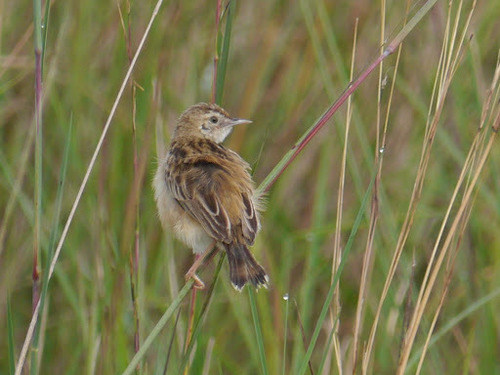
The closest relatives of the Gray-capped Warbler that you can see in Serengeti National Park (family Cisticolidae, Cisticolas and Allies) are Rattling Cisticola (about 50%), Green-backed Camaroptera (about 30%) and Zitting Cisticola (about 20%), with each one's daily chance of a sighting.

Where does the Gray-capped Warbler sighting chance come from?

GBIF citizen-science records

It is estimated from how often the Gray-capped Warbler is recorded against all the birds logged in Serengeti National Park (32 verified sightings from 2019 to 2026), calibrated against known sighting rates. Figures are rounded to the nearest 10% because citizen-science data supports honest approximations, not decimals, and months with records from fewer than five people show "—". How it works.

← Back to Serengeti National Park