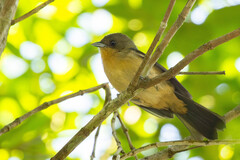

Black-goggled Tanager

Black-goggled Tanager

Trichothraupis melanops

Silhouette: Sheatherius · PhyloPic

LCLeast ConcernNTVUENCR
Daily sighting probability <5% · Rare
at Serra da Canastra National Park

In 3 days ~10% in a week ~20%

13 Verified sightings at Serra da Canastra National Park From 2019 to 2026
4,595 In all 7 parks
May Best month
☀️ Diurnal When it's spotted

About the Black-goggled Tanager

The black-goggled tanager (Trichothraupis melanops) is a species of bird in the family Thraupidae, the tanagers and allies. It is found in Argentina, Bolivia, Brazil, Paraguay, Peru, and Uruguay. The black-goggled tanager was formally described in 1818 by the French ornithologist Louis Pierre Vieillot under the binomial name Muscicapa melanops. Vieillot based his description on the Lindo pardo copete amarillo that had been described by the Spanish naturalist Félix de Azara in 1802 based on a specimen collected in Paraguay. The black-goggled tanager is now the only species in the genus Trichothraupis that was introduced by the German ornithologist Jean Cabanis in 1851. The genus name Trichothraupis combines the Ancient Greek thrix meaning "hair" with the genus name Thraupis. The specific epithet combines the Ancient Greek melas meaning "black" with ōps meaning "face". Within the Thraupidae the black-goggled tanager is a member of the subfamily Tachyphoninae and is the sister species to the grey-headed tanager (Eucometis penicillata).

The black-goggled tanager's further taxonomy is unsettled. The IOC, AviList, and the Clements taxonomy recognize two subspecies... Wikipedia →

Sounds

Call0:43

Brazil · 2026

© JAYRSON ARAUJO DE OLIVEIRA · XC1150900 · CC BY-NC-SA 4.0

Alarm call0:21

Argentina · 2005

© Bernabe Lopez-Lanus · XC47048 · CC BY-NC-SA 3.0

Song0:23

Brazil · 2009

© Luiz Gabriel Mazzoni · XC35966 · CC BY-NC-ND 2.5

Global Distribution

Parks Where Found

# Park Country Daily sighting probability
1 Amboró National Park 🇧🇴 Bolivia
~40%
2 Itatiaia National Park 🇧🇷 Brazil
~40%
3 Serra dos Órgãos National Park 🇧🇷 Brazil
~40%
4 Iguaçu National Park 🇧🇷 Brazil
~30%
5 Iguazú National Park 🇦🇷 Argentina
~30%
6 Serra da Canastra National Park 🇧🇷 Brazil
<5%
7 Tijuca National Park 🇧🇷 Brazil
<5%

Cities Where Found

# City Country Daily sighting probability
1 Curitiba 🇧🇷 Brazil
<5%
2 São Paulo 🇧🇷 Brazil
<5%
3 Belo Horizonte 🇧🇷 Brazil
<5%
4 Santos 🇧🇷 Brazil
<5%

Before you go

What are the chances of seeing a Black-goggled Tanager in Serra da Canastra National Park?

Rare

Under 5% of wildlife watchers report a Black-goggled Tanager sighting in Serra da Canastra National Park on a given day, based on 13 verified sightings from GBIF citizen-science data from 2019 to 2026. It is the 237th most-seen of the 294 birds we can rate there. Over three days the chance rises to about 10%, and over a week to about 20%, if each day is a fresh chance.

When is the best time to see a Black-goggled Tanager in Serra da Canastra National Park?

May and July

In those months about 10% of wildlife watchers report a Black-goggled Tanager in Serra da Canastra National Park on a given day, against under 5% in June and August–April, the lowest months. Those are among Serra da Canastra National Park's driest months, with about 20 mm of rain a month against 280 mm in January.

What time of day is best to see a Black-goggled Tanager?

Between 9 am and noon

Across all the parks we cover, that three-hour window holds the most Black-goggled Tanager sightings with a recorded time, and about 9 in 10 of them come between 6 am and 6 pm: it is a daytime animal.

Which relatives of the Black-goggled Tanager live in Serra da Canastra National Park?

Same family: Thraupidae

The closest relatives of the Black-goggled Tanager that you can see in Serra da Canastra National Park (family Thraupidae, Tanagers and Allies) are Saffron Finch (about 80%), Sayaca Tanager (about 60%) and Burnished-buff Tanager (about 60%), with each one's daily chance of a sighting.

Where does the Black-goggled Tanager sighting chance come from?

GBIF citizen-science records

It is estimated from how often the Black-goggled Tanager is recorded against all the birds logged in Serra da Canastra National Park (13 verified sightings from 2019 to 2026), calibrated against known sighting rates. Figures are rounded to the nearest 10% because citizen-science data supports honest approximations, not decimals, and months with records from fewer than five people show "—". How it works.

← Back to Serra da Canastra National Park