
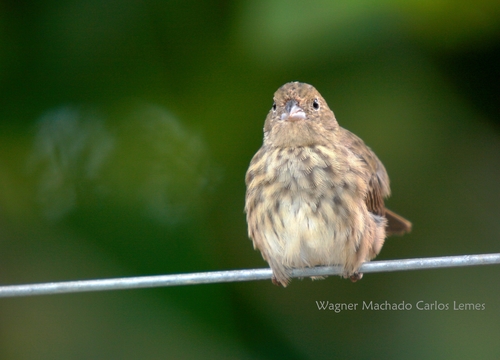
Ruby-crowned Tanager

Ruby-crowned Tanager

Tachyphonus coronatus

Silhouette: Sheatherius · PhyloPic

LCLeast ConcernNTVUENCR
Daily sighting probability ~20% · Possible
at Serra da Canastra National Park

In 3 days ~40% in a week ~70%

88 Verified sightings at Serra da Canastra National Park From 2019 to 2026
3,469 In all 6 parks
April Best month
☀️ Diurnal When it's spotted

About the Ruby-crowned Tanager

The ruby-crowned tanager (Tachyphonus coronatus) is a species of bird in the family Thraupidae, the tanagers and allies. It is found in Argentina, Brazil, Paraguay, and as a vagrant to Uruguay. The ruby-crowned tanager was formally described in 1822 with the binomial Agelaius Coronatus [sic], mistakenly classifying it as a New World blackbird. It now shares the genus Tachyphonus with four other species and is sister to the white-lined tanager (T. rufus).

The ruby-crowned tanager is monotypic. The ruby-crowned tanager is about 16 cm (6.3 in) long and weighs 26 to 33 g (0.92 to 1.2 oz). The species is sexually dimorphic. Adult males are mostly glossy blue-black. They have the eponymous red patch in the center of their crown, though it is usually hidden except during a display. They sometimes have a white patch on the scapulars that also is seldom visible. Their underwing coverts are white and show well in flight. Adult females have a grayish head. Their upperparts and wings are rufous-brown and their rump, uppertail coverts, and tail are more rufescent. Their throat is pale yellowish buff and the rest of their underparts a darker yellowish... Wikipedia →

Sounds

Call0:24

Brazil · 2026

© JAYRSON ARAUJO DE OLIVEIRA · XC1150805 · CC BY-NC-SA 4.0

Song0:19

Argentina · 2018

© Franco Vushurovich · XC594743 · CC BY-NC-SA 4.0

Chamado1:30

Brazil · 2016

© Caio Brito · XC428024 · CC BY-NC-SA 4.0

Global Distribution

Parks Where Found

# Park Country Daily sighting probability
1 Serra dos Órgãos National Park 🇧🇷 Brazil
~60%
2 Itatiaia National Park 🇧🇷 Brazil
~50%
3 Iguazú National Park 🇦🇷 Argentina
~20%
4 Iguaçu National Park 🇧🇷 Brazil
~20%
5 Serra da Canastra National Park 🇧🇷 Brazil
~20%
6 Tijuca National Park 🇧🇷 Brazil
<5%

Cities Where Found

# City Country Daily sighting probability
1 Curitiba 🇧🇷 Brazil
~20%
2 São Paulo 🇧🇷 Brazil
~10%
3 Santos 🇧🇷 Brazil
~10%
4 Campinas 🇧🇷 Brazil
<5%
5 Belo Horizonte 🇧🇷 Brazil
<5%
6 Rio de Janeiro 🇧🇷 Brazil
<5%
7 Buenos Aires 🇦🇷 Argentina
<5%

Zoos & Centres Where Found

# Zoo / Centre Country
1 Parque Zoobotânico de Joinville 🇧🇷 Brazil In captivity

Before you go

What are the chances of seeing a Ruby-crowned Tanager in Serra da Canastra National Park?

Possible

About 20% of wildlife watchers report a Ruby-crowned Tanager sighting in Serra da Canastra National Park on a given day, based on 88 verified sightings from GBIF citizen-science data from 2019 to 2026. It is the 117th most-seen of the 294 birds we can rate there. Over three days the chance rises to about 40%, and over a week to about 70%, if each day is a fresh chance.

When is the best time to see a Ruby-crowned Tanager in Serra da Canastra National Park?

April

In that month about 30% of wildlife watchers report a Ruby-crowned Tanager in Serra da Canastra National Park on a given day, against about 10% in May, September and December–February, the lowest months. That is one of Serra da Canastra National Park's driest months, with about 70 mm of rain against 280 mm in January.

What time of day is best to see a Ruby-crowned Tanager?

Between 2 and 5 pm

Across all the parks we cover, that three-hour window holds the most Ruby-crowned Tanager sightings with a recorded time, and nearly all of them come between 6 am and 6 pm: it is a daytime animal.

Where does the Ruby-crowned Tanager sighting chance come from?

GBIF citizen-science records

It is estimated from how often the Ruby-crowned Tanager is recorded against all the birds logged in Serra da Canastra National Park (88 verified sightings from 2019 to 2026), calibrated against known sighting rates. Figures are rounded to the nearest 10% because citizen-science data supports honest approximations, not decimals, and months with records from fewer than five people show "—". How it works.

← Back to Serra da Canastra National Park