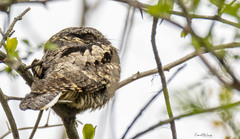
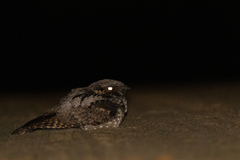
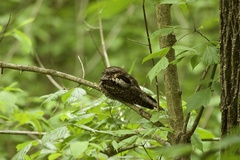
Eastern Whip-poor-will

Eastern Whip-poor-will

Antrostomus vociferus

Silhouette: Sheatherius · PhyloPic

LCNTNear ThreatenedVUENCR
Daily sighting probability <5% · Rare
at Shenandoah National Park

In 3 days <5%

34 Verified sightings at Shenandoah National Park From 2019 to 2026
757 In all 6 parks
July Best month
🌙 Nocturnal When it's spotted

About the Eastern Whip-poor-will

The eastern whip-poor-will (Antrostomus vociferus; also called "whip-o-will", "whip o' will", etc.) is a medium-sized (22–27 cm or 8.7–10.6 in) bird within the nightjar family, Caprimulgidae, from North America. The whip-poor-will is commonly heard within its range, but less often seen because of its camouflage. It is named onomatopoeically after its song.

This medium-sized nightjar measures 22–27 cm (8+1⁄2–10+1⁄2 in) in length, spans 45–50 cm (17+1⁄2–19+1⁄2 in) across the wings and weighs 42–69 g (1+1⁄2–2+7⁄16 oz). Further standard measurements are a wing chord of 14.7 to 16.9 cm (5+13⁄16 to 6+5⁄8 in), a tail of 10.5 to 12.8 cm (4+1⁄8 to 5+1⁄16 in), a bill of 1 to 1.4 cm (3⁄8 to 9⁄16 in) and a tarsus of 1.5 to 1.8 cm (9⁄16 to 11⁄16 in). Adults have mottled plumage: the upperparts are grey, black and brown; the lower parts are grey and black. They have a very short bill and a black throat. Males have a white patch below the throat and white tips on the outer tail feathers; in the female, these parts are light brown.

This bird is sometimes confused with the related chuck-will's-widow (Antrostomus carolinensis) which has a similar but lower-pitched and slower call.... Wikipedia →

Sounds

Song0:39

United States · 2023

© Sue Riffe · XC860759 · CC BY-NC-SA 4.0

Call0:44

United States · 2022

© Jorge de Leon Cardozo &amp; Susan Hochgraf · XC728665 · CC BY-NC-SA 4.0

Song0:58

United States · 2021

© Daniel Parker · XC734181 · CC BY-NC-SA 4.0

Global Distribution

Parks Where Found

# Park Country Daily sighting probability
1 Point Pelee National Park 🇨🇦 Canada
<5%
2 Great Smoky Mountains National Park 🇺🇸 United States
<5%
3 Everglades National Park 🇺🇸 United States
<5%
4 Shenandoah National Park 🇺🇸 United States
<5%
5 Big Cypress National Preserve 🇺🇸 United States
<5%
6 Merritt Island National Wildlife Refuge 🇺🇸 United States
<5%

Cities Where Found

# City Country Daily sighting probability
1 Chicago 🇺🇸 United States
<5%
2 Baltimore 🇺🇸 United States
<5%
3 Houston 🇺🇸 United States
<5%
4 Detroit 🇺🇸 United States
<5%
5 Miami 🇺🇸 United States
<5%
6 San Antonio 🇺🇸 United States
<5%
7 Toronto 🇨🇦 Canada
<5%
8 Washington 🇺🇸 United States
<5%
9 Austin 🇺🇸 United States
<5%
10 New York City 🇺🇸 United States
<5%

Before you go

What are the chances of seeing an Eastern Whip-poor-will in Shenandoah National Park?

Rare

Under 5% of wildlife watchers report an Eastern Whip-poor-will sighting in Shenandoah National Park on a given day, based on 34 verified sightings from GBIF citizen-science data from 2019 to 2026. It is the 151st most-seen of the 186 birds we can rate there. Over three days the chance rises to under 5%, if each day is a fresh chance.

When is the best time to see an Eastern Whip-poor-will in Shenandoah National Park?

Any time of year

In every month with enough records, under 5% of wildlife watchers report an Eastern Whip-poor-will in Shenandoah National Park on a given day, so our monthly data shows no clear season.

What time of day is best to see an Eastern Whip-poor-will?

Between 8 and 11 pm

Across all the parks we cover, that three-hour window holds the most Eastern Whip-poor-will sightings with a recorded time, and about 9 in 10 of them come between 6 pm and 6 am: it is mostly seen at night.

Is Shenandoah National Park the best place to see an Eastern Whip-poor-will?

Among the best

Of the 6 parks where we can rate Eastern Whip-poor-will sightings, Shenandoah National Park ranks 4th at under 5%, level with the leaders once rounded. The best odds are in Point Pelee National Park (Canada, under 5%), Great Smoky Mountains National Park (United States, under 5%) and Everglades National Park (United States, under 5%).

Where does the Eastern Whip-poor-will sighting chance come from?

GBIF citizen-science records

It is estimated from how often the Eastern Whip-poor-will is recorded against all the birds logged in Shenandoah National Park (34 verified sightings from 2019 to 2026), calibrated against known sighting rates. Figures are rounded to the nearest 10% because citizen-science data supports honest approximations, not decimals, and months with records from fewer than five people show "—". How it works.

← Back to Shenandoah National Park