Salt Marsh Moth
Daily sighting probability ~10% · With luck
at Shenandoah National Park

In 3 days ~20% in a week ~50%

19 Verified sightings at Shenandoah National Park From 2019 to 2026
185 In all 8 parks
August Best month
☀️ Diurnal When it's spotted

About the Salt Marsh Moth

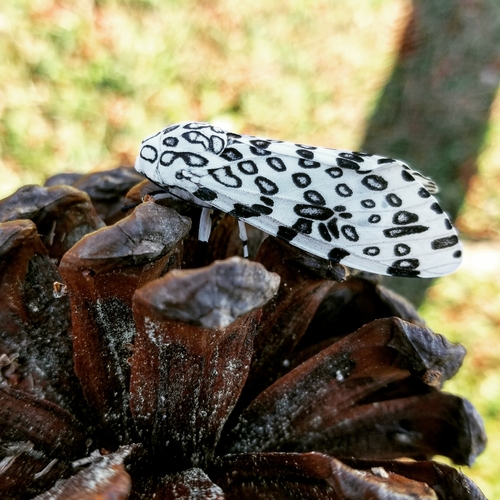
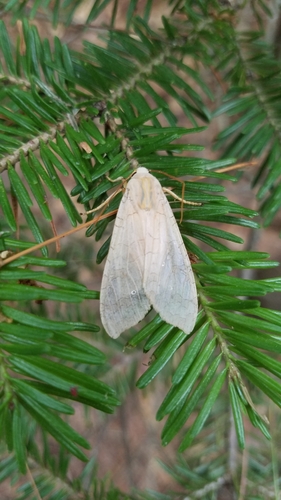
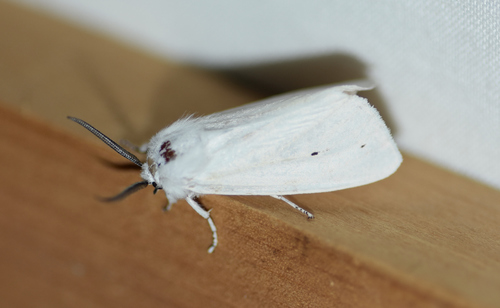
Estigmene acrea, the salt marsh moth or acrea moth, is a moth in the family Erebidae. The species was first described by Dru Drury in 1773. It is found in North America, and southwards from Mexico to Colombia. The head and thorax are white, and the abdomen is yellow orange with a row of black spots. The forewing is white with a variable pattern of black spots, with some individuals lacking any spots. The hindwing is yellow orange in males and white in females. Both sexes have three or four black spots or blotches on the hindwings. The wingspan measures 4.5 to 6.8 cm (1.8 to 2.7 in).

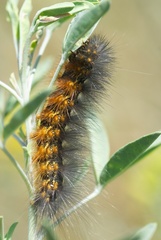
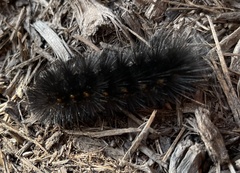
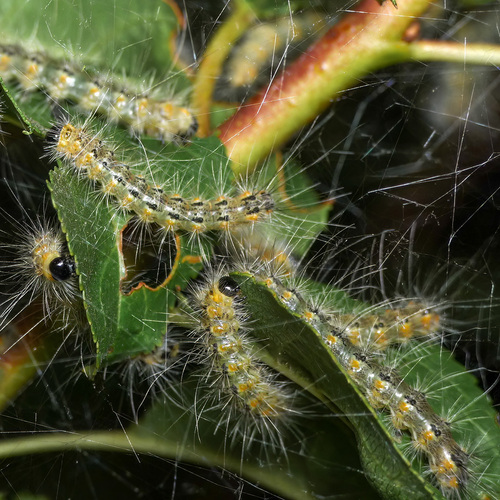
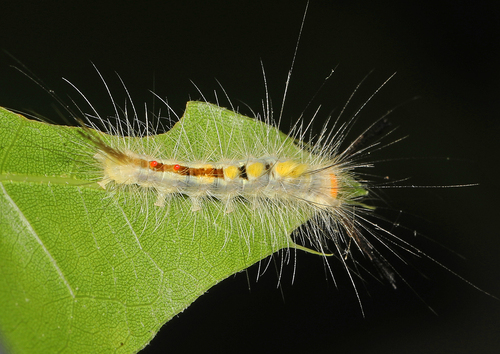
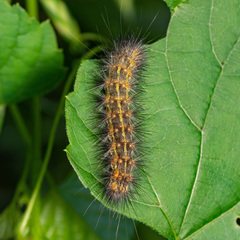
This moth is generally seen from May to August, but it is seen all year in southern Florida and southern Texas. The yellowish eggs are laid in clusters on the host plant leaves. The larva, known as the salt marsh caterpillar, which grows to about 5 cm (2 in) in length, is highly variable in color, ranging from pale yellow to rusty orange brown to dark brownish black. It is hairy, with numerous soft setae, growing in tufts (several tufts on each segment), with a few individual hairs that are longer toward the end of the body. The thoracic and abdominal segments... Wikipedia →

Global Distribution

Parks Where Found

# Park Country Daily sighting probability
1 Channel Islands National Park 🇺🇸 United States
~30%
2 Padre Island National Seashore 🇺🇸 United States
~20%
3 Shenandoah National Park 🇺🇸 United States
~10%
4 Congaree National Park 🇺🇸 United States
~10%
5 Point Pelee National Park 🇨🇦 Canada
~10%
6 Merritt Island National Wildlife Refuge 🇺🇸 United States
~10%
7 Everglades National Park 🇺🇸 United States
~10%
8 Cumbres de Monterrey National Park 🇲🇽 Mexico
<5%

Cities Where Found

# City Country Daily sighting probability
1 Austin 🇺🇸 United States
~20%
2 Houston 🇺🇸 United States
~20%
3 San Antonio 🇺🇸 United States
~20%
4 Dallas 🇺🇸 United States
~10%
5 San Diego 🇺🇸 United States
~10%
6 Los Angeles 🇺🇸 United States
~10%
7 Tijuana 🇲🇽 México
~10%
8 Monterrey 🇲🇽 México
~10%
9 Montreal 🇨🇦 Canada
~10%
10 Mexico City 🇲🇽 México
<5%

Before you go

What are the chances of seeing a Salt Marsh Moth in Shenandoah National Park?

With luck

About 10% of wildlife watchers report a Salt Marsh Moth sighting in Shenandoah National Park on a given day, based on 19 verified sightings from GBIF citizen-science data from 2019 to 2026. It is the 194th most-seen of the 723 insects we can rate there. Over three days the chance rises to about 20%, and over a week to about 50%, if each day is a fresh chance.

When is the best time to see a Salt Marsh Moth in Shenandoah National Park?

August

In that month about 20% of wildlife watchers report a Salt Marsh Moth in Shenandoah National Park on a given day, against under 5% in June–July and November–April, the lowest months.

What time of day is best to see a Salt Marsh Moth?

Between 9 am and noon

Across all the parks we cover, that three-hour window holds the most Salt Marsh Moth sightings with a recorded time, and about 8 in 10 of them come between 6 am and 6 pm: it is a daytime animal.

Is Shenandoah National Park the best place to see a Salt Marsh Moth?

3rd of 8

Of the 8 parks where we can rate Salt Marsh Moth sightings, Shenandoah National Park ranks 3rd at about 10%. The best odds are in Channel Islands National Park (United States, about 30%) and Padre Island National Seashore (United States, about 20%).

Which relatives of the Salt Marsh Moth live in Shenandoah National Park?

Same family: Erebidae

The closest relatives of the Salt Marsh Moth that you can see in Shenandoah National Park (family Erebidae, Underwing, Tiger, Tussock, and Allied Moths) are Spongy Moth (about 40%), Isabella Tiger Moth (about 30%) and Hickory Tussock Moth (about 30%), with each one's daily chance of a sighting.

Where does the Salt Marsh Moth sighting chance come from?

GBIF citizen-science records

It is estimated from how often the Salt Marsh Moth is recorded against all the insects logged in Shenandoah National Park (19 verified sightings from 2019 to 2026), calibrated against known sighting rates. Figures are rounded to the nearest 10% because citizen-science data supports honest approximations, not decimals, and months with records from fewer than five people show "—". How it works.

← Back to Shenandoah National Park