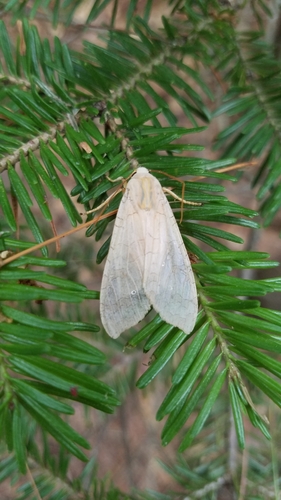
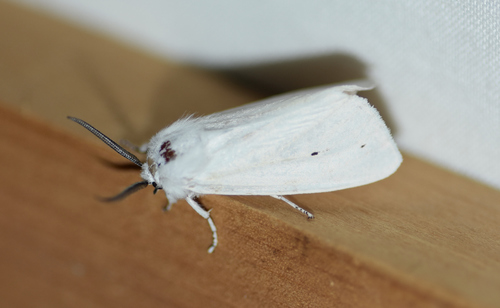
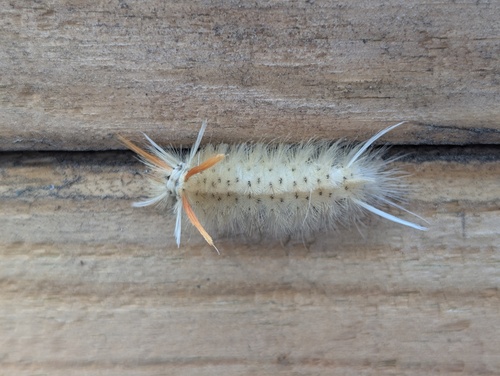
White-Marked Tussock Moth

White-Marked Tussock Moth

Orgyia leucostigma

Daily sighting probability ~10% · With luck
at Shenandoah National Park

In 3 days ~30% in a week ~60%

41 Verified sightings at Shenandoah National Park From 2019 to 2026
375 In all 7 parks
September Best month
☀️ Diurnal When it's spotted

About the White-Marked Tussock Moth

Orgyia leucostigma, the white-marked tussock moth, is a moth in the family Erebidae. The species was first described by James Edward Smith in 1797. The caterpillar is very common especially in late summer in eastern North America, extending as far west as Texas, California, and Alberta.

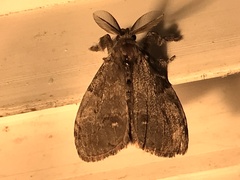
The genus name Orgyia is from the ancient Greek word ὄργυια, órgyia - 'outstretched arms'. So named because, when at rest, the moth stretches forward its forelegs like arms. Two or more generations occur per year in eastern North America. They overwinter in the egg stage.

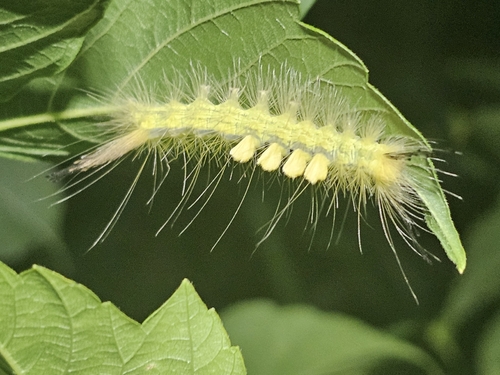
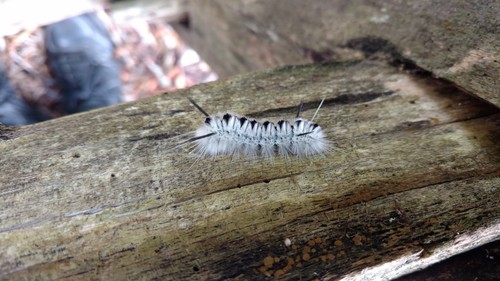
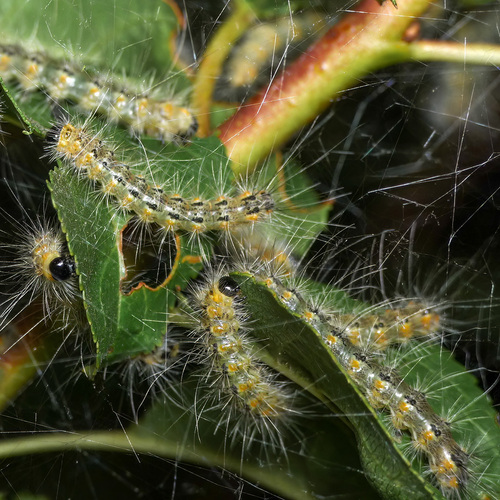
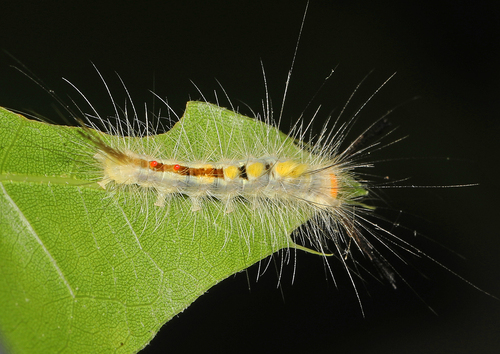
Eggs are laid in a single mass over the cocoon of the female, and covered in a froth. Up to 300 eggs are laid at a time. The larvae are brightly colored, with tufts of hair-like setae. The head is bright red and the body has yellow or white stripes, with a black stripe along the middle of the back. Bright red defensive glands are seen on the hind end of the back. Four white toothbrush-like tufts stand out from the back, and a gray-brown hair pencil is at the hind end. The four white tufts on the larva's back may mimic the cocoons of parasitic wasps. Touching the hairs sets off... Wikipedia →
Global Distribution

Parks Where Found

# Park Country Daily sighting probability
1 Gros Morne National Park 🇨🇦 Canada
~30%
2 Congaree National Park 🇺🇸 United States
~30%
3 Point Pelee National Park 🇨🇦 Canada
~20%
4 Acadia National Park 🇺🇸 United States
~20%
5 Shenandoah National Park 🇺🇸 United States
~10%
6 Riding Mountain National Park 🇨🇦 Canada
~10%
7 Great Smoky Mountains National Park 🇺🇸 United States
<5%

Cities Where Found

# City Country Daily sighting probability
1 Chicago 🇺🇸 United States
~10%
2 Minneapolis [Saint Paul] 🇺🇸 United States
~10%
3 Baltimore 🇺🇸 United States
~10%
4 Toronto 🇨🇦 Canada
<5%
5 Washington 🇺🇸 United States
<5%
6 Detroit 🇺🇸 United States
<5%
7 Montreal 🇨🇦 Canada
<5%
8 Dallas 🇺🇸 United States
<5%
9 Philadelphia 🇺🇸 United States
<5%
10 New York City 🇺🇸 United States
<5%

Before you go

What are the chances of seeing a White-Marked Tussock Moth in Shenandoah National Park?

With luck

About 10% of wildlife watchers report a White-Marked Tussock Moth sighting in Shenandoah National Park on a given day, based on 41 verified sightings from GBIF citizen-science data from 2019 to 2026. It is the 96th most-seen of the 723 insects we can rate there. Over three days the chance rises to about 30%, and over a week to about 60%, if each day is a fresh chance.

When is the best time to see a White-Marked Tussock Moth in Shenandoah National Park?

September

In that month about 30% of wildlife watchers report a White-Marked Tussock Moth in Shenandoah National Park on a given day, against under 5% in May and November–March, the lowest months.

What time of day is best to see a White-Marked Tussock Moth?

Between 8 and 11 am

Across all the parks we cover, that three-hour window holds the most White-Marked Tussock Moth sightings with a recorded time, and about 9 in 10 of them come between 6 am and 6 pm: it is a daytime animal.

Is Shenandoah National Park the best place to see a White-Marked Tussock Moth?

5th of 7

Of the 7 parks where we can rate White-Marked Tussock Moth sightings, Shenandoah National Park ranks 5th at about 10%. The best odds are in Gros Morne National Park (Canada, about 30%), Congaree National Park (United States, about 30%) and Point Pelee National Park (Canada, about 20%).

Where does the White-Marked Tussock Moth sighting chance come from?

GBIF citizen-science records

It is estimated from how often the White-Marked Tussock Moth is recorded against all the insects logged in Shenandoah National Park (41 verified sightings from 2019 to 2026), calibrated against known sighting rates. Figures are rounded to the nearest 10% because citizen-science data supports honest approximations, not decimals, and months with records from fewer than five people show "—". How it works.

← Back to Shenandoah National Park