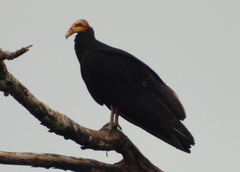
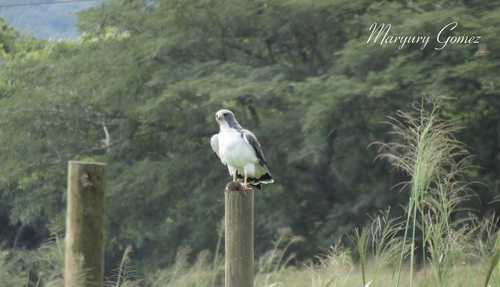
Greater Yellow-headed Vulture

Greater Yellow-headed Vulture

Cathartes melambrotus

Silhouette: Jan Sevcik (photo), John E. McCormack, Michael G. Harvey, Brant C. Faircloth, Nicholas G. Crawford, Travis C. Glenn, Robb T. Brumfield & T. Michael Keesey · PhyloPic

LCLeast ConcernNTVUENCR
Daily sighting probability ~10% · With luck
at Sierra de la Macarena National Park

In 3 days ~30% in a week ~60%

125 Verified sightings at Sierra de la Macarena National Park From 2019 to 2026
5,030 In all 8 parks
June Best month
☀️ Diurnal When it's spotted

About the Greater Yellow-headed Vulture

The greater yellow-headed vulture (Cathartes melambrotus), also known as the forest vulture, is a species of bird in the New World vulture family Cathartidae. It was considered to be the same species as the lesser yellow-headed vulture until they were split in 1964. It is found in South America in tropical moist lowland forests. It is a fairly large bird, with a wingspan of 166–178 cm (65–70 in), a weight of 1.65 kilograms (3.6 lb) and a body length of 64–75 cm (25–30 in). The body plumage is black, and the head and neck, which are featherless, range in color from deep yellow to pale orange. It lacks a syrinx, and its vocalizations are therefore limited to grunts or low hisses.

The greater yellow-headed vulture feeds on carrion and locates carcasses by sight and by smell, an ability which is rare in birds. It is dependent on larger vultures, such as the king vulture, to open the hides of larger animal carcasses, as its bill is not strong enough to do this. Like other New World vultures, the greater yellow-headed vulture utilizes thermals to stay aloft with minimal effort. It lays its eggs on flat surfaces, such as the floors of caves, or in the hollows of stumps. It feeds its young by regurgitation. Wikipedia →

Sounds

Recording

© Cameron Rutt · XCXC540005 · CC BY-NC-SA 4.0

Global Distribution

Parks Where Found

# Park Country Daily sighting probability
1 Cuyabeno Wildlife Reserve 🇪🇨 Ecuador
~50%
2 Yasuní National Park 🇪🇨 Ecuador
~50%
3 Brownsberg Nature Park 🇸🇷 Suriname
~40%
4 Manu National Park 🇵🇪 Peru
~30%
5 Tambopata National Reserve 🇵🇪 Peru
~30%
6 Anavilhanas National Park 🇧🇷 Brazil
~30%
7 Amacayacu National Natural Park 🇨🇴 Colombia
~20%
8 Sierra de la Macarena National Park 🇨🇴 Colombia
~10%

Cities Where Found

# City Country Daily sighting probability
1 Belém 🇧🇷 Brazil
<5%
2 Manaus 🇧🇷 Brazil
<5%

Zoos & Centres Where Found

# Zoo / Centre Country
1 Bioparc Fuengirola 🇪🇸 Spain In captivity

Before you go

What are the chances of seeing a Greater Yellow-headed Vulture in Sierra de la Macarena National Park?

With luck

About 10% of wildlife watchers report a Greater Yellow-headed Vulture sighting in Sierra de la Macarena National Park on a given day, based on 125 verified sightings from GBIF citizen-science data from 2019 to 2026. It is the 96th most-seen of the 418 birds we can rate there. Over three days the chance rises to about 30%, and over a week to about 60%, if each day is a fresh chance.

When is the best time to see a Greater Yellow-headed Vulture in Sierra de la Macarena National Park?

February, April, June, October and December

In those months about 20% of wildlife watchers report a Greater Yellow-headed Vulture in Sierra de la Macarena National Park on a given day, against under 5% in August, the lowest month.

What time of day is best to see a Greater Yellow-headed Vulture?

Between 8 and 11 am

Across all the parks we cover, that three-hour window holds the most Greater Yellow-headed Vulture sightings with a recorded time, and about 9 in 10 of them come between 6 am and 6 pm: it is a daytime animal.

Which relatives of the Greater Yellow-headed Vulture live in Sierra de la Macarena National Park?

Same genus: Cathartes

The closest relatives of the Greater Yellow-headed Vulture that you can see in Sierra de la Macarena National Park (genus Cathartes, Turkey and Yellow-headed Vultures) are Turkey Vulture (about 30%) and Lesser Yellow-headed Vulture (about 10%), with each one's daily chance of a sighting.

Where does the Greater Yellow-headed Vulture sighting chance come from?

GBIF citizen-science records

It is estimated from how often the Greater Yellow-headed Vulture is recorded against all the birds logged in Sierra de la Macarena National Park (125 verified sightings from 2019 to 2026), calibrated against known sighting rates. Figures are rounded to the nearest 10% because citizen-science data supports honest approximations, not decimals, and months with records from fewer than five people show "—". How it works.

← Back to Sierra de la Macarena National Park