Grey Tinamou

Grey Tinamou

Tinamus tao

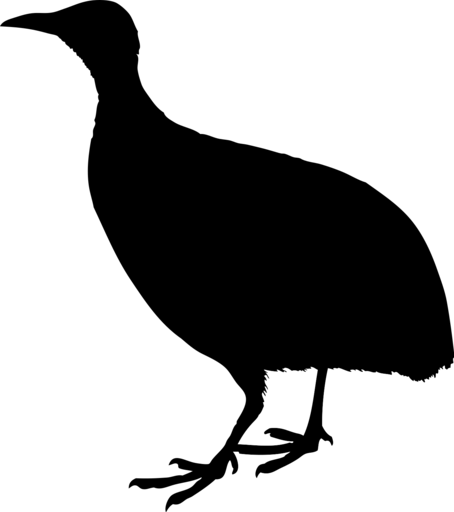
Silhouette: George Edward Lodge · PhyloPic

LCNTVUVulnerableENCR
Daily sighting probability <5% · Rare
at Sierra de la Macarena National Park

In 3 days ~10% in a week ~30%

48 Verified sightings at Sierra de la Macarena National Park From 2019 to 2026
589 In all 6 parks
February Best month
☀️ Diurnal When it's spotted

About the Grey Tinamou

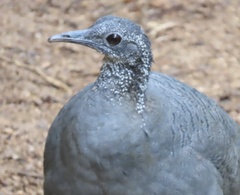
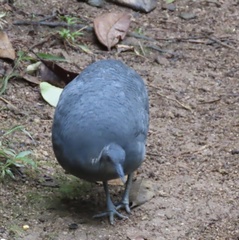
The grey tinamou (Tinamus tao) is a type of ground bird native to South America. Four subspecies are recognised. All tinamou are from the family Tinamidae, and in the larger scheme are also ratites. All ratites evolved from prehistoric flying birds, and tinamous are the closest living relative of these birds.

The grey tinamou has several subspecies: T. t. larensis with a range in the montane forests of central Colombia and northwestern Venezuela. T. t. kleei with a range of south-central Colombia, eastern Ecuador, eastern Peru, eastern Bolivia, and western Brazil.

T. t. septentrionalis with a range of northeastern Venezuela and possibly northwestern Guyana. T. t. tao with a range of north central Brazil, far eastern Peru, and far northwestern Bolivia. The gray tinamou is believed to be the largest species among the tinamous. Reported total length

is from 41.5 to 49 cm (16.3 to 19.3 in) and possibly as much as 53 cm (21 in). In body mass, males may scale from 1,325 to 1,863 g (2.921 to 4.107 lb), averaging 1,565 g (3.450 lb), and females can weigh from 1,430 to 2,080 g (3.15 to 4.59 lb), averaging 1,636 g (3.607 lb) and possibly weighing as much as... Wikipedia →

Sounds

Call0:06

Brazil · 2025

© JAYRSON ARAUJO DE OLIVEIRA · XC1044945 · CC BY-NC-SA 4.0

Song0:50

Brazil · 2020

© GABRIEL LEITE · XC597722 · CC BY-NC-SA 4.0

Song0:27

Colombia · 2016

© Fabrice Schmitt · XC318739 · CC BY-NC-SA 4.0

Global Distribution

Parks Where Found

# Park Country Daily sighting probability
1 Podocarpus National Park 🇪🇨 Ecuador
~20%
2 Amboró National Park 🇧🇴 Bolivia
~20%
3 Sierra de la Macarena National Park 🇨🇴 Colombia
<5%
4 Manu National Park 🇵🇪 Peru
<5%
5 Henri Pittier National Park 🇻🇪 Venezuela
<5%
6 Tambopata National Reserve 🇵🇪 Peru
<5%

Before you go

What are the chances of seeing a Grey Tinamou in Sierra de la Macarena National Park?

Rare

Under 5% of wildlife watchers report a Grey Tinamou sighting in Sierra de la Macarena National Park on a given day, based on 48 verified sightings from GBIF citizen-science data from 2019 to 2026. It is the 200th most-seen of the 418 birds we can rate there. Over three days the chance rises to about 10%, and over a week to about 30%, if each day is a fresh chance.

When is the best time to see a Grey Tinamou in Sierra de la Macarena National Park?

February

In that month about 20% of wildlife watchers report a Grey Tinamou in Sierra de la Macarena National Park on a given day, against under 5% in March–April, June–September and November–January, the lowest months. That is one of Sierra de la Macarena National Park's driest months, with about 110 mm of rain against 430 mm in May.

What time of day is best to see a Grey Tinamou?

Between 3 and 6 pm

Across all the parks we cover, that three-hour window holds the most Grey Tinamou sightings with a recorded time, and about 7 in 10 of them come between 6 am and 6 pm: it is a daytime animal.

Is Sierra de la Macarena National Park the best place to see a Grey Tinamou?

3rd of 6

Of the 6 parks where we can rate Grey Tinamou sightings, Sierra de la Macarena National Park ranks 3rd at under 5%. The best odds are in Podocarpus National Park (Ecuador, about 20%) and Amboró National Park (Bolivia, about 20%).

Where does the Grey Tinamou sighting chance come from?

GBIF citizen-science records

It is estimated from how often the Grey Tinamou is recorded against all the birds logged in Sierra de la Macarena National Park (48 verified sightings from 2019 to 2026), calibrated against known sighting rates. Figures are rounded to the nearest 10% because citizen-science data supports honest approximations, not decimals, and months with records from fewer than five people show "—". How it works.

← Back to Sierra de la Macarena National Park