Dark-fronted Babbler

Dark-fronted Babbler

Rhopocichla atriceps

Silhouette: Jiekun He · PhyloPic

Daily sighting probability ~40% · Likely
at Sinharaja Forest Reserve

In 3 days ~80% in a week >90%

747 Verified sightings at Sinharaja Forest Reserve From 2019 to 2026
1,708 In all 10 parks
September Best month
🌅 Crepuscular When it's spotted

About the Dark-fronted Babbler

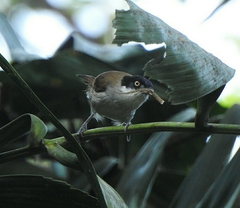
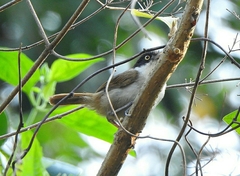
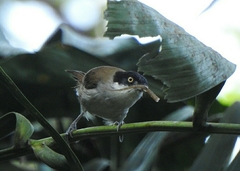
The dark-fronted babbler (Dumetia atriceps) is an Old World babbler found in the Western Ghats of India and the forests of Sri Lanka. They are small chestnut brown birds with a dark black cap, a whitish underside and pale yellow iris. They forage in flocks in the undergrowth of forests constantly making calls and uttering alarm calls when disturbed.

The dark-fronted babbler was formally described in 1839 by the English naturalist Thomas Jerdon under the binomial name Brachypteryx atriceps. He specified the range as Thrissur, Wadakkancherry, Coonoor and the Wayanad of southwest India. The type locality was restricted to Wayanad by Hugh Whistler in 1935. The dark-fronted babbler was formerly placed in the monotypic genus Rhopocichla. It was moved to Dumetia with the tawny-bellied babbler based on the results of a large molecular phylogenetic study published in 2019. The genus Dumetia was introduced in 1852 by the English zoologist Edward Blyth. The genus name is from Latin dumetum, dumeti meaning "thicket". The specific epithet atriceps combines the Latin ater meaning "black" with -ceps meaning "-capped" or "-headed".

Four subspecies are recognised: Wikipedia →

Global Distribution

Parks Where Found

# Park Country Daily sighting probability
1 Sinharaja Forest Reserve 🇱🇰 Sri Lanka
~40%
2 Horton Plains National Park 🇱🇰 Sri Lanka
~40%
3 Periyar National Park 🇮🇳 India
~20%
4 Wilpattu National Park 🇱🇰 Sri Lanka
~10%
5 Minneriya National Park 🇱🇰 Sri Lanka
~10%
6 Yala National Park 🇱🇰 Sri Lanka
<5%
7 Udawalawe National Park 🇱🇰 Sri Lanka
<5%
8 Nagarhole National Park 🇮🇳 India
<5%
9 Bandipur National Park 🇮🇳 India
<5%
10 Mudumalai National Park 🇮🇳 India
<5%

Cities Where Found

# City Country Daily sighting probability
1 Colombo [Sri Jayawardenepura Kotte] 🇱🇰 Sri Lanka
<5%

Before you go

What are the chances of seeing a Dark-fronted Babbler in Sinharaja Forest Reserve?

Likely

About 40% of wildlife watchers report a Dark-fronted Babbler sighting in Sinharaja Forest Reserve on a given day, based on 747 verified sightings from GBIF citizen-science data from 2019 to 2026. It is the 21st most-seen of the 156 birds we can rate there. Over three days the chance rises to about 80%, and over a week to over 90%, if each day is a fresh chance.

When is the best time to see a Dark-fronted Babbler in Sinharaja Forest Reserve?

May and September

In those months about 60% of wildlife watchers report a Dark-fronted Babbler in Sinharaja Forest Reserve on a given day, against about 30% in October and November, the lowest months.

What time of day is best to see a Dark-fronted Babbler?

Between 3 and 6 am

Across all the parks we cover, that three-hour window holds the most Dark-fronted Babbler sightings with a recorded time, and about 6 in 10 of them come between 6 am and 6 pm: it is most active around dawn and dusk.

Is Sinharaja Forest Reserve the best place to see a Dark-fronted Babbler?

Yes

Of the 10 parks where we can rate Dark-fronted Babbler sightings, Sinharaja Forest Reserve has the highest daily chance: about 40%. Next come Horton Plains National Park (Sri Lanka, about 40%) and Periyar National Park (India, about 20%).

Where does the Dark-fronted Babbler sighting chance come from?

GBIF citizen-science records

It is estimated from how often the Dark-fronted Babbler is recorded against all the birds logged in Sinharaja Forest Reserve (747 verified sightings from 2019 to 2026), calibrated against known sighting rates. Figures are rounded to the nearest 10% because citizen-science data supports honest approximations, not decimals, and months with records from fewer than five people show "—". How it works.

← Back to Sinharaja Forest Reserve