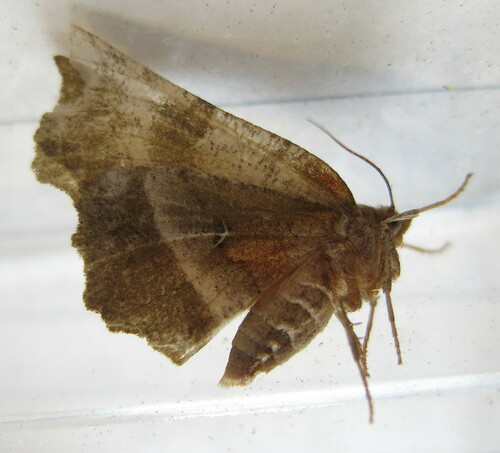
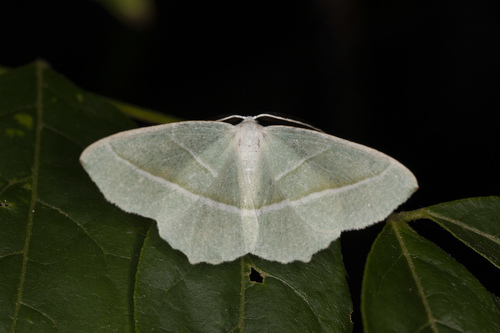
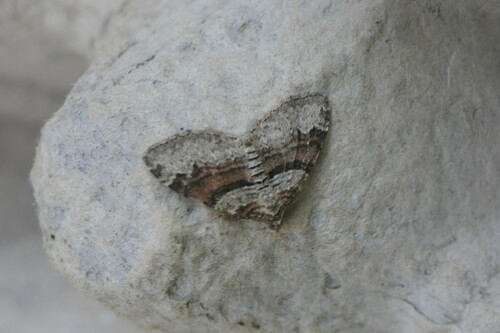
Barred Red

Barred Red

Hylaea fasciaria

Daily sighting probability ~10% · With luck
at Snowdonia National Park

In 3 days ~20% in a week ~40%

8 Verified sightings at Snowdonia National Park From 2019 to 2026
99 In all 8 parks
July Best month
☀️🌙 Day & Night When it's spotted

About the Barred Red

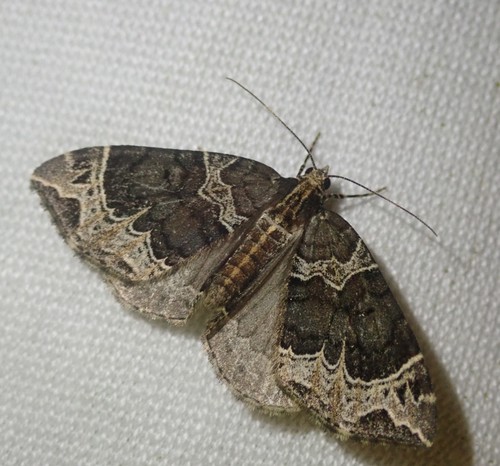
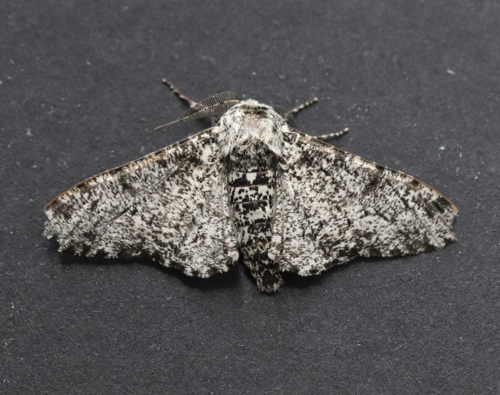
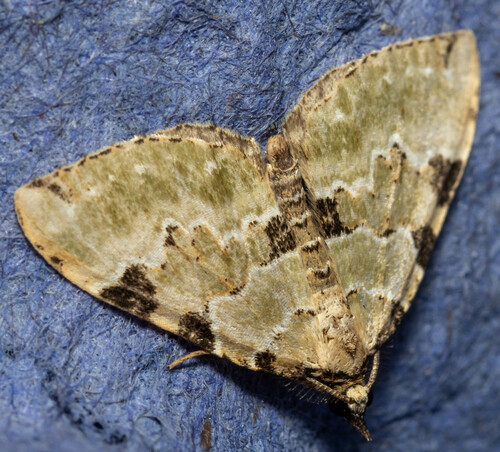
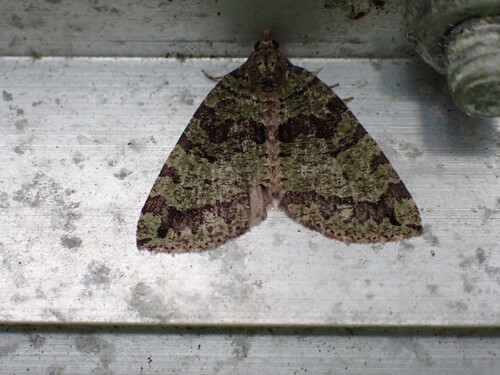
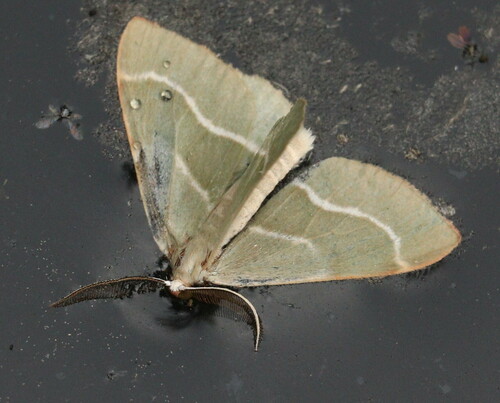
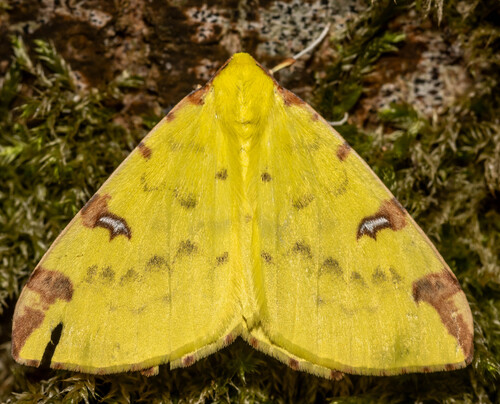
Hylaea fasciaria, the barred red, is a species of moth in the family Geometridae. The species can be found in central and northern Europe, the Urals, Caucasus, Altai and eastern Siberia. The wingspan is 27–40 mm. The forma fasciaria has a rust-red leaf colour, the forma prasinaria has green coloured wings. Both have on the front wings two slightly irregular curved, thin transverse bands, the midfield thus closed has usually a slightly darker colour. These bands are pale whitish coloured in the rust-red form, in the green form the colouring varies from pale whitish to beige to light brown. In addition in the green form the front edge of the front wing (costa) is weakly coloured in the same shade, the outer edge of both pairs of wings is fringed in this colour.

The hindwings are usually somewhat lighter in colour and have a more or less clear, pale cross line in the second half of the wing. In addition to the two main forms, there are other colour variants with different shades of green or plain brown.

"Linne twice described this species; first a worn, greyish red form, then on the following page (as prosapiaria) a brighter red example. Both forms show the 2 curved lines of the forewing and 1 on the hindwing. — ab. grisearia Fuchs differs little from Linnes first type, but is stillgreyer. Frequent in Scotland. Also recorded from Germany and Austria. — ab. manitaria H.-Sch. is of a umform dark liver-colour with the lines obliterated. — ab. cinereostrigaria Klem. has the lines dark grey instead of white. The type specimens (females) were also narrow-winged. — ab. ochreochrearia Joan. (= ochracearia Rbl.) is clear ochreous, nearly as in Ennomos erosaria ab. intermediaria Gmpbg. is a transitional form, green with red costal margin, fringes, and edging to the lines. — prasinaria Schiff. is an interesting green form with the white lines usually well-developed and is common in some localities, the larva feeding on pines and spruce fir, while that of typical fasciaria feeds on Scotch fir. ab. extiticta Vorbr. Mull-Rutz is a modification of prasinaria, darker green with the white lines almost or entirely obsolete."

The moths fly in two generations from April to October. [1]. The caterpillars feed on coniferous trees, including Pinus sylvestris and Picea abies. Wikipedia →
Global Distribution

Parks Where Found

# Park Country Daily sighting probability
1 Cairngorms National Park 🇬🇧 United Kingdom
~10%
2 Vanoise National Park 🇫🇷 France
~10%
3 Snowdonia National Park 🇬🇧 United Kingdom
~10%
4 Sierra de Guadarrama National Park 🇪🇸 Spain
~10%
5 Wadden Sea National Park 🇩🇪 Germany
~10%
6 Bavarian Forest National Park 🇩🇪 Germany
~10%
7 Pyrénées National Park 🇫🇷 France
<5%
8 Cévennes National Park 🇫🇷 France
<5%

Cities Where Found

# City Country Daily sighting probability
1 Turin 🇮🇹 Italy
~10%
2 Copenhagen 🇩🇰 Denmark
<5%

Before you go

What are the chances of seeing a Barred Red in Snowdonia National Park?

With luck

About 10% of wildlife watchers report a Barred Red sighting in Snowdonia National Park on a given day, based on 8 verified sightings from GBIF citizen-science data from 2019 to 2026. It is the 264th most-seen of the 387 insects we can rate there. Over three days the chance rises to about 20%, and over a week to about 40%, if each day is a fresh chance.

When is the best time to see a Barred Red in Snowdonia National Park?

July

In that month about 20% of wildlife watchers report a Barred Red in Snowdonia National Park on a given day, against under 5% in August to April, the lowest months.

What time of day is best to see a Barred Red?

Between 11 pm and 2 am

Across all the parks we cover, that three-hour window holds the most Barred Red sightings with a recorded time, and about half of them come between 6 am and 6 pm: it is seen both by day and at night.

Is Snowdonia National Park the best place to see a Barred Red?

Among the best

Of the 8 parks where we can rate Barred Red sightings, Snowdonia National Park ranks 3rd at about 10%, level with the leaders once rounded. The best odds are in Cairngorms National Park (United Kingdom, about 10%) and Vanoise National Park (France, about 10%).

Which relatives of the Barred Red live in Snowdonia National Park?

Same family: Geometridae

The closest relatives of the Barred Red that you can see in Snowdonia National Park (family Geometridae, Geometer Moths) are Brimstone Moth (about 30%), Small Phoenix (about 20%) and Peppered Moth (about 20%), with each one's daily chance of a sighting.

Where does the Barred Red sighting chance come from?

GBIF citizen-science records

It is estimated from how often the Barred Red is recorded against all the insects logged in Snowdonia National Park (8 verified sightings from 2019 to 2026), calibrated against known sighting rates. Figures are rounded to the nearest 10% because citizen-science data supports honest approximations, not decimals, and months with records from fewer than five people show "—". How it works.

← Back to Snowdonia National Park