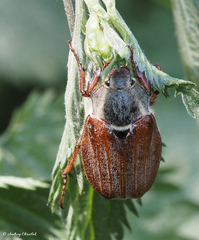
Common Cockchafer

Common Cockchafer

Melolontha melolontha

Daily sighting probability ~20% · Possible
at Snowdonia National Park

In 3 days ~50% in a week ~80%

34 Verified sightings at Snowdonia National Park From 2019 to 2026
136 In all 7 parks
May Best month
☀️🌙 Day & Night When it's spotted

About the Common Cockchafer

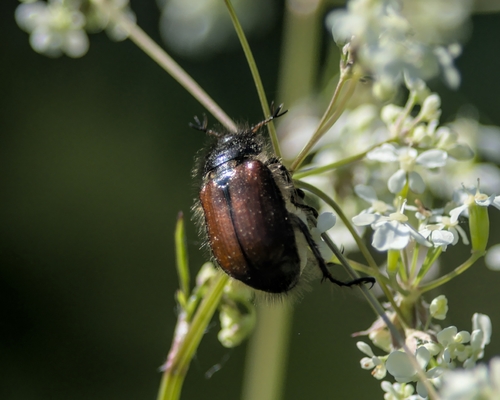
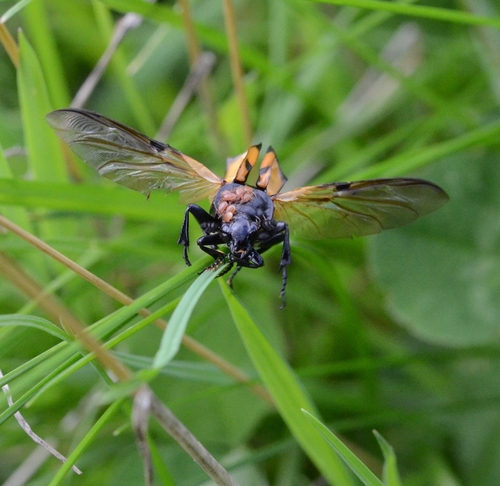
The common cockchafer (Melolontha melolontha), known colloquially as the Maybug, Maybeetle, or doodlebug, among many other names, is a species of scarab beetle belonging to the genus Melolontha. It is native to Europe, and it is also one of the several closely-related and morphologically similar species of Melolontha called cockchafers, alongside Melolontha hippocastani (the forest cockchafer) as the latter also shows sexual dimorphism, mating practices, and key physical features such as the number of lamellae.

The cockchafer develops via metamorphosis, in which the beetle undergoes stages of eggs, larvae, pupae and adults. The mating behaviour is controlled by pheromones. The males usually swarm during the mating season while the females stay put and feed on leaves. When cockchafers feed, they cause leaves to release green leaf volatiles, which the males can detect and thus locate females for mating. The larvae use both the plant volatiles and CO2 to locate the plant root for food.

This species is an important and nutritious food source for many predators. The adults and larvae feed on plants, and are regarded as agricultural pests of crops such as grasses and fruit trees. Adults have harmful effects for the crop when they aggregate in large groups. The larvae can cause severe damage and kill the plant by gnawing the plant roots. Wikipedia →

Global Distribution

Parks Where Found

# Park Country Daily sighting probability
1 Snowdonia National Park 🇬🇧 United Kingdom
~20%
2 Biebrza National Park 🇵🇱 Poland
~20%
3 Triglav National Park 🇸🇮 Slovenia
~10%
4 Białowieża National Park 🇵🇱 Poland
~10%
5 Bavarian Forest National Park 🇩🇪 Germany
~10%
6 Cévennes National Park 🇫🇷 France
~10%
7 Pyrénées National Park 🇫🇷 France
~10%

Cities Where Found

# City Country Daily sighting probability
1 Kharkiv 🇺🇦 Ukraine
~20%
2 Kyiv 🇺🇦 Ukraine
~10%
3 Essen 🇩🇪 Germany
~10%
4 Hamburg 🇩🇪 Germany
~10%
5 Minsk 🇧🇾 Belarus
~10%
6 Liverpool 🇬🇧 United Kingdom
~10%
7 Turin 🇮🇹 Italy
~10%
8 Brussels 🇧🇪 Belgium
~10%
9 Budapest 🇭🇺 Hungary
~10%
10 Berlin 🇩🇪 Germany
~10%

Before you go

What are the chances of seeing a Common Cockchafer in Snowdonia National Park?

Possible

About 20% of wildlife watchers report a Common Cockchafer sighting in Snowdonia National Park on a given day, based on 34 verified sightings from GBIF citizen-science data from 2019 to 2026. It is the 46th most-seen of the 387 insects we can rate there. Over three days the chance rises to about 50%, and over a week to about 80%, if each day is a fresh chance.

When is the best time to see a Common Cockchafer in Snowdonia National Park?

May

In that month about 40% of wildlife watchers report a Common Cockchafer in Snowdonia National Park on a given day, against under 5% in July and September–March, the lowest months.

What time of day is best to see a Common Cockchafer?

Between 9 pm and midnight

Across all the parks we cover, that three-hour window holds the most Common Cockchafer sightings with a recorded time, and about 6 in 10 of them come between 6 am and 6 pm: it is seen both by day and at night.

Is Snowdonia National Park the best place to see a Common Cockchafer?

Yes

Of the 7 parks where we can rate Common Cockchafer sightings, Snowdonia National Park has the highest daily chance: about 20%. Next come Biebrza National Park (Poland, about 20%) and Triglav National Park (Slovenia, about 10%).

Which relatives of the Common Cockchafer live in Snowdonia National Park?

Same family: Scarabaeidae

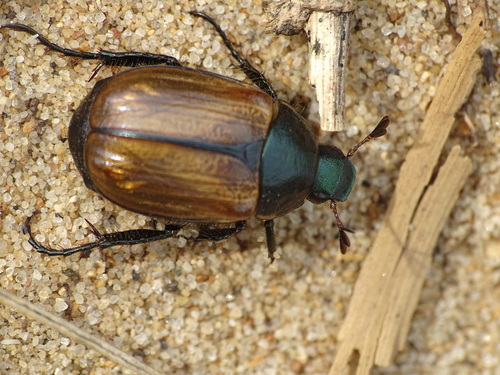
The closest relatives of the Common Cockchafer that you can see in Snowdonia National Park (family Scarabaeidae, Scarabs) are Garden Chafer (about 30%), Dune Chafer (about 10%) and Aegialia arenaria (about 10%), with each one's daily chance of a sighting.

Where does the Common Cockchafer sighting chance come from?

GBIF citizen-science records

It is estimated from how often the Common Cockchafer is recorded against all the insects logged in Snowdonia National Park (34 verified sightings from 2019 to 2026), calibrated against known sighting rates. Figures are rounded to the nearest 10% because citizen-science data supports honest approximations, not decimals, and months with records from fewer than five people show "—". How it works.

← Back to Snowdonia National Park