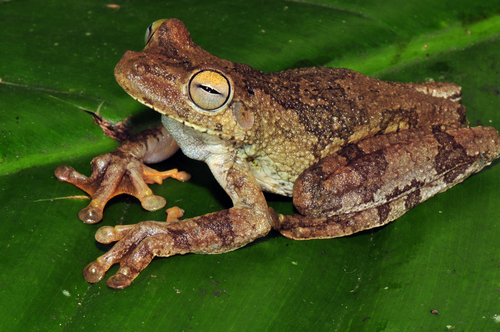
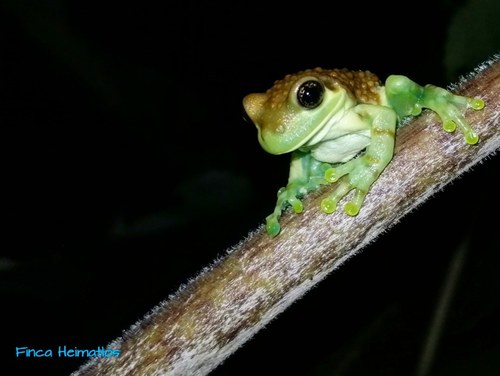
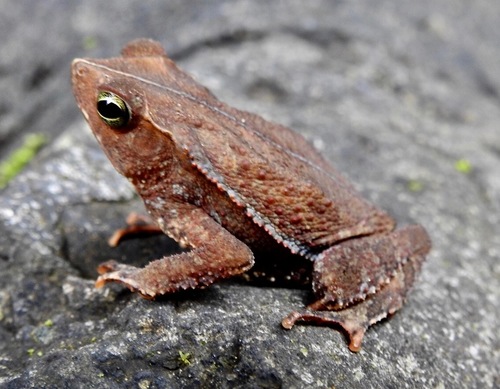
Rusty Tree Frog

Rusty Tree Frog

Boana boans

Silhouette: Andy Wilson · PhyloPic

LCLeast ConcernNTVUENCR
Daily sighting probability ~10% · With luck
at Soberanía National Park

In 3 days ~20% in a week ~30%

5 Verified sightings at Soberanía National Park From 2019 to 2026
47 In all 4 parks
February Best month
🌙 Nocturnal When it's spotted

About the Rusty Tree Frog

The rusty tree frog (Boana boans), also known as the giant gladiator treefrog, is a species of frog in the family Hylidae found in South America and Panama. Its natural habitats are subtropical or tropical moist lowland forests, rivers, and intermittent freshwater marshes. In some areas, it is sympatric with H. rosenbergi.

It is called ukato in the Kwaza language of Rondônia, Brazil. Wikipedia →

Sounds

Advertisement call0:13

Brazil · 2026

© JAYRSON ARAUJO DE OLIVEIRA · XC1186228 · CC BY-NC-SA 4.0

Recording0:30

French Guiana · 2024

© Augustin Bussac · XC928837 · CC BY-NC-SA 4.0

Advertisement call0:12

Trinidad & Tobago · 2018

© Chris Harrison · XC892928 · CC BY-NC-SA 4.0

Global Distribution

Parks Where Found

# Park Country Daily sighting probability
1 Tambopata National Reserve 🇵🇪 Peru
~20%
2 Manu National Park 🇵🇪 Peru
~10%
3 Yasuní National Park 🇪🇨 Ecuador
~10%
4 Soberanía National Park 🇵🇦 Panama
~10%

Before you go

What are the chances of seeing a Rusty Tree Frog in Soberanía National Park?

With luck

About 10% of wildlife watchers report a Rusty Tree Frog sighting in Soberanía National Park on a given day, based on 5 verified sightings from GBIF citizen-science data from 2019 to 2026. It is the 34th most-seen of the 34 amphibians we can rate there. Over three days the chance rises to about 20%, and over a week to about 30%, if each day is a fresh chance.

When is the best time to see a Rusty Tree Frog in Soberanía National Park?

January and February

In those months about 10% of wildlife watchers report a Rusty Tree Frog in Soberanía National Park on a given day, against under 5% in March to December, the lowest months. Those are among Soberanía National Park's driest months, with about 40 mm of rain a month against 350 mm in November.

What time of day is best to see a Rusty Tree Frog?

Between 7 and 10 pm

Across all the parks we cover, that three-hour window holds the most Rusty Tree Frog sightings with a recorded time, and about 8 in 10 of them come between 6 pm and 6 am: it is mostly seen at night.

Is Soberanía National Park the best place to see a Rusty Tree Frog?

4th of 4

Of the 4 parks where we can rate Rusty Tree Frog sightings, Soberanía National Park ranks 4th at about 10%. The best odds are in Tambopata National Reserve (Peru, about 20%), Manu National Park (Peru, about 10%) and Yasuní National Park (Ecuador, about 10%).

Which relatives of the Rusty Tree Frog live in Soberanía National Park?

Same genus: Boana

The closest relatives of the Rusty Tree Frog that you can see in Soberanía National Park (genus Boana, Gladiator Tree Frogs) are Rosenberg's Gladiator Frog (about 40%) and Red-webbed Tree Frog (about 10%), with each one's daily chance of a sighting.

Where does the Rusty Tree Frog sighting chance come from?

GBIF citizen-science records

It is estimated from how often the Rusty Tree Frog is recorded against all the amphibians logged in Soberanía National Park (5 verified sightings from 2019 to 2026), calibrated against known sighting rates. Figures are rounded to the nearest 10% because citizen-science data supports honest approximations, not decimals, and months with records from fewer than five people show "—". How it works.

← Back to Soberanía National Park