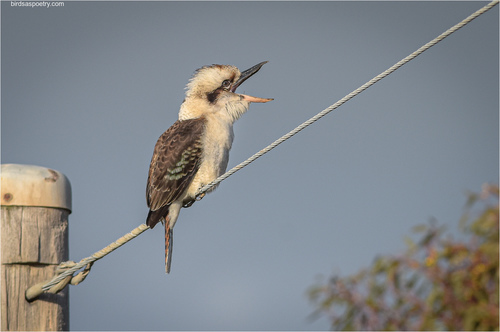
Forest Kingfisher

Forest Kingfisher

Todiramphus macleayii

Silhouette: Steven Traver · PhyloPic

LCLeast ConcernNTVUENCR
Daily sighting probability ~10% · With luck
at Springbrook National Park

In 3 days ~20% in a week ~50%

130 Verified sightings at Springbrook National Park From 2019 to 2026
1,852 In all 7 parks
February Best month
☀️ Diurnal When it's spotted

About the Forest Kingfisher

The forest kingfisher (Todiramphus macleayii), also known as Macleay's or the blue kingfisher, is a species of kingfisher in the subfamily Halcyoninae, also known as tree kingfishers. It is a predominantly a blue and white bird. It is found in Indonesia, New Guinea and coastal eastern and Northern Australia. Like many other kingfishers, it hunts invertebrates, small frogs, and lizards.

The forest kingfisher was first described by the naturalists Sir William Jardine and Prideaux John Selby in 1830. It was known for many years by its old scientific name of Halcyon macleayi before being transferred to the genus Todiramphus.

Three subspecies are recognised: T. m. macleayi, the nominate subspecies, is found across the Top End eastwards to the Gulf of Carpentaria. T. m. incinctus, described by John Gould, has a greener tinge to its back and is slightly larger. It is found down the east coast of Australia.... Wikipedia →

Sounds

Call0:06

Australia · 2022

© James Lambert · XC707008 · CC BY-NC-ND 4.0

Song0:18

Australia · 2022

© Marc Anderson · XC705142 · CC BY-NC-ND 4.0

Song1:22

Australia · 2010

© Meena Haribal · XC629556 · CC BY-NC-SA 4.0

Global Distribution

Parks Where Found

# Park Country Daily sighting probability
1 Kakadu National Park 🇦🇺 Australia
~50%
2 Daintree National Park 🇦🇺 Australia
~30%
3 Litchfield National Park 🇦🇺 Australia
~20%
4 Nitmiluk National Park 🇦🇺 Australia
~10%
5 Springbrook National Park 🇦🇺 Australia
~10%
6 Noosa National Park 🇦🇺 Australia
<5%
7 Lamington National Park 🇦🇺 Australia
<5%

Cities Where Found

# City Country Daily sighting probability
1 Brisbane 🇦🇺 Australia
~10%
2 Sydney 🇦🇺 Australia
<5%

Zoos & Centres Where Found

# Zoo / Centre Country
1 Taronga Zoo 🇦🇺 Australia In captivity
2 Currumbin Wildlife Sanctuary 🇦🇺 Australia In captivity
3 Hunter Valley Wildlife Park 🇦🇺 Australia In captivity
4 Flying High Bird Sanctuary 🇦🇺 Australia In captivity

Before you go

What are the chances of seeing a Forest Kingfisher in Springbrook National Park?

With luck

About 10% of wildlife watchers report a Forest Kingfisher sighting in Springbrook National Park on a given day, based on 130 verified sightings from GBIF citizen-science data from 2019 to 2026. It is the 76th most-seen of the 136 birds we can rate there. Over three days the chance rises to about 20%, and over a week to about 50%, if each day is a fresh chance.

When is the best time to see a Forest Kingfisher in Springbrook National Park?

February

In that month about 30% of wildlife watchers report a Forest Kingfisher in Springbrook National Park on a given day, against under 5% in April, June and December–January, the lowest months. That is one of Springbrook National Park's wettest months, with about 210 mm of rain against 45 mm in August.

What time of day is best to see a Forest Kingfisher?

Between 2 and 5 pm

Across all the parks we cover, that three-hour window holds the most Forest Kingfisher sightings with a recorded time, and about 9 in 10 of them come between 6 am and 6 pm: it is a daytime animal.

Is Springbrook National Park the best place to see a Forest Kingfisher?

5th of 7

Of the 7 parks where we can rate Forest Kingfisher sightings, Springbrook National Park ranks 5th at about 10%. The best odds are in Kakadu National Park (Australia, about 50%), Daintree National Park (Australia, about 30%) and Litchfield National Park (Australia, about 20%).

Where does the Forest Kingfisher sighting chance come from?

GBIF citizen-science records

It is estimated from how often the Forest Kingfisher is recorded against all the birds logged in Springbrook National Park (130 verified sightings from 2019 to 2026), calibrated against known sighting rates. Figures are rounded to the nearest 10% because citizen-science data supports honest approximations, not decimals, and months with records from fewer than five people show "—". How it works.

← Back to Springbrook National Park