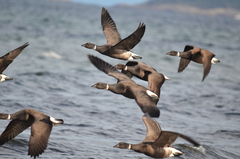
About the Brant
The brant or brent goose (Branta bernicla) is a small goose in the genus Branta. There are three subspecies, all of which winter along temperate-zone sea-coasts and breed on the high-Arctic tundra. The Brent oilfield was named after the species.
The brant was formally described in 1758 by the Swedish naturalist Carl Linnaeus in the tenth edition of his Systema Naturae under the binomial name Anas bernicla. Linnaeus specified the type locality as Europe but in 1761 restricted it to Sweden. The brant is now one of six species placed in the genus Branta that was introduced in 1769 by the Austrian naturalist Giovanni Antonio Scopoli. The genus name Branta is a Latinised form of Old Norse brandgás, "burnt (black) goose". The specific epithet bernicla is Medieval Latin for barnacle.
The brant and the similar barnacle goose were previously considered to be the same species and believed to be the same creature as the barnacle. That myth can be dated back to at least the 12th century. Gerald of Wales claimed to have seen these birds hanging down from pieces of timber, William Turner accepted the theory, and John Gerard claimed to have seen the birds emerging from their shells... Wikipedia →