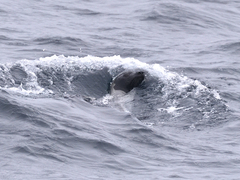



Harp Seal

Harp Seal

Pagophilus groenlandicus

Silhouette: Tracy A. Heath · PhyloPic

LCNTNear ThreatenedVUENCR
Daily sighting probability ~10% · With luck
at Svalbard

In 3 days ~30% in a week ~60%

11 Verified sightings at Svalbard From 2019 to 2026
17 In all 2 parks
April Best month
☀️ Diurnal When it's spotted

About the Harp Seal

The harp seal (Pagophilus groenlandicus), also known as the saddleback seal or Greenland seal, is a species of earless seal, or true seal, native to the northernmost Atlantic Ocean and Arctic Ocean. Originally in the genus Phoca with a number of other species, it was reclassified into the monotypic genus Pagophilus in 1844. In Greek, its scientific name translates to "Greenlandic ice-lover", and its taxonomic synonym, Phoca groenlandica translates to "Greenlandic seal".

The mature harp seal has pure black eyes. It has a silver-grey fur covering its body, with black harp- or wishbone-shaped markings dorsally, accounting for its common name. Adult harp seals grow to be 1.7 to 2.0 m (5 ft 7 in to 6 ft 7 in) long and weigh from 115 to 140 kg (254 to 309 lb). The harp seal pup has a white coat for the first 2–3 weeks until the first moult, when it is replaced by a black-dotted silver to grey coat. Pups acquire their characteristic pattern once they near sexual maturity. In males, the transition to the harp-pattern tends to be abrupt, while in females it may be gradual and span years. Some females may never lose all their spots or not fully develop the harp-pattern. Harp... Wikipedia →

Global Distribution

Parks Where Found

# Park Country Daily sighting probability
1 Gros Morne National Park 🇨🇦 Canada
~10%
2 Svalbard 🇳🇴 Norway
~10%

Zoos & Centres Where Found

# Zoo / Centre Country
1 Milwaukee County Zoo 🇺🇸 United States In captivity
2 Aquarium du Québec 🇨🇦 Canada In captivity
3 Osaka Aquarium Kaiyukan 🇯🇵 Japan In captivity
4 Huntsman Fundy Discovery Aquarium 🇨🇦 Canada In captivity

Before you go

What are the chances of seeing a Harp Seal in Svalbard?

With luck

About 10% of wildlife watchers report a Harp Seal sighting in Svalbard on a given day, based on 11 verified sightings from GBIF citizen-science data from 2019 to 2026. It is the 13th most-seen of the 14 mammals we can rate there. Over three days the chance rises to about 30%, and over a week to about 60%, if each day is a fresh chance.

When is the best time to see a Harp Seal in Svalbard?

April

In that month about 30% of wildlife watchers report a Harp Seal in Svalbard on a given day, against under 5% in January–March, May and September, the lowest months. December has too few records to rate.

What time of day is best to see a Harp Seal?

Between 8 and 11 am

Across all the parks we cover, that three-hour window holds the most Harp Seal sightings with a recorded time, and about 8 in 10 of them come between 6 am and 6 pm: it is a daytime animal.

Is Svalbard the best place to see a Harp Seal?

Among the best

Of the 2 parks where we can rate Harp Seal sightings, Svalbard ranks 2nd at about 10%, level with the leaders once rounded. The best odds are in Gros Morne National Park (Canada, about 10%).

Which relatives of the Harp Seal live in Svalbard?

Same family: Phocidae

The closest relatives of the Harp Seal that you can see in Svalbard (family Phocidae, Earless Seals) are Harbor Seal (about 50%), Bearded Seal (about 50%) and Ringed Seal (about 20%), with each one's daily chance of a sighting.

Where does the Harp Seal sighting chance come from?

GBIF citizen-science records

It is estimated from how often the Harp Seal is recorded against all the mammals logged in Svalbard (11 verified sightings from 2019 to 2026), calibrated against known sighting rates. Figures are rounded to the nearest 10% because citizen-science data supports honest approximations, not decimals, and months with records from fewer than five people show "—". How it works.

← Back to Svalbard