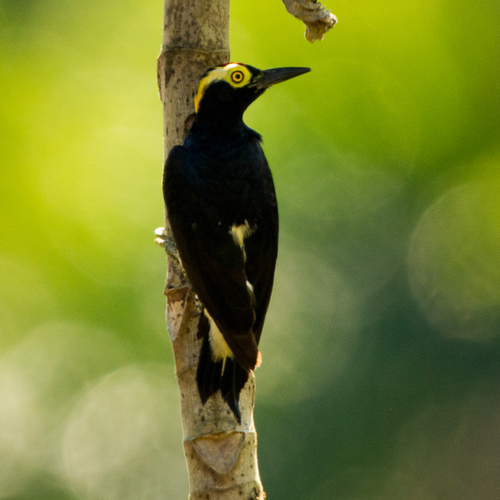
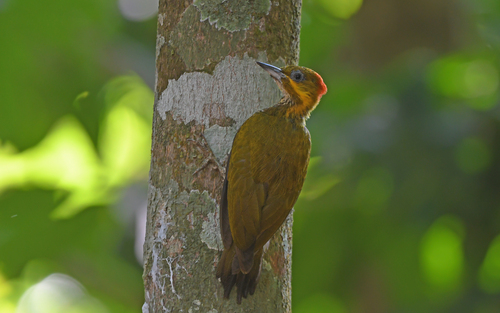
Waved Woodpecker

Waved Woodpecker

Celeus undatus

Silhouette: Pepe Reigada · PhyloPic

LCLeast ConcernNTVUENCR
Daily sighting probability <5% · Rare
at Tambopata National Reserve

In 3 days ~10% in a week ~20%

77 Verified sightings at Tambopata National Reserve From 2019 to 2026
663 In all 7 parks
October Best month
☀️ Diurnal When it's spotted

About the Waved Woodpecker

The waved woodpecker (Celeus undatus) or variable woodpecker is a species of bird in subfamily Picinae of the woodpecker family Picidae. It is found in Bolivia, Brazil, Colombia, Ecuador, French Guiana, Guyana, Peru, Suriname, and Venezuela.

The English naturalist George Edwards described and illustrated the waved woodpecker in his Gleanings of Natural History which he published in 1764. Edwards used the English name "Red-cheeked Wood-pecker". When in 1766 the Swedish naturalist Carl Linnaeus updated his Systema Naturae for the twelfth edition, he included the waved woodpecker, coined the binomial name Picus undatus, and cited Edwards's book. Linnaeus specified the type locality as Surinam [sic]. The waved woodpecker is now placed in the genus Celeus that was introduced by the German zoologist Friedrich Boie in 1831.

The waved woodpecker has a complicated taxonomic history. For much of the past it was assigned three subspecies. A 2011 publication suggested that the four subspecies of the scaly-breasted woodpecker (then C. grammicus) properly belonged as subspecies of the waved woodpecker, and a 2018 publication provided further evidence. In 2019 BirdLife... Wikipedia →

Sounds

Song0:17

Brazil · 2025

© JAYRSON ARAUJO DE OLIVEIRA · XC1045238 · CC BY-NC-SA 4.0

Call0:44

Guyana · 2020

© Barry Edmonston · XC526131 · CC BY-NC-SA 4.0

?0:17

French Guiana · 2010

© Renaudier Alexandre · XC59332 · CC BY-NC-ND 2.5

Global Distribution

Parks Where Found

# Park Country Daily sighting probability
1 Brownsberg Nature Park 🇸🇷 Suriname
~30%
2 Amacayacu National Natural Park 🇨🇴 Colombia
~10%
3 Yasuní National Park 🇪🇨 Ecuador
~10%
4 Anavilhanas National Park 🇧🇷 Brazil
~10%
5 Cuyabeno Wildlife Reserve 🇪🇨 Ecuador
~10%
6 Tambopata National Reserve 🇵🇪 Peru
<5%
7 Manu National Park 🇵🇪 Peru
<5%

Before you go

What are the chances of seeing a Waved Woodpecker in Tambopata National Reserve?

Rare

Under 5% of wildlife watchers report a Waved Woodpecker sighting in Tambopata National Reserve on a given day, based on 77 verified sightings from GBIF citizen-science data from 2019 to 2026. It is the 328th most-seen of the 550 birds we can rate there. Over three days the chance rises to about 10%, and over a week to about 20%, if each day is a fresh chance.

When is the best time to see a Waved Woodpecker in Tambopata National Reserve?

February, August, October and December

In those months about 10% of wildlife watchers report a Waved Woodpecker in Tambopata National Reserve on a given day, against under 5% in January, March–July, September and November, the lowest months.

What time of day is best to see a Waved Woodpecker?

Between 6 and 9 am

Across all the parks we cover, that three-hour window holds the most Waved Woodpecker sightings with a recorded time, and about 9 in 10 of them come between 6 am and 6 pm: it is a daytime animal.

Which relatives of the Waved Woodpecker live in Tambopata National Reserve?

Same genus: Celeus

The closest relatives of the Waved Woodpecker that you can see in Tambopata National Reserve (genus Celeus, Neotropical Crested Woodpeckers) are Cream-colored Woodpecker (about 10%) and Ringed Woodpecker (about 10%), with each one's daily chance of a sighting.

Where does the Waved Woodpecker sighting chance come from?

GBIF citizen-science records

It is estimated from how often the Waved Woodpecker is recorded against all the birds logged in Tambopata National Reserve (77 verified sightings from 2019 to 2026), calibrated against known sighting rates. Figures are rounded to the nearest 10% because citizen-science data supports honest approximations, not decimals, and months with records from fewer than five people show "—". How it works.

← Back to Tambopata National Reserve