
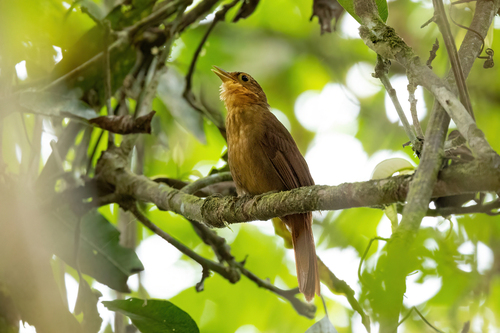
Spot-crowned Woodcreeper

Spot-crowned Woodcreeper

Lepidocolaptes affinis

Silhouette: Sheatherius · PhyloPic

LCLeast ConcernNTVUENCR
Daily sighting probability ~20% · Possible
at Tapantí-Macizo de la Muerte National Park

In 3 days ~40% in a week ~70%

1,462 Verified sightings at Tapantí-Macizo de la Muerte National Park From 2019 to 2026
8,751 In all 12 parks
December Best month
☀️ Diurnal When it's spotted

About the Spot-crowned Woodcreeper

The spot-crowned woodcreeper (Lepidocolaptes affinis), is a passerine bird in the subfamily Dendrocolaptinae of the ovenbird family Furnariidae. it is found in Middle America from Mexico to Panama. What is now the montane woodcreeper (L. lacrymiger) was formerly considered conspecific with the spot-crowned woodcreeper but they were split in the early 2000s. The spot-crowned woodcreeper's taxonomy since then remains unsettled. The International Ornithological Committee and the Clements taxonomy assign it these three subspecies:

However, BirdLife International's Handbook of the Birds of the World (HBW) treats L. a. neglectus as a separate species, the southern spot-crowned woodcreeper. This article follows the one species, three-subspecies, model.

The spot-crowned woodcreeper is 19 to 22 cm (7.5 to 8.7 in) long and weighs 28 to 38 g (0.99 to 1.3 oz). It is a slim, medium-sized woodcreeper with a slim, moderately decurved bill. The sexes have the same... Wikipedia →

Sounds

Call0:18

Mexico · 2022

© Sue Riffe · XC772139 · CC BY-NC-SA 4.0

Song1:11

Panama · 2009

© Andrew Spencer · XC31828 · CC BY-NC-ND 2.5

Call0:15

Costa Rica · 2019

© Odirlei Vieira da Fonseca · XC552506 · CC BY-NC-SA 4.0

Global Distribution

Parks Where Found

# Park Country Daily sighting probability
1 Los Quetzales National Park 🇨🇷 Costa Rica
~40%
2 Volcán Barú National Park 🇵🇦 Panama
~40%
3 Irazú Volcano National Park 🇨🇷 Costa Rica
~20%
4 El Triunfo 🇲🇽 Mexico
~20%
5 Tapantí-Macizo de la Muerte National Park 🇨🇷 Costa Rica
~20%
6 La Amistad International Park (Panama) 🇵🇦 Panama
~20%
7 La Tigra National Park 🇭🇳 Honduras
~10%
8 Chirripó National Park 🇨🇷 Costa Rica
~10%
9 Cusuco National Park 🇭🇳 Honduras
~10%
10 Braulio Carrillo National Park 🇨🇷 Costa Rica
~10%
11 Celaque National Park 🇭🇳 Honduras
~10%
12 Poás Volcano National Park 🇨🇷 Costa Rica
<5%

Cities Where Found

# City Country Daily sighting probability
1 San José 🇨🇷 Costa Rica
<5%

Before you go

What are the chances of seeing a Spot-crowned Woodcreeper in Tapantí-Macizo de la Muerte National Park?

Possible

About 20% of wildlife watchers report a Spot-crowned Woodcreeper sighting in Tapantí-Macizo de la Muerte National Park on a given day, based on 1,462 verified sightings from GBIF citizen-science data from 2019 to 2026. It is the 51st most-seen of the 467 birds we can rate there. Over three days the chance rises to about 40%, and over a week to about 70%, if each day is a fresh chance.

When is the best time to see a Spot-crowned Woodcreeper in Tapantí-Macizo de la Muerte National Park?

May–June, August–September and December–March

In those months about 20% of wildlife watchers report a Spot-crowned Woodcreeper in Tapantí-Macizo de la Muerte National Park on a given day, against about 10% in April, July and October–November, the lowest months.

What time of day is best to see a Spot-crowned Woodcreeper?

Between 8 and 11 am

Across all the parks we cover, that three-hour window holds the most Spot-crowned Woodcreeper sightings with a recorded time, and about 9 in 10 of them come between 6 am and 6 pm: it is a daytime animal.

Where does the Spot-crowned Woodcreeper sighting chance come from?

GBIF citizen-science records

It is estimated from how often the Spot-crowned Woodcreeper is recorded against all the birds logged in Tapantí-Macizo de la Muerte National Park (1,462 verified sightings from 2019 to 2026), calibrated against known sighting rates. Figures are rounded to the nearest 10% because citizen-science data supports honest approximations, not decimals, and months with records from fewer than five people show "—". How it works.

← Back to Tapantí-Macizo de la Muerte National Park