Yellow-winged Vireo

Yellow-winged Vireo

Vireo carmioli

Silhouette: Caleb Gordon · PhyloPic

LCLeast ConcernNTVUENCR
Daily sighting probability ~20% · Possible
at Tapantí-Macizo de la Muerte National Park

In 3 days ~50% in a week ~80%

1,996 Verified sightings at Tapantí-Macizo de la Muerte National Park From 2019 to 2026
7,715 In all 8 parks
December Best month
☀️ Diurnal When it's spotted

About the Yellow-winged Vireo

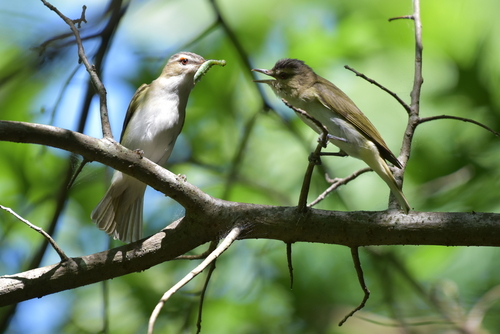
The yellow-winged vireo, or Carmiol's vireo, (Vireo carmioli) is a small passerine bird in the family Vireonidae, the vireos, greenlets, and shrike-babblers. It is found in Costa Rica and Panama. The yellow-winged vireo was originally described in 1866 as Vireo carmioli, its current binomial. Its specific epithet and alternate English name honor "Mr. Julian Carmiol, who has been so indefatigable in developing the ornithology of Costa Rica".

The yellow-winged vireo is monotypic. The yellow-winged vireo is 11 to 11.5 cm (4.3 to 4.5 in) long and weighs about 13 to 15 g (0.46 to 0.53 oz). The sexes have the same plumage. Adults have a gray-green crown. A whitish to buffy yellow area above the lores and eye-ring give the appearance of spectacles. Their nape and upperparts are dull greenish. Their wing coverts are dark greenish gray with wide whitish to pale yellow tips that show as two wing bars. Their primaries and secondaries are blackish gray with wide yellow-green edges. Their rectrices are blackish gray with wide greenish yellow edges on the outer webs. Their throat is yellowish white, their breast and belly yellow with yellowish green... Wikipedia →

Sounds

Recording0:31

Costa Rica · 2024

© Alain Verneau · XC875497 · CC BY-NC-SA 4.0

Song0:28

Costa Rica · 2019

© Hans Matheve · XC518747 · CC BY-NC-ND 4.0

Call0:14

Costa Rica · 2011

© Andrew Spencer · XC72468 · CC BY-NC-ND 2.5

Global Distribution

Parks Where Found

# Park Country Daily sighting probability
1 Los Quetzales National Park 🇨🇷 Costa Rica
~40%
2 Volcán Barú National Park 🇵🇦 Panama
~20%
3 Tapantí-Macizo de la Muerte National Park 🇨🇷 Costa Rica
~20%
4 Irazú Volcano National Park 🇨🇷 Costa Rica
~10%
5 La Amistad International Park (Panama) 🇵🇦 Panama
~10%
6 Braulio Carrillo National Park 🇨🇷 Costa Rica
~10%
7 Poás Volcano National Park 🇨🇷 Costa Rica
<5%
8 Chirripó National Park 🇨🇷 Costa Rica
<5%

Cities Where Found

# City Country Daily sighting probability
1 San José 🇨🇷 Costa Rica
<5%

Before you go

What are the chances of seeing a Yellow-winged Vireo in Tapantí-Macizo de la Muerte National Park?

Possible

About 20% of wildlife watchers report a Yellow-winged Vireo sighting in Tapantí-Macizo de la Muerte National Park on a given day, based on 1,996 verified sightings from GBIF citizen-science data from 2019 to 2026. It is the 38th most-seen of the 467 birds we can rate there. Over three days the chance rises to about 50%, and over a week to about 80%, if each day is a fresh chance.

When is the best time to see a Yellow-winged Vireo in Tapantí-Macizo de la Muerte National Park?

December

In that month about 30% of wildlife watchers report a Yellow-winged Vireo in Tapantí-Macizo de la Muerte National Park on a given day, against about 10% in May, August and October–November, the lowest months.

What time of day is best to see a Yellow-winged Vireo?

Between 8 and 11 am

Across all the parks we cover, that three-hour window holds the most Yellow-winged Vireo sightings with a recorded time, and about 9 in 10 of them come between 6 am and 6 pm: it is a daytime animal.

Is Tapantí-Macizo de la Muerte National Park the best place to see a Yellow-winged Vireo?

3rd of 8

Of the 8 parks where we can rate Yellow-winged Vireo sightings, Tapantí-Macizo de la Muerte National Park ranks 3rd at about 20%. The best odds are in Los Quetzales National Park (Costa Rica, about 40%) and Volcán Barú National Park (Panama, about 20%).

Where does the Yellow-winged Vireo sighting chance come from?

GBIF citizen-science records

It is estimated from how often the Yellow-winged Vireo is recorded against all the birds logged in Tapantí-Macizo de la Muerte National Park (1,996 verified sightings from 2019 to 2026), calibrated against known sighting rates. Figures are rounded to the nearest 10% because citizen-science data supports honest approximations, not decimals, and months with records from fewer than five people show "—". How it works.

← Back to Tapantí-Macizo de la Muerte National Park