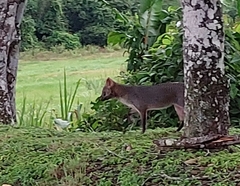
Crab-eating Fox

Crab-eating Fox

Cerdocyon thous

Silhouette: Margot Michaud · PhyloPic

LCLeast ConcernNTVUENCR
Daily sighting probability ~20% · Possible
at Tayrona National Natural Park

In 3 days ~50% in a week ~80%

9 Verified sightings at Tayrona National Natural Park From 2019 to 2026
190 In all 7 parks
January Best month
🌅 Crepuscular When it's spotted

About the Crab-eating Fox

The crab-eating fox (Cerdocyon thous), also known as the forest dog, wood fox, bushfox (not to be confused with the bush dog) or maikong, is an extant species of medium-sized canid endemic to the central part of South America since at least the Pleistocene epoch. Like South American foxes, which are in the genus Lycalopex, it is not closely related to true foxes. Cerdocyon comes from the Greek words kerdo (meaning fox) and kyon (dog) referring to the dog- and fox-like characteristics of this animal.

The crab-eating fox was originally described as Canis thous by Linnaeus (1766), and first placed in its current genus Cerdocyon by Hamilton-Smith in 1839. Cerdocyonina is a tribe which appeared around 6.0 million years ago (Mya) in North America as Ferrucyon avius becoming extinct by around 1.4–1.3 Mya. living about 4.7 million years. This genus has persisted in South America from an undetermined time, possibly around 3.1 Mya, and continues to the present in the same or a similar form to the crab-eating fox.

As one of the species of the tribe Canini, it is related to the genus Canis. The crab-eating fox's nearest living relative, as theorized at present, is the... Wikipedia →

Sounds

Call1:29

Argentina · 2021

© Jacob Wijpkema · XC998019 · CC BY-NC-SA 4.0

Recording0:45

Argentina · 2018

© Leonardo Adrián LEIVA · iNaturalist · CC BY-NC 4.0

Recording0:09

Brazil · 2023

© Breno Farias · iNaturalist · CC BY-NC 4.0

Global Distribution

Parks Where Found

# Park Country Daily sighting probability
1 El Palmar National Park 🇦🇷 Argentina
~70%
2 Emas National Park 🇧🇷 Brazil
~60%
3 Iberá National Park 🇦🇷 Argentina
~40%
4 El Impenetrable National Park 🇦🇷 Argentina
~30%
5 Tayrona National Natural Park 🇨🇴 Colombia
~20%
6 Los Nevados National Natural Park 🇨🇴 Colombia
~10%
7 Soberanía National Park 🇵🇦 Panama
~10%

Cities Where Found

# City Country Daily sighting probability
1 João Pessoa 🇧🇷 Brazil
~20%
2 Fortaleza 🇧🇷 Brazil
~20%
3 Medellín 🇨🇴 Colombia
~10%
4 Campinas 🇧🇷 Brazil
~10%
5 Rio de Janeiro 🇧🇷 Brazil
~10%
6 Bogota 🇨🇴 Colombia
<5%

Zoos & Centres Where Found

# Zoo / Centre Country
1 Zoobotanic Park of Brusque 🇧🇷 Brazil In captivity
2 Zoológico de Brasília 🇧🇷 Brazil In captivity
3 Curitiba Zoo 🇧🇷 Brazil In captivity
4 São Paulo Zoo 🇧🇷 Brazil In captivity
5 Parque Municipal Summit 🇵🇦 Panama In captivity
6 Ukumarí Biopark 🇨🇴 Colombia In captivity
7 Gramado Zoo 🇧🇷 Brazil In captivity
8 Parque Zoobotânico Getúlio Vargas 🇧🇷 Brazil In captivity
9 Parque Zoobotânico Arruda Câmara (BICA) 🇧🇷 Brazil In captivity
10 Zoológico Municipal de Cascavel 🇧🇷 Brazil In captivity
11 Municipal Zoological Park Quinzinho de Barros 🇧🇷 Brazil In captivity
12 Rio de Janeiro Zoological Garden 🇧🇷 Brazil In captivity
13 Parque Ecológico de São Carlos 🇧🇷 Brazil In captivity
14 Zoo Americana / Parque Ecológico Municipal 🇧🇷 Brazil In captivity
15 Bosque dos Jequitibás 🇧🇷 Brazil In captivity
16 Bioparque Los Ocarros 🇨🇴 Colombia In captivity
17 Parque de la Conservación 🇨🇴 Colombia In captivity
18 Parque Zoobotânico de Joinville 🇧🇷 Brazil In captivity
19 El Nispero Zoo 🇵🇦 Panama In captivity
20 Agroflori Parque de las Aves 🇧🇴 Bolivia In captivity
21 Pantanal Aquarium 🇧🇷 Brazil In captivity
22 Zoológico de Canindé 🇧🇷 Brazil In captivity
23 Fundação Zoobotânica de Marabá 🇧🇷 Brazil In captivity
24 Zooparque Itatiba 🇧🇷 Brazil In captivity

Before you go

What are the chances of seeing a Crab-eating Fox in Tayrona National Natural Park?

Possible

About 20% of wildlife watchers report a Crab-eating Fox sighting in Tayrona National Natural Park on a given day, based on 9 verified sightings from GBIF citizen-science data from 2019 to 2026. It is the 8th most-seen of the 11 mammals we can rate there. Over three days the chance rises to about 50%, and over a week to about 80%, if each day is a fresh chance.

When is the best time to see a Crab-eating Fox in Tayrona National Natural Park?

December to February

In those months about 30% of wildlife watchers report a Crab-eating Fox in Tayrona National Natural Park on a given day, against under 5% in April to October, the lowest months. Those are among Tayrona National Natural Park's driest months, with about 20 mm of rain a month against 180 mm in October.

What time of day is best to see a Crab-eating Fox?

Between 6 and 9 pm

Across all the parks we cover, that three-hour window holds the most Crab-eating Fox sightings with a recorded time, and about half of them come between 6 am and 6 pm: it is most active around dawn and dusk.

Where does the Crab-eating Fox sighting chance come from?

GBIF citizen-science records

It is estimated from how often the Crab-eating Fox is recorded against all the mammals logged in Tayrona National Natural Park (9 verified sightings from 2019 to 2026), calibrated against known sighting rates. Figures are rounded to the nearest 10% because citizen-science data supports honest approximations, not decimals, and months with records from fewer than five people show "—". How it works.

← Back to Tayrona National Natural Park