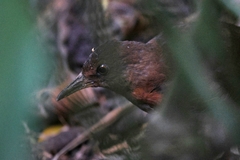
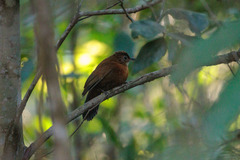
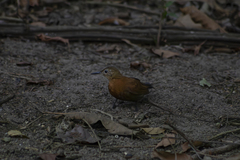

Rufous-breasted Leaftosser

Rufous-breasted Leaftosser

Sclerurus scansor

Silhouette: Sheatherius · PhyloPic

LCLeast ConcernNTVUENCR
Daily sighting probability <5% · Rare
at Tijuca National Park

In 3 days ~10%

52 Verified sightings at Tijuca National Park From 2019 to 2026
298 In all 5 parks
November Best month
☀️ Diurnal When it's spotted

About the Rufous-breasted Leaftosser

The rufous-breasted leaftosser (Sclerurus scansor) is a species of bird in the subfamily Sclerurinae, the leaftossers and miners, of the ovenbird family Furnariidae. It is found in Argentina, Brazil, and Paraguay. The rufous-breasted leaftosser's taxonomy is unsettled. BirdLife International's Handbook of the Birds of the World (HBW) treats the taxa as two separate species, the rufous-breasted leaftosser sensu stricto and the Ceara leaftosser S. cearensis. The South American Classification Committee of the American Ornithological Society also does not recognize the "Ceara leaftosser" but does not address subspecies within the rufous-breasted.

The rufous-breasted and grey-throated leaftosser (S. albigularis) are sister species. This article follows the one species, two-subspecies model. The rufous-breasted leaftosser is one of the larger members of genus Sclerurus. It is 17.5 to 20.1 cm (6.9 to 7.9 in) long and weighs 30 to 41 g (1.1 to 1.4 oz). The sexes... Wikipedia →

Sounds

Song0:05

Brazil · 2025

© JAYRSON ARAUJO DE OLIVEIRA · XC1053046 · CC BY-NC-SA 4.0

Call1:16

Brazil · 2025

© Joost van Bruggen · XC1050563 · CC BY-NC-ND 4.0

Alarm call1:10

Brazil · 2020

© Odirlei Vieira da Fonseca · XC581127 · CC BY-NC-SA 4.0

Global Distribution

Parks Where Found

# Park Country Daily sighting probability
1 Serra dos Órgãos National Park 🇧🇷 Brazil
~20%
2 Itatiaia National Park 🇧🇷 Brazil
<5%
3 Tijuca National Park 🇧🇷 Brazil
<5%
4 Iguazú National Park 🇦🇷 Argentina
<5%
5 Iguaçu National Park 🇧🇷 Brazil
<5%

Cities Where Found

# City Country Daily sighting probability
1 Rio de Janeiro 🇧🇷 Brazil
<5%
2 São Paulo 🇧🇷 Brazil
<5%

Before you go

What are the chances of seeing a Rufous-breasted Leaftosser in Tijuca National Park?

Rare

Under 5% of wildlife watchers report a Rufous-breasted Leaftosser sighting in Tijuca National Park on a given day, based on 52 verified sightings from GBIF citizen-science data from 2019 to 2026. It is the 133rd most-seen of the 214 birds we can rate there. Over three days the chance rises to about 10%, if each day is a fresh chance.

When is the best time to see a Rufous-breasted Leaftosser in Tijuca National Park?

Any time of year

In every month with enough records, under 5% of wildlife watchers report a Rufous-breasted Leaftosser in Tijuca National Park on a given day, so our monthly data shows no clear season.

What time of day is best to see a Rufous-breasted Leaftosser?

Between 7 and 10 am

Across all the parks we cover, that three-hour window holds the most Rufous-breasted Leaftosser sightings with a recorded time, and about 9 in 10 of them come between 6 am and 6 pm: it is a daytime animal.

Is Tijuca National Park the best place to see a Rufous-breasted Leaftosser?

3rd of 5

Of the 5 parks where we can rate Rufous-breasted Leaftosser sightings, Tijuca National Park ranks 3rd at under 5%. The best odds are in Serra dos Órgãos National Park (Brazil, about 20%) and Itatiaia National Park (Brazil, under 5%).

Which relatives of the Rufous-breasted Leaftosser live in Tijuca National Park?

Same family: Furnariidae

The closest relatives of the Rufous-breasted Leaftosser that you can see in Tijuca National Park (family Furnariidae, Ovenbirds and Woodcreepers) are Rufous Hornero (about 30%), Plain-brown Woodcreeper (about 20%) and Lesser Woodcreeper (about 10%), with each one's daily chance of a sighting.

Where does the Rufous-breasted Leaftosser sighting chance come from?

GBIF citizen-science records

It is estimated from how often the Rufous-breasted Leaftosser is recorded against all the birds logged in Tijuca National Park (52 verified sightings from 2019 to 2026), calibrated against known sighting rates. Figures are rounded to the nearest 10% because citizen-science data supports honest approximations, not decimals, and months with records from fewer than five people show "—". How it works.

← Back to Tijuca National Park