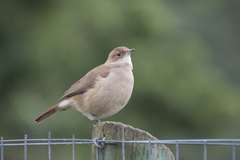
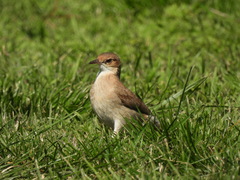

Rufous Hornero

Rufous Hornero

Furnarius rufus

Silhouette: Abraão B. Leite · PhyloPic

LCLeast ConcernNTVUENCR
Daily sighting probability ~30% · Possible
at Tijuca National Park

In 3 days ~70% in a week ~90%

991 Verified sightings at Tijuca National Park From 2019 to 2026
10,253 In all 14 parks
January Best month
☀️ Diurnal When it's spotted

About the Rufous Hornero

The rufous hornero (Furnarius rufus) is a medium-sized ovenbird in the family Furnariidae. It occurs in eastern South America and is the national bird of Argentina. Also known as the red ovenbird, it is common in savannas, second-growth scrub, pastures, and agricultural land and is synanthropic. Its range includes midwestern, southeastern, and southern Brazil, Bolivia, Paraguay, Uruguay, and northern and central Argentina, extending as far south as northern Patagonia. The species is most closely related to the crested hornero of Paraguay and Argentina. There are four accepted subspecies.

The rufous hornero is medium-sized with a square tail and very slightly decurved bill. The plumage is overall reddish brown with a dull brown crown and a whitish throat. Sexes are alike and juvenile birds are slightly paler below (probably because they are cleaner). Rufous horneros feed on insects and other arthropods obtained by foraging on the ground while walking. They sometimes feed on scraps such as bread crumbs. Songs in the rufous hornero are sexually distinct. The rapid trill that is usually heard as part of the duet is faster in the male and slower in the female, and both beat their wings at their sides while singing and the wings beat at the same rate as their trill. Thus, while watching an observer may identify the sex by how fast their wings beat while singing. Wikipedia →

Sounds

Duet0:05

Brazil · 2026

© JAYRSON ARAUJO DE OLIVEIRA · XC1163747 · CC BY-NC-SA 4.0

Song0:08

Argentina · 2024

© Marcos E. Sosa · XC943374 · CC BY-NC-SA 4.0

Call0:13

Argentina · 2023

© Bernard BOUSQUET · XC838919 · CC BY-NC-SA 4.0

Global Distribution

Parks Where Found

# Park Country Daily sighting probability
1 Iberá National Park 🇦🇷 Argentina
~80%
2 El Palmar National Park 🇦🇷 Argentina
~70%
3 Chapada dos Guimarães National Park 🇧🇷 Brazil
~70%
4 El Impenetrable National Park 🇦🇷 Argentina
~60%
5 Iguazú National Park 🇦🇷 Argentina
~50%
6 Iguaçu National Park 🇧🇷 Brazil
~40%
7 Amboró National Park 🇧🇴 Bolivia
~40%
8 Parque Estadual Encontro das Águas 🇧🇷 Brazil
~40%
9 Emas National Park 🇧🇷 Brazil
~40%
10 Tijuca National Park 🇧🇷 Brazil
~30%
11 Serra da Canastra National Park 🇧🇷 Brazil
~30%
12 Chapada Diamantina National Park 🇧🇷 Brazil
~20%
13 Serra dos Órgãos National Park 🇧🇷 Brazil
~10%
14 Itatiaia National Park 🇧🇷 Brazil
~10%

Cities Where Found

# City Country Daily sighting probability
1 Brasilia 🇧🇷 Brazil
~90%
2 Porto Alegre 🇧🇷 Brazil
~90%
3 Montevideo 🇺🇾 Uruguay
~90%
4 Cordoba 🇦🇷 Argentina
~90%
5 Buenos Aires 🇦🇷 Argentina
~90%
6 Mendoza 🇦🇷 Argentina
~90%
7 Curitiba 🇧🇷 Brazil
~90%
8 Salvador 🇧🇷 Brazil
~90%
9 Rosario 🇦🇷 Argentina
~90%
10 Campo Grande 🇧🇷 Brazil
~80%

Before you go

What are the chances of seeing a Rufous Hornero in Tijuca National Park?

Possible

About 30% of wildlife watchers report a Rufous Hornero sighting in Tijuca National Park on a given day, based on 991 verified sightings from GBIF citizen-science data from 2019 to 2026. It is the 23rd most-seen of the 214 birds we can rate there. Over three days the chance rises to about 70%, and over a week to about 90%, if each day is a fresh chance.

When is the best time to see a Rufous Hornero in Tijuca National Park?

December to May

In those months about 40% of wildlife watchers report a Rufous Hornero in Tijuca National Park on a given day, against about 30% in June to November, the lowest months.

What time of day is best to see a Rufous Hornero?

Between 11 am and 2 pm

Across all the parks we cover, that three-hour window holds the most Rufous Hornero sightings with a recorded time, and about 9 in 10 of them come between 6 am and 6 pm: it is a daytime animal.

Where does the Rufous Hornero sighting chance come from?

GBIF citizen-science records

It is estimated from how often the Rufous Hornero is recorded against all the birds logged in Tijuca National Park (991 verified sightings from 2019 to 2026), calibrated against known sighting rates. Figures are rounded to the nearest 10% because citizen-science data supports honest approximations, not decimals, and months with records from fewer than five people show "—". How it works.

← Back to Tijuca National Park