
Streak-capped Antwren

Streak-capped Antwren

Terenura maculata

Silhouette: Sheatherius · PhyloPic

LCLeast ConcernNTVUENCR
Daily sighting probability ~10% · With luck
at Tijuca National Park

In 3 days ~20% in a week ~40%

197 Verified sightings at Tijuca National Park From 2019 to 2026
2,468 In all 5 parks
April Best month
☀️ Diurnal When it's spotted

About the Streak-capped Antwren

The streak-capped antwren (Terenura maculata) is a species of bird in subfamily Thamnophilinae of family Thamnophilidae, the "typical antbirds". It is found in Argentina, Brazil, and Paraguay. The streak-capped antwren is monotypic. It shares genus Terenura with the orange-bellied antwren (T. sicki); the two are sister species and may form a superspecies.

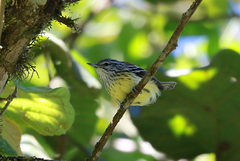
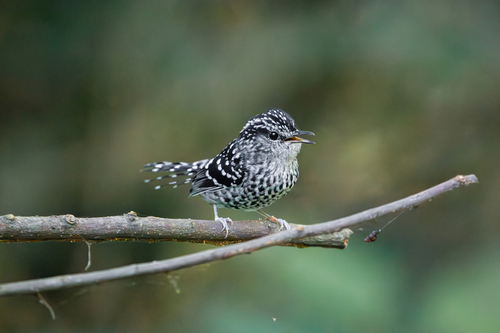
The streak-capped antwren is 9 to 10 cm (3.5 to 3.9 in) long; one individual weighed 6.5 g (0.23 oz). Adult males' crown, nape, and upper back are streaked black and white. The rest of their upperparts are tawny to chestnut with some yellow mixed in on the rump; they have a hidden white patch between the shoulders. Their wings are black with pale yellow edges on the flight feathers (tawny on the tertials) and white tips on the coverts. Their tail is olive-gray. Their throat and upper breast are white with black streaks, their lower breast yellow with black streaks, and their belly and undertail coverts unstreaked yellow. Adult females are much like males, though paler overall. The white streaks on their head and nape have a pale buff tinge and the streaking on their underparts is less... Wikipedia →

Sounds

Song0:32

Brazil · 2025

© Joost van Bruggen · XC1050621 · CC BY-NC-ND 4.0

Call0:37

Brazil · 2021

© Marcelo J Feliti · XC643269 · CC BY-NC-SA 4.0

Duet0:36

Brazil · 2020

© Marcelo da Rocha · XC592736 · CC BY-NC-SA 4.0

Global Distribution

Parks Where Found

# Park Country Daily sighting probability
1 Serra dos Órgãos National Park 🇧🇷 Brazil
~50%
2 Itatiaia National Park 🇧🇷 Brazil
~20%
3 Iguazú National Park 🇦🇷 Argentina
~20%
4 Iguaçu National Park 🇧🇷 Brazil
~20%
5 Tijuca National Park 🇧🇷 Brazil
~10%

Cities Where Found

# City Country Daily sighting probability
1 Rio de Janeiro 🇧🇷 Brazil
<5%

Before you go

What are the chances of seeing a Streak-capped Antwren in Tijuca National Park?

With luck

About 10% of wildlife watchers report a Streak-capped Antwren sighting in Tijuca National Park on a given day, based on 197 verified sightings from GBIF citizen-science data from 2019 to 2026. It is the 71st most-seen of the 214 birds we can rate there. Over three days the chance rises to about 20%, and over a week to about 40%, if each day is a fresh chance.

When is the best time to see a Streak-capped Antwren in Tijuca National Park?

February–April, June–September and November

In those months about 10% of wildlife watchers report a Streak-capped Antwren in Tijuca National Park on a given day, against under 5% in May, October and December–January, the lowest months.

What time of day is best to see a Streak-capped Antwren?

Between 8 and 11 am

Across all the parks we cover, that three-hour window holds the most Streak-capped Antwren sightings with a recorded time, and nearly all of them come between 6 am and 6 pm: it is a daytime animal.

Which relatives of the Streak-capped Antwren live in Tijuca National Park?

Same family: Thamnophilidae

The closest relatives of the Streak-capped Antwren that you can see in Tijuca National Park (family Thamnophilidae, Typical Antbirds) are Chestnut-backed Antshrike (about 20%), Rufous-margined Antwren (about 20%) and Plain Antvireo (about 10%), with each one's daily chance of a sighting.

Where does the Streak-capped Antwren sighting chance come from?

GBIF citizen-science records

It is estimated from how often the Streak-capped Antwren is recorded against all the birds logged in Tijuca National Park (197 verified sightings from 2019 to 2026), calibrated against known sighting rates. Figures are rounded to the nearest 10% because citizen-science data supports honest approximations, not decimals, and months with records from fewer than five people show "—". How it works.

← Back to Tijuca National Park