






Giant Peacock Moth

Giant Peacock Moth

Saturnia pyri

Daily sighting probability ~10% · With luck
at Triglav National Park

In 3 days ~30% in a week ~60%

13 Verified sightings at Triglav National Park From 2019 to 2026
188 In all 7 parks
May Best month
☀️🌙 Day & Night When it's spotted

About the Giant Peacock Moth

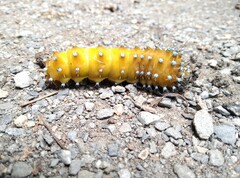
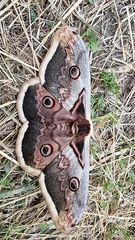
Saturnia pyri, the giant peacock moth, great peacock moth, giant emperor moth or Viennese emperor, is a Saturniid moth which is native to Europe. The species was first described by Michael Denis and Ignaz Schiffermüller in 1775. It is the largest European moth, with a wingspan reaching 15–20 cm (6–8 in).

The giant peacock moth has a range that includes the Iberian Peninsula, southern France, northern Hungary, central and southern Serbia, Croatia, Montenegro, southern and eastern Bulgaria, southern Greece southern Turkey, south Kyrgyzstan, western Syria, Lebanon, Israel, southern Romania, Russia, Ukraine, Czech Republic, Slovak Republic, Slovenia, North Macedonia and Italy and extends into Siberia and North Africa. It is absent from the UK, though a small handful of individuals have been recorded, likely of captive origin. Wikipedia →

Global Distribution

Parks Where Found

# Park Country Daily sighting probability
1 Cévennes National Park 🇫🇷 France
~20%
2 Triglav National Park 🇸🇮 Slovenia
~10%
3 Monfragüe National Park 🇪🇸 Spain
~10%
4 Pyrénées National Park 🇫🇷 France
~10%
5 Camargue 🇫🇷 France
~10%
6 Fertő-Hanság National Park 🇭🇺 Hungary
~10%
7 Sierra de Guadarrama National Park 🇪🇸 Spain
~10%

Cities Where Found

# City Country Daily sighting probability
1 Vienna 🇦🇹 Austria
~10%
2 Istanbul 🇹🇷 Turkey
~10%
3 Paris 🇫🇷 France
~10%
4 Milan 🇮🇹 Italy
<5%
5 Lyon 🇫🇷 France
<5%

Before you go

What are the chances of seeing a Giant Peacock Moth in Triglav National Park?

With luck

About 10% of wildlife watchers report a Giant Peacock Moth sighting in Triglav National Park on a given day, based on 13 verified sightings from GBIF citizen-science data from 2019 to 2026. It is the 133rd most-seen of the 260 insects we can rate there. Over three days the chance rises to about 30%, and over a week to about 60%, if each day is a fresh chance.

When is the best time to see a Giant Peacock Moth in Triglav National Park?

May

In that month about 30% of wildlife watchers report a Giant Peacock Moth in Triglav National Park on a given day, against under 5% in September to April, the lowest months.

What time of day is best to see a Giant Peacock Moth?

Between 10 pm and 1 am

Across all the parks we cover, that three-hour window holds the most Giant Peacock Moth sightings with a recorded time, and about half of them come between 6 am and 6 pm: it is seen both by day and at night.

Is Triglav National Park the best place to see a Giant Peacock Moth?

2nd of 7

Of the 7 parks where we can rate Giant Peacock Moth sightings, Triglav National Park ranks 2nd at about 10%. The best odds are in Cévennes National Park (France, about 20%).

Which relatives of the Giant Peacock Moth live in Triglav National Park?

Same family: Saturniidae

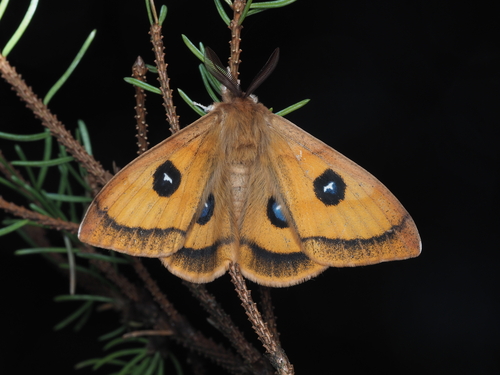
The closest relatives of the Giant Peacock Moth that you can see in Triglav National Park (family Saturniidae, Emperor and Giant Silk Moths) are Japanese Silk Moth (about 40%) and Tau Emperor Moth (about 20%), with each one's daily chance of a sighting.

Where does the Giant Peacock Moth sighting chance come from?

GBIF citizen-science records

It is estimated from how often the Giant Peacock Moth is recorded against all the insects logged in Triglav National Park (13 verified sightings from 2019 to 2026), calibrated against known sighting rates. Figures are rounded to the nearest 10% because citizen-science data supports honest approximations, not decimals, and months with records from fewer than five people show "—". How it works.

← Back to Triglav National Park