Wild Water Buffalo

Wild Water Buffalo

Bubalus arnee

Silhouette: Cristopher Silva · PhyloPic

LCNTVUENEndangeredCR
Daily sighting probability ~50% · Likely
at Udawalawe National Park

In 3 days ~90% in a week >90%

27 Verified sightings at Udawalawe National Park From 2019 to 2026
470 In all 7 parks
December Best month
🌅 Crepuscular When it's spotted

About the Wild Water Buffalo

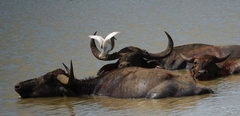
The wild water buffalo (Bubalus arnee), also called Asian buffalo, Asiatic buffalo and wild buffalo, is a large bovine native to the Indian subcontinent and Southeast Asia. It was first described in 1792. The wild water buffalo is the most likely ancestor of the domestic water buffalo. It has been listed as endangered on the IUCN Red List since 1986, as the global population totals less than 4,000 mature individuals.

Bos arnee was the scientific name proposed by Robert Kerr in 1792 who described a skull with horns of a buffalo zoological specimen from Bengal in northern India. Bubalus arnee was proposed by Charles Hamilton Smith in 1827 who introduced the generic name Bubalus for bovids with large heads, convex-shaped narrow foreheads, laterally bent flat horns, funnel-shaped ears, small dewlaps and slender tails.

Later authors subordinated the wild water buffalo under either Bos, Bubalus or Buffelus. In 2003, the International Commission on Zoological Nomenclature placed Bubalus arnee on the Official List of Specific Names in Zoology, recognizing the validity of this name for a wild species. Most authors have adopted the binomen Bubalus arnee for the wild water buffalo... Wikipedia →

Sounds

Recording0:17

India · 2024

© Ashwin A · iNaturalist · CC BY 4.0

Global Distribution

Parks Where Found

# Park Country Daily sighting probability
1 Kaziranga National Park 🇮🇳 India
~80%
2 Yala National Park 🇱🇰 Sri Lanka
~70%
3 Wilpattu National Park 🇱🇰 Sri Lanka
~70%
4 Manas National Park 🇮🇳 India
~50%
5 Udawalawe National Park 🇱🇰 Sri Lanka
~50%
6 Royal Manas National Park 🇧🇹 Bhutan
~30%
7 Minneriya National Park 🇱🇰 Sri Lanka
~10%

Zoos & Centres Where Found

# Zoo / Centre Country
1 Copenhagen Zoo 🇩🇰 Denmark In captivity
2 Port Lympne Wild Animal Park 🇬🇧 United Kingdom In captivity
3 Parc de l'Auxois 🇫🇷 France In captivity
4 Kathmandu Zoo 🇳🇵 Nepal In captivity
5 Iwate Safari Park 🇯🇵 Japan In captivity

Before you go

What are the chances of seeing a Wild Water Buffalo in Udawalawe National Park?

Likely

About 50% of wildlife watchers report a Wild Water Buffalo sighting in Udawalawe National Park on a given day, based on 27 verified sightings from GBIF citizen-science data from 2019 to 2026. It is the 7th most-seen of the 15 mammals we can rate there. Over three days the chance rises to about 90%, and over a week to over 90%, if each day is a fresh chance.

When is the best time to see a Wild Water Buffalo in Udawalawe National Park?

December

In that month about 80% of wildlife watchers report a Wild Water Buffalo in Udawalawe National Park on a given day, against under 5% in February, the lowest month.

What time of day is best to see a Wild Water Buffalo?

Between 8 and 11 am

Across all the parks we cover, that three-hour window holds the most Wild Water Buffalo sightings with a recorded time, and about 7 in 10 of them come between 6 am and 6 pm: it is most active around dawn and dusk.

Which relatives of the Wild Water Buffalo live in Udawalawe National Park?

Same order: Artiodactyla

The closest relatives of the Wild Water Buffalo that you can see in Udawalawe National Park (order Artiodactyla, Even-toed Ungulates and Cetaceans) are Axis Deer (about 80%), Wild Boar (about 30%) and Sambar (about 30%), with each one's daily chance of a sighting.

Where does the Wild Water Buffalo sighting chance come from?

GBIF citizen-science records

It is estimated from how often the Wild Water Buffalo is recorded against all the mammals logged in Udawalawe National Park (27 verified sightings from 2019 to 2026), calibrated against known sighting rates. Figures are rounded to the nearest 10% because citizen-science data supports honest approximations, not decimals, and months with records from fewer than five people show "—". How it works.

← Back to Udawalawe National Park