Atrato Glass Frog

Atrato Glass Frog

Hyalinobatrachium aureoguttatum

Silhouette: Jose Carlos Arenas-Monroy · PhyloPic

LCLeast ConcernNTVUENCR
Daily sighting probability ~40% · Likely
at Utría National Natural Park

In 3 days ~80% in a week >90%

7 Verified sightings at Utría National Natural Park From 2019 to 2026
7 In 1 park
November Best month
☀️🌙 Day & Night When it's spotted

About the Atrato Glass Frog

Hyalinobatrachium aureoguttatum, also known as the Atrato Glass Frog and Sun Glassfrog, is a species of frog in the family Centrolenidae. It is found in northern Ecuador (Esmeraldas and Imbabura Provinces), Pacific lowlands and western slopes of the Cordillera Occidental in Colombia, and eastern Panama (Darién Province). It occurs from near sea level to 1,560 m (5,120 ft) asl.

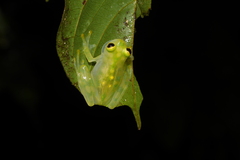
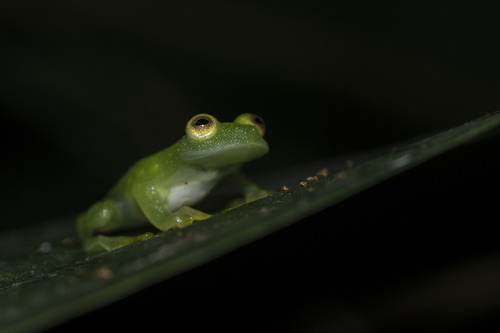
Males measure 20–24 mm (0.79–0.94 in) and females 23–24 mm (0.91–0.94 in) in snout–vent length. They are yellow-green dorsally, with numerous small brown and larger, more distinct creamy yellow spots. There is a diffuse green middorsal stripe. The ventral surface is transparent.

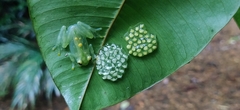
Males call from vegetation above streams. Clutch size is up to 35 eggs; eggs are green and encased in a gelatinous mass. Eggs are laid on the lower surface of leaves. After hatching the tadpoles fall into the stream below. Males appear sometimes to guard the eggs.

Natural habitats of Hyalinobatrachium aureoguttatum are lowland primary and secondary rainforests as well as sub-Andean forests (cloud forests). It occurs on vegetation next to streams. It is a very common species... Wikipedia →

Global Distribution

Parks Where Found

# Park Country Daily sighting probability
1 Utría National Natural Park 🇨🇴 Colombia
~40%

More parks will be added in future updates.

Zoos & Centres Where Found

# Zoo / Centre Country
1 Philadelphia Zoo 🇺🇸 United States In captivity

Before you go

What are the chances of seeing an Atrato Glass Frog in Utría National Natural Park?

Likely

About 40% of wildlife watchers report an Atrato Glass Frog sighting in Utría National Natural Park on a given day, based on 7 verified sightings from GBIF citizen-science data from 2019 to 2026. It is the 6th most-seen of the 9 amphibians we can rate there. Over three days the chance rises to about 80%, and over a week to over 90%, if each day is a fresh chance.

When is the best time to see an Atrato Glass Frog in Utría National Natural Park?

March and November

In those months about 60% of wildlife watchers report an Atrato Glass Frog in Utría National Natural Park on a given day, against about 10% in June–July, September–October and December–January, the lowest months. May has too few records to rate.

What time of day is best to see an Atrato Glass Frog?

Between 7 and 10 pm

Across all the parks we cover, that three-hour window holds the most Atrato Glass Frog sightings with a recorded time, and about 6 in 10 of them come between 6 pm and 6 am: it is seen both by day and at night.

Where else can you see an Atrato Glass Frog?

Only Utría National Natural Park, in our data

Utría National Natural Park is the only park on Wallace's Line with enough records to rate Atrato Glass Frog sightings: about 40% of wildlife watchers there report one on a given day.

Where does the Atrato Glass Frog sighting chance come from?

GBIF citizen-science records

It is estimated from how often the Atrato Glass Frog is recorded against all the amphibians logged in Utría National Natural Park (7 verified sightings from 2019 to 2026), calibrated against known sighting rates. Figures are rounded to the nearest 10% because citizen-science data supports honest approximations, not decimals, and months with records from fewer than five people show "—". How it works.

← Back to Utría National Natural Park