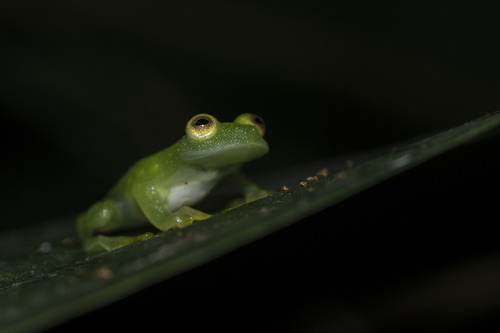
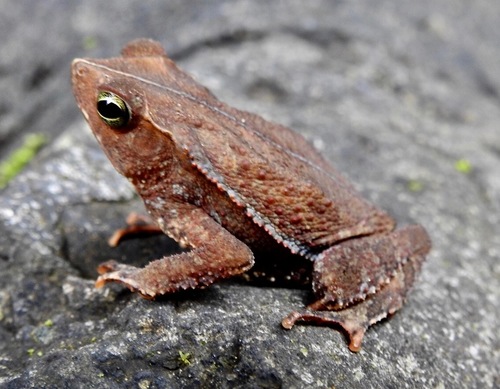
Fringe-Limbed Tree Frog

Fringe-Limbed Tree Frog

Cochranella euknemos

Silhouette: Dmitry Bogdanov (vectorized by T. Michael Keesey) · PhyloPic

LCLeast ConcernNTVUENCR
Daily sighting probability ~40% · Likely
at Utría National Natural Park

In 3 days ~80% in a week >90%

9 Verified sightings at Utría National Natural Park From 2019 to 2026
23 In all 2 parks
December Best month
🌅 Crepuscular When it's spotted

About the Fringe-Limbed Tree Frog

Cochranella euknemos, sometimes known as the San Jose Cochran frog, is a species of frog in the family Centrolenidae. It is found in central Costa Rica and south/eastward to Panama and to the western flank of the Cordillera Occidental in Colombia (Antioquia and Chocó Departments). Some Colombian records might apply to Cochranella mache.

Cochranella euknemos are small frogs, males growing to 25 mm (0.98 in) and females to 32 mm (1.3 in) in snout–vent length. They are dorsally blue-green and a little granular, with many small whitish or yellowish spots. Ventrally they are transparent white, but with more yellow on the undersides of the arms and legs. Iris is grayish ivory. Feet are moderately webbed.

In Costa Rica, males call in May–November. Egg masses are gelatinous and laid on the tips of leaves overhanging streams. The species' natural habitats are humid lowland, premontane, and montane forests. It occurs in bushes and trees along forest-covered streams. Its altitudinal range is 100–1,940 m (330–6,360 ft) asl in Colombia, somewhat narrower elsewhere.

Cochranella euknemos is generally threatened by deforestation in... Wikipedia →

Global Distribution

Parks Where Found

# Park Country Daily sighting probability
1 Utría National Natural Park 🇨🇴 Colombia
~40%
2 Soberanía National Park 🇵🇦 Panama
~10%

Zoos & Centres Where Found

# Zoo / Centre Country
1 El Nispero Zoo 🇵🇦 Panama In captivity

Before you go

What are the chances of seeing a Fringe-Limbed Tree Frog in Utría National Natural Park?

Likely

About 40% of wildlife watchers report a Fringe-Limbed Tree Frog sighting in Utría National Natural Park on a given day, based on 9 verified sightings from GBIF citizen-science data from 2019 to 2026. It is the 7th most-seen of the 9 amphibians we can rate there. Over three days the chance rises to about 80%, and over a week to over 90%, if each day is a fresh chance.

When is the best time to see a Fringe-Limbed Tree Frog in Utría National Natural Park?

April and December

In those months about 50% of wildlife watchers report a Fringe-Limbed Tree Frog in Utría National Natural Park on a given day, against about 10% in January, March, June–July and October, the lowest months. May has too few records to rate.

What time of day is best to see a Fringe-Limbed Tree Frog?

Between 5 and 8 pm

Across all the parks we cover, that three-hour window holds the most Fringe-Limbed Tree Frog sightings with a recorded time, and about 7 in 10 of them come between 6 pm and 6 am: it is most active around dawn and dusk.

Is Utría National Natural Park the best place to see a Fringe-Limbed Tree Frog?

Yes

Of the 2 parks where we can rate Fringe-Limbed Tree Frog sightings, Utría National Natural Park has the highest daily chance: about 40%. Next come Soberanía National Park (Panama, about 10%).

Which relatives of the Fringe-Limbed Tree Frog live in Utría National Natural Park?

Same family: Centrolenidae

The closest relatives of the Fringe-Limbed Tree Frog that you can see in Utría National Natural Park (family Centrolenidae, Glass Frogs) are Atrato Glass Frog (about 40%) and Tatayo's Glass Frog (about 20%), with each one's daily chance of a sighting.

Where does the Fringe-Limbed Tree Frog sighting chance come from?

GBIF citizen-science records

It is estimated from how often the Fringe-Limbed Tree Frog is recorded against all the amphibians logged in Utría National Natural Park (9 verified sightings from 2019 to 2026), calibrated against known sighting rates. Figures are rounded to the nearest 10% because citizen-science data supports honest approximations, not decimals, and months with records from fewer than five people show "—". How it works.

← Back to Utría National Natural Park