Chocó Poison Dart Frog

Chocó Poison Dart Frog

Oophaga solanensis

Silhouette: Steven Traver · PhyloPic

LCNTVUVulnerableENCR
Daily sighting probability ~60% · Likely
at Utría National Natural Park

In 3 days ~90% in a week >90%

115 Verified sightings at Utría National Natural Park From 2019 to 2026
115 In 1 park
June Best month
☀️ Diurnal When it's spotted

About the Chocó Poison Dart Frog

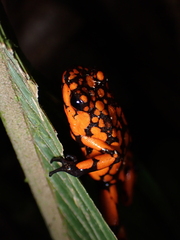
Oophaga solanensis, also known as the koe-koe, is a species of poison dart frog in the family Dendrobatidae. It was described by the herpetologists Andrés Posso-Terranova and Jose Andrés in 2018 and is named for the municipality of Bahía Solano, where it was first discovered. It is a large poison dart frog with an average snout–vent length of 36.2 ± 1.7 mm (1.425 ± 0.067 in). It has a dark black background color marked with variable orange or red spots and "bracelet"-like patterns on the limbs. Typically, there are four to five rounded or oval spots arranged in a line along the middle of the back, one or two spots on the sides, and sometimes another spot around the tympanum. There are bracelet-like bands on the upper and lower limbs, usually incomplete on the underside. The throat and chest have several spots. The fingers and toe tips are black and the skin is smooth.

The species is endemic to northwestern Colombia, where it is known from the western banks of the Atrato and San Juan rivers to the Pacific coast. It inhabits dense tropical rainforest throughout its range at elevations of 0 to 420 m (0 to 1,378 ft). Oophaga solanensis is classified as being vulnerable on the IUCN Red List due to its small range and an ongoing decline in its population due to wildlife trafficking and habitat degradation. The species' habitat was historically inaccessible and protected due to the Colombian conflict, but the end of the conflict has increased the species' vulnerability to trafficking and habitat loss. Measures that have been suggested to protect the species include adding the species to Appendix I of CITES, establishing ex situ populations, additional research on threats and distribution, and better regulation of trade of the species. Wikipedia →

Sounds

Recording0:11

Colombia · 2025

© Mailer Mosquera · iNaturalist · CC BY-NC 4.0

Global Distribution

Parks Where Found

# Park Country Daily sighting probability
1 Utría National Natural Park 🇨🇴 Colombia
~60%

More parks will be added in future updates.

Before you go

What are the chances of seeing a Chocó Poison Dart Frog in Utría National Natural Park?

Likely

About 60% of wildlife watchers report a Chocó Poison Dart Frog sighting in Utría National Natural Park on a given day, based on 115 verified sightings from GBIF citizen-science data from 2019 to 2026. It is the 2nd most-seen of the 9 amphibians we can rate there. Over three days the chance rises to about 90%, and over a week to over 90%, if each day is a fresh chance.

When is the best time to see a Chocó Poison Dart Frog in Utría National Natural Park?

February, April, June, August–September and December

In those months about 70% of wildlife watchers report a Chocó Poison Dart Frog in Utría National Natural Park on a given day, against about 50% in January, March, July and October–November, the lowest months.

What time of day is best to see a Chocó Poison Dart Frog?

Between 9 am and noon

Across all the parks we cover, that three-hour window holds the most Chocó Poison Dart Frog sightings with a recorded time, and about 7 in 10 of them come between 6 am and 6 pm: it is a daytime animal.

Where else can you see a Chocó Poison Dart Frog?

Only Utría National Natural Park, in our data

Utría National Natural Park is the only park on Wallace's Line with enough records to rate Chocó Poison Dart Frog sightings: about 60% of wildlife watchers there report one on a given day.

Where does the Chocó Poison Dart Frog sighting chance come from?

GBIF citizen-science records

It is estimated from how often the Chocó Poison Dart Frog is recorded against all the amphibians logged in Utría National Natural Park (115 verified sightings from 2019 to 2026), calibrated against known sighting rates. Figures are rounded to the nearest 10% because citizen-science data supports honest approximations, not decimals, and months with records from fewer than five people show "—". How it works.

← Back to Utría National Natural Park