Yellow-bellied Poison Frog

Yellow-bellied Poison Frog

Andinobates fulguritus

Silhouette: Steven Traver · PhyloPic

LCLeast ConcernNTVUENCR
Daily sighting probability ~40% · Likely
at Utría National Natural Park

In 3 days ~80% in a week >90%

10 Verified sightings at Utría National Natural Park From 2019 to 2026
10 In 1 park
February Best month
☀️ Diurnal When it's spotted

About the Yellow-bellied Poison Frog

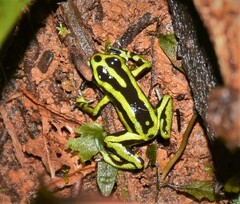
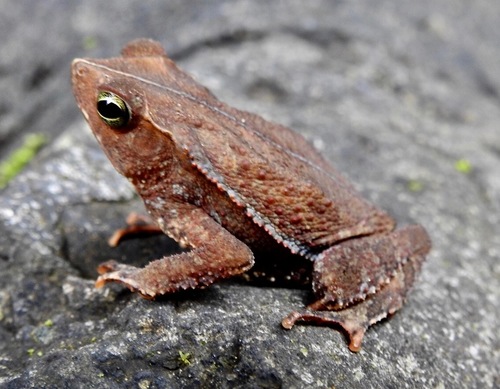
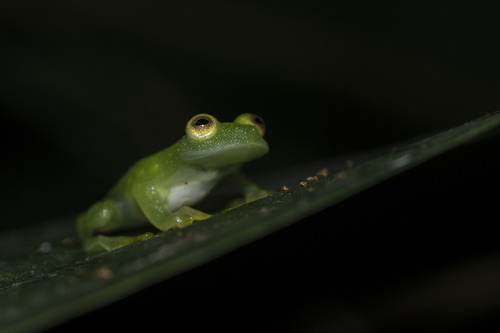
The yellow-bellied poison frog, yellow-bellied poison-arrow frog, or yellowbelly poison frog (Andinobates fulguritus) is a species of frog in the family Dendrobatidae. It is found in northwestern Colombia (Chocó Department and the westernmost Antioquia and Risaralda) and east-central Panama.

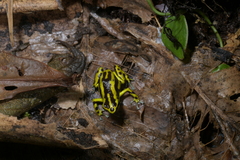
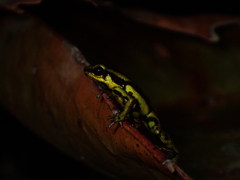
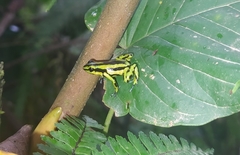
Males measure 13.5–15 mm (0.53–0.59 in) and females 14–16.5 mm (0.55–0.65 in) in snout–vent length. The dorsum is black with gold, yellow, or yellow-green dorso-lateral and lateral stripes (only the former are complete). On the anterior part of the dorsum there is an incomplete median stripe. The venter is gold or yellow and has black marbling or spots. The skin is slightly granular on the dorsum and moderately granular on the venter. The tympanum is round and has its postero-dorsal part concealed. The iris is black. Both fingers and toes lack fringes and webbing.

The frog's Latin name, fulguritus, means "struck by lightning." The male frog identifies a suitable egg deposition site and leads the female frog to it. He deposits his sperm first and she lays her eggs on top of it. The eggs are deposited in leaf-litter. The male frog returns to the... Wikipedia →

Global Distribution

Parks Where Found

# Park Country Daily sighting probability
1 Utría National Natural Park 🇨🇴 Colombia
~40%

More parks will be added in future updates.

Before you go

What are the chances of seeing a Yellow-bellied Poison Frog in Utría National Natural Park?

Likely

About 40% of wildlife watchers report a Yellow-bellied Poison Frog sighting in Utría National Natural Park on a given day, based on 10 verified sightings from GBIF citizen-science data from 2019 to 2026. It is the 4th most-seen of the 9 amphibians we can rate there. Over three days the chance rises to about 80%, and over a week to over 90%, if each day is a fresh chance.

When is the best time to see a Yellow-bellied Poison Frog in Utría National Natural Park?

February

In that month about 70% of wildlife watchers report a Yellow-bellied Poison Frog in Utría National Natural Park on a given day, against about 10% in April, July–September and December–January, the lowest months. That is one of Utría National Natural Park's driest months, with about 270 mm of rain against 710 mm in October. May has too few records to rate.

What time of day is best to see a Yellow-bellied Poison Frog?

Between 9 am and noon

Across all the parks we cover, that three-hour window holds the most Yellow-bellied Poison Frog sightings with a recorded time, and about 8 in 10 of them come between 6 am and 6 pm: it is a daytime animal.

Where else can you see a Yellow-bellied Poison Frog?

Only Utría National Natural Park, in our data

Utría National Natural Park is the only park on Wallace's Line with enough records to rate Yellow-bellied Poison Frog sightings: about 40% of wildlife watchers there report one on a given day.

Where does the Yellow-bellied Poison Frog sighting chance come from?

GBIF citizen-science records

It is estimated from how often the Yellow-bellied Poison Frog is recorded against all the amphibians logged in Utría National Natural Park (10 verified sightings from 2019 to 2026), calibrated against known sighting rates. Figures are rounded to the nearest 10% because citizen-science data supports honest approximations, not decimals, and months with records from fewer than five people show "—". How it works.

← Back to Utría National Natural Park