
Condoto Stubfoot Toad

Condoto Stubfoot Toad

Atelopus spurrelli

Silhouette: Michael Scroggie, from original photograph by Gary M. Stolz, USFWS (original photograph in public domain). · PhyloPic

LCNTNear ThreatenedVUENCR Endemic
Daily sighting probability ~70% · Very likely
at Utría National Natural Park

In 3 days >90%

106 Verified sightings at Utría National Natural Park From 2019 to 2026
106 In 1 park
April Best month
☀️ Diurnal When it's spotted

About the Condoto Stubfoot Toad

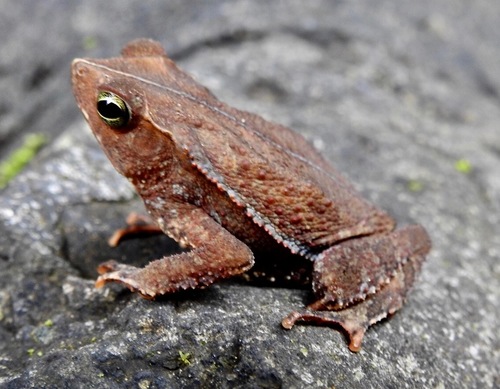
Atelopus spurrelli is a species of toad in the family Bufonidae. It is endemic to Colombia and occurs in the Pacific lowlands and foothills of the Cordillera Occidental. The specific name spurrelli honors Herbert George Flaxman Spurrell, a British physician and zoologist. Common name Condoto stubfoot toad has been coined for this species.

Male Atelopus spurrelli grow to a snout–vent length of 26 mm (1.0 in) and females to 34 mm (1.3 in). The body is elongated. The head is as long as it is wide. Skin is smooth to finely granular. The dorsum dark brown to black and has irregular yellow to olive green spots. The belly uniformly cream to white with small brown spots.

Skin of Atelopus spurrelli contains tetrodotoxin, although less than Atelopus spumarius and A. varius. Atelopus spurrelli occurs in primary and secondary tropical humid forest at elevations of 50–900 m (160–2,950 ft) above sea level. It lives in leaf-litter near water, and presumably breeds in streams. It can be locally common, but has also declined or disappeared from many sites where chytridiomycosis has been reported. It can also be locally threatened by deforestation caused... Wikipedia →

Global Distribution

Parks Where Found

# Park Country Daily sighting probability
1 Utría National Natural Park 🇨🇴 Colombia
~70%

More parks will be added in future updates.

Before you go

What are the chances of seeing a Condoto Stubfoot Toad in Utría National Natural Park?

Very likely

About 70% of wildlife watchers report a Condoto Stubfoot Toad sighting in Utría National Natural Park on a given day, based on 106 verified sightings from GBIF citizen-science data from 2019 to 2026. It is the most-seen of the 9 amphibians we can rate there. Over three days the chance rises to over 90%, if each day is a fresh chance.

When is the best time to see a Condoto Stubfoot Toad in Utría National Natural Park?

March–April and June

In those months about 80% of wildlife watchers report a Condoto Stubfoot Toad in Utría National Natural Park on a given day, against about 20% in July and October, the lowest months. May has too few records to rate.

What time of day is best to see a Condoto Stubfoot Toad?

Between 8 and 11 am

Across all the parks we cover, that three-hour window holds the most Condoto Stubfoot Toad sightings with a recorded time, and about 7 in 10 of them come between 6 am and 6 pm: it is a daytime animal.

Where else can you see a Condoto Stubfoot Toad?

Only Utría National Natural Park, in our data

Utría National Natural Park is the only park on Wallace's Line with enough records to rate Condoto Stubfoot Toad sightings: about 70% of wildlife watchers there report one on a given day.

Where does the Condoto Stubfoot Toad sighting chance come from?

GBIF citizen-science records

It is estimated from how often the Condoto Stubfoot Toad is recorded against all the amphibians logged in Utría National Natural Park (106 verified sightings from 2019 to 2026), calibrated against known sighting rates. Figures are rounded to the nearest 10% because citizen-science data supports honest approximations, not decimals, and months with records from fewer than five people show "—". How it works.

← Back to Utría National Natural Park