Band-rumped Swift

Band-rumped Swift

Chaetura spinicaudus

Silhouette: Aviceda (vectorized by T. Michael Keesey) · PhyloPic

LCLeast ConcernNTVUENCR
Daily sighting probability ~10% · With luck
at Utría National Natural Park

In 3 days ~40% in a week ~70%

14 Verified sightings at Utría National Natural Park From 2019 to 2026
2,907 In all 10 parks
February Best month
☀️ Diurnal When it's spotted

About the Band-rumped Swift

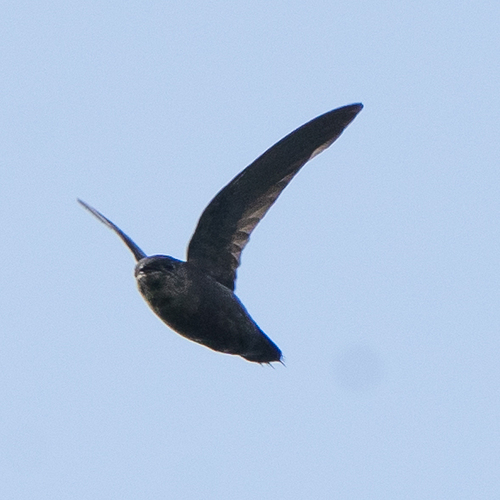
The band-rumped swift (Chaetura spinicaudus) is a species of bird in subfamily Apodinae of the swift family Apodidae. It is found from Panama south through Colombia into Ecuador, east from Venezuela into the Guianas and Brazil, and on Trinidad.

The band-rumped swift, pale-rumped swift (C. egregia), grey-rumped swift (C. cinereiventris), and Lesser Antillean swift (C. martinica) were at one time placed in genus Acanthylis. During much of the 20th century the Costa Rican swift (C. fumosa) was treated as a subspecies of the band-rumped. Other subspecies have been proposed but not accepted.

The band-rumped swift is 10.5 to 12.6 cm (4.1 to 5.0 in) long and weighs 13.8 to 18.5 g (0.49 to 0.65 oz). It has a protruding head, a short square tail, and wings that bulge in the middle and somewhat hook at the end. The sexes are alike. Adults of the nominate subspecies have black-brown upperparts with a white band on the rump. Their underparts are dark with a slightly paler throat. Juveniles have white tips on some wing feathers... Wikipedia →
Sounds

Flight call1:01

French Guiana · 2010

© Alexandre Renaudier · XC64024 · CC BY-NC-ND 2.5

Call0:30

Brazil · 2018

© Dante Buzzetti · XC613875 · CC BY-NC-SA 4.0

Song0:34

Venezuela · 2006

© Nathan Pieplow · XC11647 · CC BY-NC-ND 2.5

Global Distribution

Parks Where Found

# Park Country Daily sighting probability
1 Brownsberg Nature Park 🇸🇷 Suriname
~40%
2 Soberanía National Park 🇵🇦 Panama
~20%
3 Utría National Natural Park 🇨🇴 Colombia
~10%
4 Darién National Park 🇵🇦 Panama
~10%
5 San Lorenzo Protected Forest 🇵🇦 Panama
~10%
6 Anavilhanas National Park 🇧🇷 Brazil
~10%
7 Chagres National Park 🇵🇦 Panama
<5%
8 Tayrona National Natural Park 🇨🇴 Colombia
<5%
9 Caroni Swamp 🇹🇹 Trinidad and Tobago
<5%
10 Parque Natural Metropolitano 🇵🇦 Panama
<5%

Cities Where Found

# City Country Daily sighting probability
1 Panama City 🇵🇦 Panama
<5%

Before you go

What are the chances of seeing a Band-rumped Swift in Utría National Natural Park?

With luck

About 10% of wildlife watchers report a Band-rumped Swift sighting in Utría National Natural Park on a given day, based on 14 verified sightings from GBIF citizen-science data from 2019 to 2026. It is the 68th most-seen of the 154 birds we can rate there. Over three days the chance rises to about 40%, and over a week to about 70%, if each day is a fresh chance.

When is the best time to see a Band-rumped Swift in Utría National Natural Park?

January and February

In those months about 30% of wildlife watchers report a Band-rumped Swift in Utría National Natural Park on a given day, against about 10% in March, May, July and September–November, the lowest months. Those are among Utría National Natural Park's driest months, with about 310 mm of rain a month against 710 mm in October. April, June and December have too few records to rate.

What time of day is best to see a Band-rumped Swift?

Between 2 and 5 pm

Across all the parks we cover, that three-hour window holds the most Band-rumped Swift sightings with a recorded time, and about 8 in 10 of them come between 6 am and 6 pm: it is a daytime animal.

Is Utría National Natural Park the best place to see a Band-rumped Swift?

3rd of 10

Of the 10 parks where we can rate Band-rumped Swift sightings, Utría National Natural Park ranks 3rd at about 10%. The best odds are in Brownsberg Nature Park (Suriname, about 40%) and Soberanía National Park (Panama, about 20%).

Where does the Band-rumped Swift sighting chance come from?

GBIF citizen-science records

It is estimated from how often the Band-rumped Swift is recorded against all the birds logged in Utría National Natural Park (14 verified sightings from 2019 to 2026), calibrated against known sighting rates. Figures are rounded to the nearest 10% because citizen-science data supports honest approximations, not decimals, and months with records from fewer than five people show "—". How it works.

← Back to Utría National Natural Park
