Iron Prominent

Iron Prominent

Notodonta dromedarius

Daily sighting probability ~10% · With luck
at Vanoise National Park

In 3 days ~30% in a week ~50%

6 Verified sightings at Vanoise National Park From 2019 to 2026
117 In all 7 parks
October Best month
☀️🌙 Day & Night When it's spotted

About the Iron Prominent

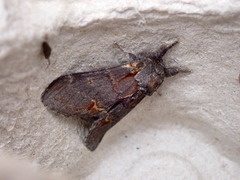
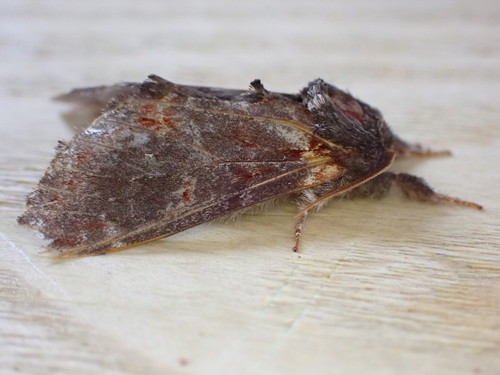
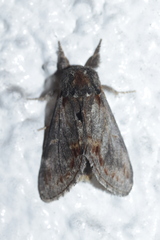
Notodonta dromedarius, the iron prominent, is a moth of the family Notodontidae. The species was first described by Carl Linnaeus in 1767. It is found in Europe and Anatolia. The wingspan is 35–40 mm. Notodonta dromedarius has grey or dark brown forewings with rusty and yellowish stains. A broken rust-brown band runs along the outside edge of the forewing. There is a small discal spot, a postmedial crossline which is often broken and outer margins which are suffused dark red. The hindwings are usually pale grey-brown with dark veining. The colouring is very variable and very dark specimens are found.

Description in Seitz-Forewing pale brownish grey to dark drome- grey-brown, with light-edged dark brown pre- and postdiscal dentate bands, the dark discal spot likewise pale-. edged; marginal area more or less distinctly rust -brown around a dark longitudinal streak, the rather broad submarginal band also bright rust-brown. Hindwing grey-brown or predominantly grey. In specimens whose ground-colour is faded on account of age or is not properly developed, the bright markings are very prominent. On the other hand, quite fresh specimens are almost uniformly black-brown... Wikipedia →

Global Distribution

Parks Where Found

# Park Country Daily sighting probability
1 Vanoise National Park 🇫🇷 France
~10%
2 Snowdonia National Park 🇬🇧 United Kingdom
~10%
3 Wadden Sea National Park 🇩🇪 Germany
~10%
4 Bavarian Forest National Park 🇩🇪 Germany
~10%
5 Pyrénées National Park 🇫🇷 France
~10%
6 Cairngorms National Park 🇬🇧 United Kingdom
~10%
7 Cévennes National Park 🇫🇷 France
<5%

Cities Where Found

# City Country Daily sighting probability
1 Liverpool 🇬🇧 United Kingdom
~10%
2 Essen 🇩🇪 Germany
~10%
3 Manchester 🇬🇧 United Kingdom
~10%
4 Birmingham 🇬🇧 United Kingdom
~10%
5 London 🇬🇧 United Kingdom
<5%
6 Moscow 🇷🇺 Russia
<5%

Before you go

What are the chances of seeing an Iron Prominent in Vanoise National Park?

With luck

About 10% of wildlife watchers report an Iron Prominent sighting in Vanoise National Park on a given day, based on 6 verified sightings from GBIF citizen-science data from 2019 to 2026. It is the 220th most-seen of the 308 insects we can rate there. Over three days the chance rises to about 30%, and over a week to about 50%, if each day is a fresh chance.

When is the best time to see an Iron Prominent in Vanoise National Park?

October

In that month about 40% of wildlife watchers report an Iron Prominent in Vanoise National Park on a given day, against under 5% in August and November–June, the lowest months.

What time of day is best to see an Iron Prominent?

Between 10 pm and 1 am

Across all the parks we cover, that three-hour window holds the most Iron Prominent sightings with a recorded time, and about 6 in 10 of them come between 6 pm and 6 am: it is seen both by day and at night.

Is Vanoise National Park the best place to see an Iron Prominent?

Yes

Of the 7 parks where we can rate Iron Prominent sightings, Vanoise National Park has the highest daily chance: about 10%. Next come Snowdonia National Park (United Kingdom, about 10%) and Wadden Sea National Park (Germany, about 10%).

Which relatives of the Iron Prominent live in Vanoise National Park?

Same order: Lepidoptera

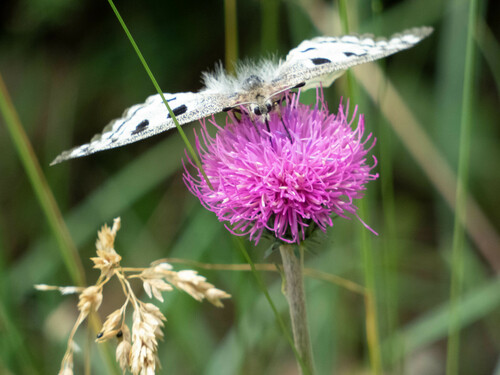
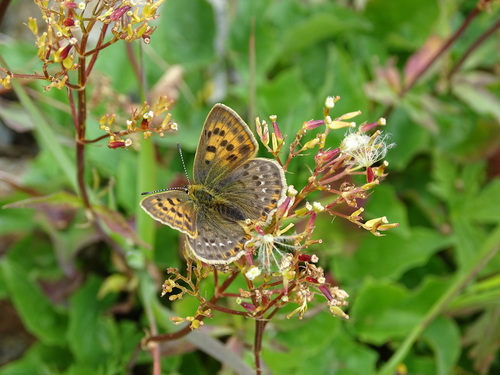
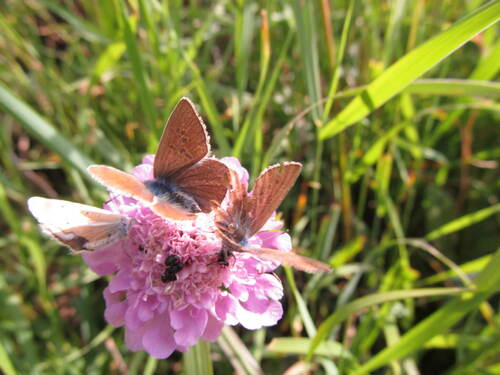
The closest relatives of the Iron Prominent that you can see in Vanoise National Park (order Lepidoptera, Butterflies and Moths) are Apollo (about 50%), Scarce Copper (about 40%) and Damon Blue (about 40%), with each one's daily chance of a sighting.

Where does the Iron Prominent sighting chance come from?

GBIF citizen-science records

It is estimated from how often the Iron Prominent is recorded against all the insects logged in Vanoise National Park (6 verified sightings from 2019 to 2026), calibrated against known sighting rates. Figures are rounded to the nearest 10% because citizen-science data supports honest approximations, not decimals, and months with records from fewer than five people show "—". How it works.
← Back to Vanoise National Park