
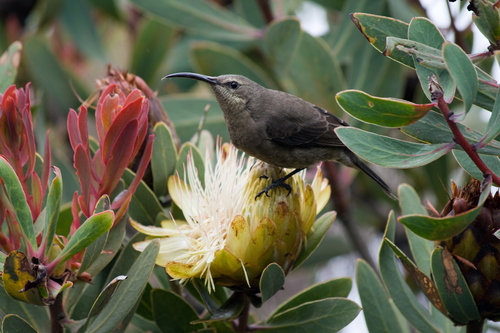
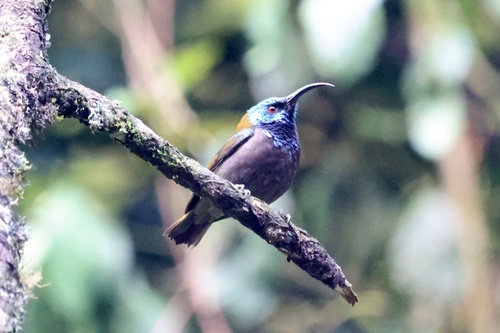
Bronze Sunbird

Bronze Sunbird

Nectarinia kilimensis

Silhouette: Sheatherius · PhyloPic

LCLeast ConcernNTVUENCR
Daily sighting probability ~20% · Possible
at Virunga National Park

In 3 days ~50% in a week ~80%

86 Verified sightings at Virunga National Park From 2019 to 2026
3,406 In all 18 parks
December Best month
☀️ Diurnal When it's spotted

About the Bronze Sunbird

The bronze sunbird (Nectarinia kilimensis) is a species of bird in the family Nectariniidae. It is native to the Bié Plateau (Angola) and eastern Afromontane forests. Bronze sunbirds have a long, thin, well-curved bill. Males have bronze-and-green undertones but most often look black in light. While the male has the undertones, the female however has a pale eyebrow and an added yellowish park below the belly with fine streaking. On some subspecies specifically located in Angola there is a splash of odd green, but it does not overlap in range with malachite or scarlet-tufted sunbirds in similar areas which do not have this green streaking. Male sunbirds lack any purple tones to the plumage which is found on female species.

Bronze sunbirds use a jumble of twittering notes followed by cleaner whistle sounds. These sounds are most often heard during the early morning and mid day. The bronze sunbird can be found in Africa. While not very common they can be best found near the edges of the Afromontane forest, mountain sides and Zimbabwe's eastern highlands and adjacent next to Mozambique. Other countries they can be found... Wikipedia →

Sounds

Dawn song0:35

Kenya · 2026

© Ding Li Yong · XC1180776 · CC BY-NC-ND 4.0

Song0:21

Zimbabwe · 2024

© Dries Van de Loock · XC963297 · CC BY-NC-ND 4.0

Call0:52

Kenya · 2021

© isaac kilusu · XC622850 · CC BY-NC-SA 4.0

Global Distribution

Parks Where Found

# Park Country Daily sighting probability
1 Volcanoes National Park 🇷🇼 Rwanda
~50%
2 Arusha National Park 🇹🇿 Tanzania
~50%
3 Kibale National Park 🇺🇬 Uganda
~40%
4 Bwindi Impenetrable National Park 🇺🇬 Uganda
~30%
5 Nairobi National Park 🇰🇪 Kenya
~30%
6 Virunga National Park 🇨🇩 Democratic Republic of the Congo
~20%
7 Aberdare National Park 🇰🇪 Kenya
~20%
8 Ngorongoro Conservation Area 🇹🇿 Tanzania
~20%
9 Lake Nakuru National Park 🇰🇪 Kenya
~10%
10 Queen Elizabeth National Park 🇺🇬 Uganda
~10%
11 Nyungwe National Park 🇷🇼 Rwanda
~10%
12 Akagera National Park 🇷🇼 Rwanda
<5%
13 Masai Mara National Reserve 🇰🇪 Kenya
<5%
14 Lake Mburo National Park 🇺🇬 Uganda
<5%
15 Lake Manyara National Park 🇹🇿 Tanzania
<5%
16 Serengeti National Park 🇹🇿 Tanzania
<5%
17 Samburu National Reserve 🇰🇪 Kenya
<5%
18 Tarangire National Park 🇹🇿 Tanzania
<5%

Cities Where Found

# City Country Daily sighting probability
1 Nairobi 🇰🇪 Kenya
~50%
2 Kigali 🇷🇼 Rwanda
~40%
3 Kampala 🇺🇬 Uganda
<5%

Before you go

What are the chances of seeing a Bronze Sunbird in Virunga National Park?

Possible

About 20% of wildlife watchers report a Bronze Sunbird sighting in Virunga National Park on a given day, based on 86 verified sightings from GBIF citizen-science data from 2019 to 2026. It is the 38th most-seen of the 316 birds we can rate there. Over three days the chance rises to about 50%, and over a week to about 80%, if each day is a fresh chance.

When is the best time to see a Bronze Sunbird in Virunga National Park?

December

In that month about 50% of wildlife watchers report a Bronze Sunbird in Virunga National Park on a given day, against about 10% in February–May, August–September and November, the lowest months. That is one of Virunga National Park's driest months, with about 80 mm of rain against 250 mm in May.

What time of day is best to see a Bronze Sunbird?

Between 3 and 6 pm

Across all the parks we cover, that three-hour window holds the most Bronze Sunbird sightings with a recorded time, and about 8 in 10 of them come between 6 am and 6 pm: it is a daytime animal.

Where does the Bronze Sunbird sighting chance come from?

GBIF citizen-science records

It is estimated from how often the Bronze Sunbird is recorded against all the birds logged in Virunga National Park (86 verified sightings from 2019 to 2026), calibrated against known sighting rates. Figures are rounded to the nearest 10% because citizen-science data supports honest approximations, not decimals, and months with records from fewer than five people show "—". How it works.

← Back to Virunga National Park