Flame-throated Warbler

Flame-throated Warbler

Oreothlypis gutturalis

Silhouette: Andy Wilson · PhyloPic

LCLeast ConcernNTVUENCR
Daily sighting probability ~40% · Likely
at Volcán Barú National Park

In 3 days ~80% in a week >90%

739 Verified sightings at Volcán Barú National Park From 2019 to 2026
9,574 In all 9 parks
August Best month
☀️ Diurnal When it's spotted

About the Flame-throated Warbler

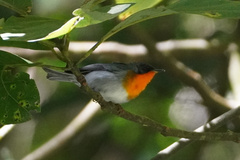
The flame-throated warbler (Oreothlypis gutturalis) is a small New World warbler. It is sometimes placed in the genera Vermivora and Parula. The adult flame-throated warbler is 12 cm (4.7 in) long and weighs 10 g (0.35 oz). It has slate grey upper parts, with black on the back, lores, and around the eye. It has a vermilion throat and breast which contrast with the whitish belly. The sexes are almost identical, but the black mask is more extensive in the male. The young bird is browner above, duller below, and has a weak buff eyestripe and wing bars.

The call of this warbler is a sharp chit. The song is a buzzing pi pipipipi shwaaaa. This species is a resident breeder within the Talamancan montane forests of Costa Rica and western Panama, where it occurs in the canopy, woodland edges, and clearings with trees typically from 2,100 m (6,900 ft) up to the timberline. On the Caribbean slope in the wet season it may occur down to as low as 1,400 m (4,600 ft).

The deep cup nest, always sheltered above by epiphytes or mosses, is built in a tree or on a low bank. Two white eggs are laid between March and May. The flame-throated... Wikipedia →

Sounds

Song0:52

Costa Rica · 2019

© Hans Matheve · XC518276 · CC BY-NC-ND 4.0

Call0:36

Costa Rica · 2019

© Brendan Sloan · XC484941 · CC BY-NC-ND 4.0

Begging call0:13

Costa Rica · 1992

© Allen T. Chartier · XC8921 · CC BY-NC-SA 3.0

Global Distribution

Parks Where Found

# Park Country Daily sighting probability
1 Irazú Volcano National Park 🇨🇷 Costa Rica
~60%
2 Los Quetzales National Park 🇨🇷 Costa Rica
~40%
3 Volcán Barú National Park 🇵🇦 Panama
~40%
4 Tapantí-Macizo de la Muerte National Park 🇨🇷 Costa Rica
~20%
5 La Amistad International Park (Panama) 🇵🇦 Panama
~10%
6 Chirripó National Park 🇨🇷 Costa Rica
~10%
7 Braulio Carrillo National Park 🇨🇷 Costa Rica
~10%
8 Poás Volcano National Park 🇨🇷 Costa Rica
~10%
9 Monteverde Cloud Forest Reserve 🇨🇷 Costa Rica
<5%

Cities Where Found

# City Country Daily sighting probability
1 San José 🇨🇷 Costa Rica
<5%

Before you go

What are the chances of seeing a Flame-throated Warbler in Volcán Barú National Park?

Likely

About 40% of wildlife watchers report a Flame-throated Warbler sighting in Volcán Barú National Park on a given day, based on 739 verified sightings from GBIF citizen-science data from 2019 to 2026. It is the 28th most-seen of the 296 birds we can rate there. Over three days the chance rises to about 80%, and over a week to over 90%, if each day is a fresh chance.

When is the best time to see a Flame-throated Warbler in Volcán Barú National Park?

August and September

In those months about 50% of wildlife watchers report a Flame-throated Warbler in Volcán Barú National Park on a given day, against about 30% in April and July, the lowest months.

What time of day is best to see a Flame-throated Warbler?

Between 9 am and noon

Across all the parks we cover, that three-hour window holds the most Flame-throated Warbler sightings with a recorded time, and about 9 in 10 of them come between 6 am and 6 pm: it is a daytime animal.

Which relatives of the Flame-throated Warbler live in Volcán Barú National Park?

Same family: Parulidae

The closest relatives of the Flame-throated Warbler that you can see in Volcán Barú National Park (family Parulidae, New World Warblers) are Slate-throated Redstart (about 60%), Wilson's Warbler (about 50%) and Black-cheeked Warbler (about 40%), with each one's daily chance of a sighting.

Where does the Flame-throated Warbler sighting chance come from?

GBIF citizen-science records

It is estimated from how often the Flame-throated Warbler is recorded against all the birds logged in Volcán Barú National Park (739 verified sightings from 2019 to 2026), calibrated against known sighting rates. Figures are rounded to the nearest 10% because citizen-science data supports honest approximations, not decimals, and months with records from fewer than five people show "—". How it works.

← Back to Volcán Barú National Park