Slaty Flowerpiercer

Slaty Flowerpiercer

Diglossa plumbea

Silhouette: Sheatherius · PhyloPic

LCLeast ConcernNTVUENCR
Daily sighting probability ~50% · Likely
at Volcán Barú National Park

In 3 days ~90% in a week >90%

1,245 Verified sightings at Volcán Barú National Park From 2019 to 2026
18,362 In all 10 parks
June Best month
☀️ Diurnal When it's spotted

About the Slaty Flowerpiercer

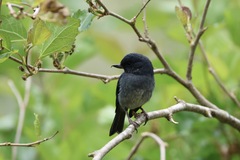
The slaty flowerpiercer (Diglossa plumbea) is a passerine bird endemic to the Talamancan montane forests. This is a common bird in mountain forest canopy and edges, and especially in sunlit clearings and areas with flowering shrubs, which can include gardens. The lower altitudinal limit of its breeding range increases from 1200 m in the north of Costa Rica to 1900 m in the southern mountains. It is found well above the timberline in páramo habitat.

The large cup nest, built by the female, is made of coarse plant material and lined with fine fibres. It is placed 0.4 to 4 m up in a dense shrub, grass tussock or pine. The clutch is two brown-speckled pale blue eggs, which are incubated by the female alone for 12–14 days to hatching.

The slaty flowerpiercer has an upturned bill with a hooked upper mandible and pointed lower mandible. It is 10 cm long and weighs 9 g. The adult male is blue-grey with a lead-grey throat and breast. The tail and wings are blackish with grey feather edges. The female is olive-brown above with a paler throat and breast shading to buff on the belly. Young birds are like the female but have two tawny wing bars and faintly streaked buff-yellow underparts.

The slaty flowerpiercer has a thin tsip call. The male's song consists of a mixture of whistles, warbles and trilled notes, see-chew see-chew see-chew seer seer surrzeep, tsee tsew tsink tsink tsink. As its name implies, the slaty flowerpiercer pierces the base of the flowers of shrubs and epiphytes with its bill and extracts the nectar through the hole with a brush-like tongue. It also feeds on tiny insects taken from foliage or in flight. It is attacked by territorial hummingbirds defending their feeding areas, and then retreats to dense cover. Wikipedia →

Sounds

Song0:19

Costa Rica · 2019

© MiriamEaglemon · XC500126 · CC BY-NC-SA 4.0

Call0:20

Costa Rica · 2011

© Andrew Spencer · XC71539 · CC BY-NC-ND 2.5

Song0:26

Costa Rica · 2016

© Frank Lambert · XC411303 · CC BY-NC-ND 4.0

Global Distribution

Parks Where Found

# Park Country Daily sighting probability
1 Irazú Volcano National Park 🇨🇷 Costa Rica
~80%
2 Los Quetzales National Park 🇨🇷 Costa Rica
~70%
3 Volcán Barú National Park 🇵🇦 Panama
~50%
4 Tapantí-Macizo de la Muerte National Park 🇨🇷 Costa Rica
~40%
5 Poás Volcano National Park 🇨🇷 Costa Rica
~20%
6 La Amistad International Park (Panama) 🇵🇦 Panama
~20%
7 Braulio Carrillo National Park 🇨🇷 Costa Rica
~10%
8 Chirripó National Park 🇨🇷 Costa Rica
<5%
9 Monteverde Cloud Forest Reserve 🇨🇷 Costa Rica
<5%
10 Arenal Volcano National Park 🇨🇷 Costa Rica
<5%

Before you go

What are the chances of seeing a Slaty Flowerpiercer in Volcán Barú National Park?

Likely

About 50% of wildlife watchers report a Slaty Flowerpiercer sighting in Volcán Barú National Park on a given day, based on 1,245 verified sightings from GBIF citizen-science data from 2019 to 2026. It is the 9th most-seen of the 296 birds we can rate there. Over three days the chance rises to about 90%, and over a week to over 90%, if each day is a fresh chance.

When is the best time to see a Slaty Flowerpiercer in Volcán Barú National Park?

February–March, June and November

In those months about 60% of wildlife watchers report a Slaty Flowerpiercer in Volcán Barú National Park on a given day, against about 30% in October, the lowest month.

What time of day is best to see a Slaty Flowerpiercer?

Between 10 am and 1 pm

Across all the parks we cover, that three-hour window holds the most Slaty Flowerpiercer sightings with a recorded time, and about 9 in 10 of them come between 6 am and 6 pm: it is a daytime animal.

Which relatives of the Slaty Flowerpiercer live in Volcán Barú National Park?

Same family: Thraupidae

The closest relatives of the Slaty Flowerpiercer that you can see in Volcán Barú National Park (family Thraupidae, Tanagers and Allies) are Silver-throated Tanager (about 50%), Yellow-faced Grassquit (about 50%) and Blue-gray Tanager (about 40%), with each one's daily chance of a sighting.

Where does the Slaty Flowerpiercer sighting chance come from?

GBIF citizen-science records

It is estimated from how often the Slaty Flowerpiercer is recorded against all the birds logged in Volcán Barú National Park (1,245 verified sightings from 2019 to 2026), calibrated against known sighting rates. Figures are rounded to the nearest 10% because citizen-science data supports honest approximations, not decimals, and months with records from fewer than five people show "—". How it works.

← Back to Volcán Barú National Park