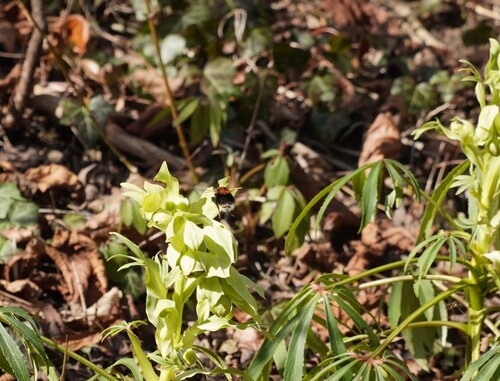
Oak Artichoke Gall Wasp

Oak Artichoke Gall Wasp

Andricus foecundatrix

Daily sighting probability <5% · Rare
at Wadden Sea National Park

In 3 days ~10% in a week ~30%

14 Verified sightings at Wadden Sea National Park From 2019 to 2026
62 In all 4 parks
August Best month
☀️ Diurnal When it's spotted

About the Oak Artichoke Gall Wasp

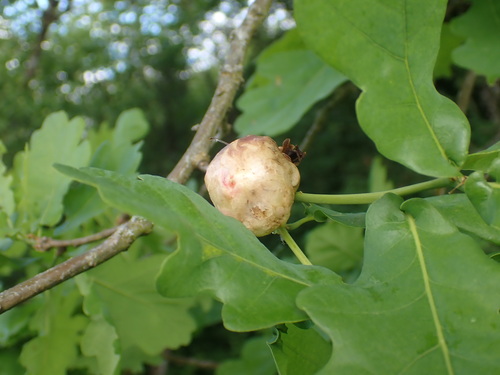
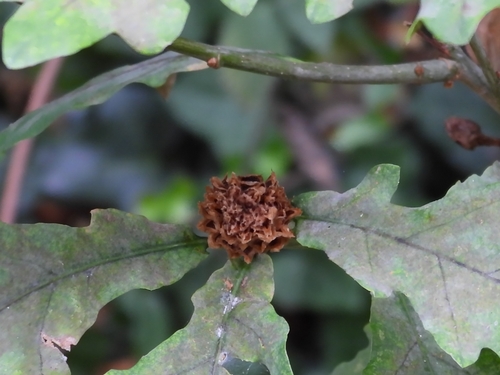
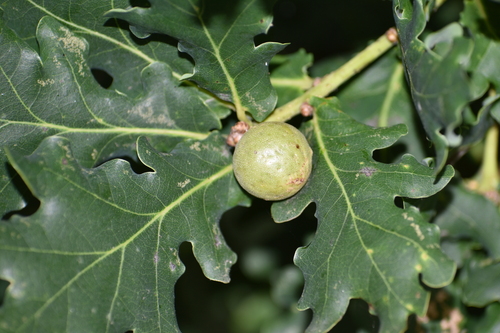
Andricus foecundatrix (formerly Andricus fecundator) is a parthenogenetic gall wasp which lays a single egg within a leaf bud, using its ovipositor, to produce a gall known as an oak artichoke gall, oak hop gall, larch-cone gall or hop strobile. The gall develops as a chemically induced distortion of leaf axillary or terminal buds on pedunculate oak (Quercus robur) or sessile oak (Quercus petraea) trees. The larva lives inside a smaller hard casing inside the artichoke and this is released in autumn. The asexual wasp emerges in spring and lays her eggs in the oak catkins. These develop into small oval galls which produce the sexual generation of wasps. A yew artichoke gall caused by the fly Taxomyia taxi also exists, but is unrelated to the oak-borne species. Previous names or synonyms for the species A. fecundator are A. fecundatrix, A. pilosus, A. foecundatrix (see below), A. gemmarum, A. gemmae, A. gemmaequercus, A. gemmaecinaraeformis and A. quercusgemmae.

The scientific name is now once again Andricus foecundatrix. Young galls exhibit a tuft of long hairs protruding from the centre of the 'artichoke', the remainder being overlapping scales. The hairs are attached to... Wikipedia →
Global Distribution

Parks Where Found

# Park Country Daily sighting probability
1 Snowdonia National Park 🇬🇧 United Kingdom
~10%
2 Bavarian Forest National Park 🇩🇪 Germany
~10%
3 Sierra de Guadarrama National Park 🇪🇸 Spain
<5%
4 Wadden Sea National Park 🇩🇪 Germany
<5%

Cities Where Found

# City Country Daily sighting probability
1 Liverpool 🇬🇧 United Kingdom
~10%
2 Manchester 🇬🇧 United Kingdom
~10%
3 Birmingham 🇬🇧 United Kingdom
~10%
4 London 🇬🇧 United Kingdom
~10%
5 Leeds 🇬🇧 United Kingdom
~10%
6 Berlin 🇩🇪 Germany
<5%
7 Prague 🇨🇿 Czechia
<5%
8 Warsaw 🇵🇱 Poland
<5%
9 Munich 🇩🇪 Germany
<5%
10 Porto 🇵🇹 Portugal
<5%

Before you go

What are the chances of seeing an Oak Artichoke Gall Wasp in Wadden Sea National Park?

Rare

Under 5% of wildlife watchers report an Oak Artichoke Gall Wasp sighting in Wadden Sea National Park on a given day, based on 14 verified sightings from GBIF citizen-science data from 2019 to 2026. It is the 422nd most-seen of the 818 insects we can rate there. Over three days the chance rises to about 10%, and over a week to about 30%, if each day is a fresh chance.

When is the best time to see an Oak Artichoke Gall Wasp in Wadden Sea National Park?

March and August

In those months about 10% of wildlife watchers report an Oak Artichoke Gall Wasp in Wadden Sea National Park on a given day, against under 5% in April–July and September–February, the lowest months.

What time of day is best to see an Oak Artichoke Gall Wasp?

Between 9 am and noon

Across all the parks we cover, that three-hour window holds the most Oak Artichoke Gall Wasp sightings with a recorded time, and about 9 in 10 of them come between 6 am and 6 pm: it is a daytime animal.

Where does the Oak Artichoke Gall Wasp sighting chance come from?

GBIF citizen-science records

It is estimated from how often the Oak Artichoke Gall Wasp is recorded against all the insects logged in Wadden Sea National Park (14 verified sightings from 2019 to 2026), calibrated against known sighting rates. Figures are rounded to the nearest 10% because citizen-science data supports honest approximations, not decimals, and months with records from fewer than five people show "—". How it works.

← Back to Wadden Sea National Park