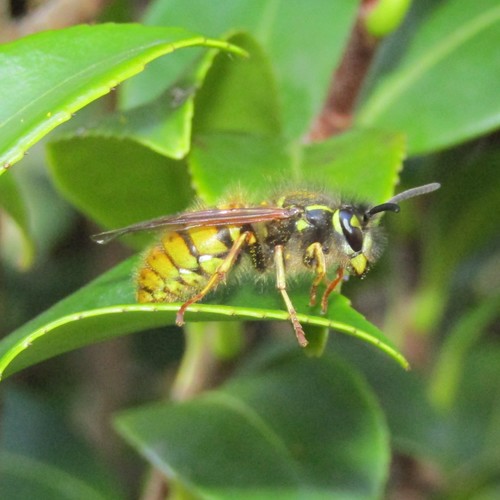
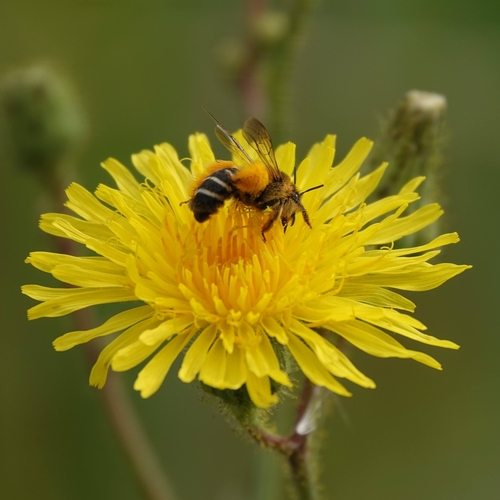
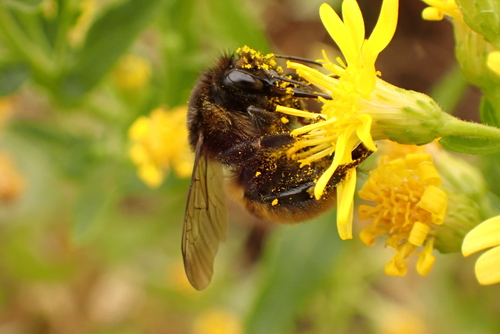
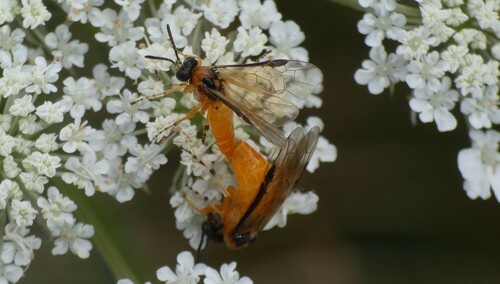
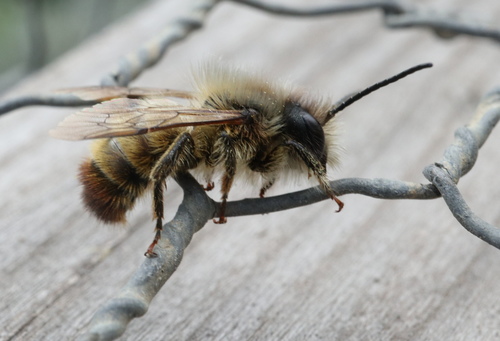
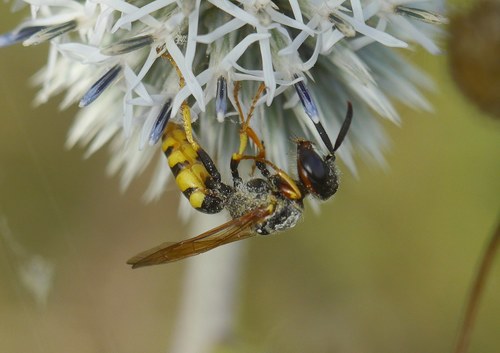
European Hornet
Daily sighting probability ~10% · With luck
at Wadden Sea National Park

In 3 days ~20% in a week ~40%

34 Verified sightings at Wadden Sea National Park From 2019 to 2026
479 In all 13 parks
September Best month
☀️ Diurnal When it's spotted

About the European Hornet

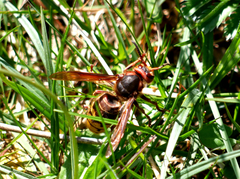
The European hornet (Vespa crabro) is the largest eusocial wasp native to Europe. It is also the only true hornet (genus Vespa) found in North America, having been introduced to the United States and Canada from Europe as early as 1840. Vespines, such as V. crabro, are known for making intricate paper-like nests out of surrounding plant materials and other fibers. Unlike most other vespines, reproductive suppression involves worker policing instead of queen pheromone control, as was previously thought.

This species stings in response to being stepped on or grabbed, but generally avoids conflict. It is also defensive of its nest and can be aggressive around food sources. Care should be taken when they are found in these circumstances, as they may sting without warning. European hornets are largely carnivorous and hunt large insects such as beetles, wasps, large moths, dragonflies, and mantises. They also feed on fallen fruit and other sources of sugary food. Mutual predation between medium-sized hornets and the Asilidae (robber flies) is often reported.

The European hornet is a true hornet (genus Vespa), a group characterized by eusocial species. The genus is in the subfamily... Wikipedia →

Global Distribution

Parks Where Found

# Park Country Daily sighting probability
1 Cévennes National Park 🇫🇷 France
~20%
2 Sierra Nevada National Park 🇪🇸 Spain
~20%
3 Great Smoky Mountains National Park 🇺🇸 United States
~20%
4 Bavarian Forest National Park 🇩🇪 Germany
~10%
5 Snowdonia National Park 🇬🇧 United Kingdom
~10%
6 Białowieża National Park 🇵🇱 Poland
~10%
7 Shenandoah National Park 🇺🇸 United States
~10%
8 Picos de Europa National Park 🇪🇸 Spain
~10%
9 Triglav National Park 🇸🇮 Slovenia
~10%
10 Sierra de Guadarrama National Park 🇪🇸 Spain
~10%
11 Pyrénées National Park 🇫🇷 France
~10%
12 Wadden Sea National Park 🇩🇪 Germany
~10%
13 Fertő-Hanság National Park 🇭🇺 Hungary
~10%

Cities Where Found

# City Country Daily sighting probability
1 Turin 🇮🇹 Italy
~20%
2 Kharkiv 🇺🇦 Ukraine
~20%
3 Kyiv 🇺🇦 Ukraine
~20%
4 Budapest 🇭🇺 Hungary
~20%
5 Berlin 🇩🇪 Germany
~20%
6 Hefei 🇨🇳 China
~20%
7 Warsaw 🇵🇱 Poland
~20%
8 Vienna 🇦🇹 Austria
~20%
9 Brussels 🇧🇪 Belgium
~20%
10 Milan 🇮🇹 Italy
~20%

Before you go

What are the chances of seeing a European Hornet in Wadden Sea National Park?

With luck

About 10% of wildlife watchers report a European Hornet sighting in Wadden Sea National Park on a given day, based on 34 verified sightings from GBIF citizen-science data from 2019 to 2026. It is the 164th most-seen of the 818 insects we can rate there. Over three days the chance rises to about 20%, and over a week to about 40%, if each day is a fresh chance.

When is the best time to see a European Hornet in Wadden Sea National Park?

May to October

In those months about 10% of wildlife watchers report a European Hornet in Wadden Sea National Park on a given day, against under 5% in November to April, the lowest months.

What time of day is best to see a European Hornet?

Between noon and 3 pm

Across all the parks we cover, that three-hour window holds the most European Hornet sightings with a recorded time, and about 7 in 10 of them come between 6 am and 6 pm: it is a daytime animal.

Which relatives of the European Hornet live in Wadden Sea National Park?

Same family: Vespidae

The closest relatives of the European Hornet that you can see in Wadden Sea National Park (family Vespidae, Hornets, Paper Wasps, Potter Wasps, and Allies) are Common European Yellowjacket (about 10%) and German Yellowjacket (about 10%), with each one's daily chance of a sighting.

Where does the European Hornet sighting chance come from?

GBIF citizen-science records

It is estimated from how often the European Hornet is recorded against all the insects logged in Wadden Sea National Park (34 verified sightings from 2019 to 2026), calibrated against known sighting rates. Figures are rounded to the nearest 10% because citizen-science data supports honest approximations, not decimals, and months with records from fewer than five people show "—". How it works.

← Back to Wadden Sea National Park