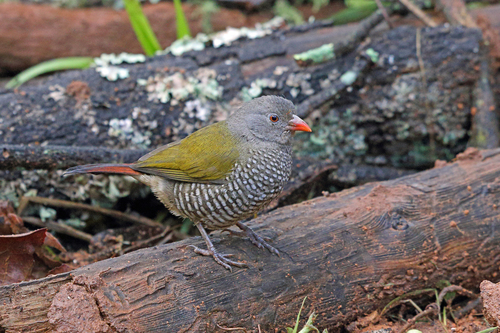
Black-faced Waxbill

Black-faced Waxbill

Estrilda erythronotos

Silhouette: Ferran Sayol · PhyloPic

Daily sighting probability ~10% · With luck
at Waterberg Plateau Park

In 3 days ~30% in a week ~60%

18 Verified sightings at Waterberg Plateau Park From 2019 to 2026
1,446 In all 19 parks
March Best month
☀️ Diurnal When it's spotted

About the Black-faced Waxbill

The black-faced waxbill (Brunhilda erythronotos) is a common species of estrildid finch found in southern Africa. It is found in Angola, Botswana, Kenya, Namibia, Rwanda, South Africa, Tanzania, Uganda, Zambia and Zimbabwe. The IUCN has classified the species as being of least concern.

The black-faced waxbill was formally described in 1817 by the French ornithologist Louis Pierre Vieillot and given the binary name Fringilla erythronotos. The specific epithet combines the Ancient Greek eruthros meaning "red" and

-nōtos meaning "-backed". The type locality is Kurrichane (Kaditshwene) in the North West province of South Africa. This species was formerly placed in the genus Estrilda. When a molecular phylogenetic study published in 2020 found that Estrilda was paraphyletic, the genus Brunhilda was resurrected for this species and the black-cheeked waxbill.

Two subspecies are recognised: Species text in The Atlas of Southern... Wikipedia →

Sounds

Recording0:31

Botswana · 2020

© Dewald du Plessis · iNaturalist · CC BY-NC 4.0

Global Distribution

Parks Where Found

# Park Country Daily sighting probability
1 Serengeti National Park 🇹🇿 Tanzania
~10%
2 Mkomazi National Park 🇹🇿 Tanzania
~10%
3 Ngorongoro Conservation Area 🇹🇿 Tanzania
~10%
4 Waterberg Plateau Park 🇳🇦 Namibia
~10%
5 Ruaha National Park 🇹🇿 Tanzania
~10%
6 Nairobi National Park 🇰🇪 Kenya
~10%
7 Akagera National Park 🇷🇼 Rwanda
~10%
8 Kgalagadi Transfrontier Park 🇿🇦 South Africa
~10%
9 Lake Mburo National Park 🇺🇬 Uganda
~10%
10 Hwange National Park 🇿🇼 Zimbabwe
~10%
11 Etosha National Park 🇳🇦 Namibia
<5%
12 Moremi Game Reserve 🇧🇼 Botswana
<5%
13 Tarangire National Park 🇹🇿 Tanzania
<5%
14 Chobe National Park 🇧🇼 Botswana
<5%
15 Amboseli National Park 🇰🇪 Kenya
<5%
16 Murchison Falls National Park 🇺🇬 Uganda
<5%
17 Tsavo West National Park 🇰🇪 Kenya
<5%
18 Masai Mara National Reserve 🇰🇪 Kenya
<5%
19 Kruger National Park 🇿🇦 South Africa
<5%

Cities Where Found

# City Country Daily sighting probability
1 Kigali 🇷🇼 Rwanda
<5%
2 Nairobi 🇰🇪 Kenya
<5%

Zoos & Centres Where Found

# Zoo / Centre Country
1 Parc Zoologique et Botanique de Mulhouse 🇫🇷 France In captivity
2 Tierpark Hagenbeck 🇩🇪 Germany In captivity

Before you go

What are the chances of seeing a Black-faced Waxbill in Waterberg Plateau Park?

With luck

About 10% of wildlife watchers report a Black-faced Waxbill sighting in Waterberg Plateau Park on a given day, based on 18 verified sightings from GBIF citizen-science data from 2019 to 2026. It is the 72nd most-seen of the 118 birds we can rate there. Over three days the chance rises to about 30%, and over a week to about 60%, if each day is a fresh chance.

When is the best time to see a Black-faced Waxbill in Waterberg Plateau Park?

February–March and December

In those months about 20% of wildlife watchers report a Black-faced Waxbill in Waterberg Plateau Park on a given day, against under 5% in November, the lowest month. Those are among Waterberg Plateau Park's wettest months, with about 70 mm of rain a month against almost none in May. April and June have too few records to rate.

What time of day is best to see a Black-faced Waxbill?

Between 11 am and 2 pm

Across all the parks we cover, that three-hour window holds the most Black-faced Waxbill sightings with a recorded time, and about 9 in 10 of them come between 6 am and 6 pm: it is a daytime animal.

Is Waterberg Plateau Park the best place to see a Black-faced Waxbill?

Among the best

Of the 19 parks where we can rate Black-faced Waxbill sightings, Waterberg Plateau Park ranks 4th at about 10%, level with the leaders once rounded. The best odds are in Serengeti National Park (Tanzania, about 10%), Mkomazi National Park (Tanzania, about 10%) and Ngorongoro Conservation Area (Tanzania, about 10%).

Which relatives of the Black-faced Waxbill live in Waterberg Plateau Park?

Same family: Estrildidae

The closest relatives of the Black-faced Waxbill that you can see in Waterberg Plateau Park (family Estrildidae, Waxbills and Allies) are Green-winged Pytilia (about 40%), Violet-eared Waxbill (about 30%) and Blue-breasted Cordonbleu (about 30%), with each one's daily chance of a sighting.

Where does the Black-faced Waxbill sighting chance come from?

GBIF citizen-science records

It is estimated from how often the Black-faced Waxbill is recorded against all the birds logged in Waterberg Plateau Park (18 verified sightings from 2019 to 2026), calibrated against known sighting rates. Figures are rounded to the nearest 10% because citizen-science data supports honest approximations, not decimals, and months with records from fewer than five people show "—". How it works.

← Back to Waterberg Plateau Park