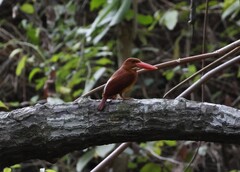
Ruddy Kingfisher

Ruddy Kingfisher

Halcyon coromanda

Silhouette: Andy Wilson · PhyloPic

LCLeast ConcernNTVUENCR
Daily sighting probability ~10% · With luck
at Way Kambas National Park

In 3 days ~20% in a week ~30%

13 Verified sightings at Way Kambas National Park From 2019 to 2026
575 In all 9 parks
May Best month
☀️ Diurnal When it's spotted

About the Ruddy Kingfisher

The ruddy kingfisher (Halcyon coromanda) is a medium-sized tree kingfisher, widely distributed in east and southeast Asia. Reaching approximately 25 cm, the ruddy kingfisher has a very large, bright red bill and equally red legs. The body is rust red, generally deepening to purple at the tail. There is little sexual dimorphism though some sources report male birds being somewhat brighter in plumage. Due to its preference for heavily forested areas, the kingfisher's high, descending call is more often heard than the bird itself is seen, and these birds generally travel singly or in pairs.

The ruddy kingfisher ranges from South Korea and Japan in the north, south through the Philippines to the Sunda Islands, and west to China and India. It is migratory, with birds in the northern part of the range migrating as far south as Borneo during winter. Locally common in southern parts of its range, the ruddy kingfisher is rare in Japan, where it is highly sought after by birders. Ruddy kingfishers inhabit forested areas from the temperate to tropical zones, often in thick jungles and rainforests.

The binomial name recalls the Coromandel... Wikipedia →

Sounds

Song0:36

Thailand · 2024

© Peter Ericsson · XC908987 · CC BY-NC-SA 4.0

Dawn song1:18

Indonesia · 2024

© Ding Li Yong · XC894407 · CC BY-NC-ND 4.0

Alarm call0:46

Malaysia · 2022

© Lim Ying Hien · XC755450 · CC BY-NC-ND 4.0

Global Distribution

Parks Where Found

# Park Country Daily sighting probability
1 Tangkoko Nature Reserve 🇮🇩 Indonesia
~20%
2 Manas National Park 🇮🇳 India
~10%
3 Sundarbans National Park 🇮🇳 India
~10%
4 Way Kambas National Park 🇮🇩 Indonesia
~10%
5 Kinabatangan Wildlife Sanctuary 🇲🇾 Malaysia
<5%
6 Royal Manas National Park 🇧🇹 Bhutan
<5%
7 Gunung Leuser National Park 🇮🇩 Indonesia
<5%
8 Namdapha National Park 🇮🇳 India
<5%
9 Kaeng Krachan National Park 🇹🇭 Thailand
<5%

Cities Where Found

# City Country Daily sighting probability
1 Singapore 🇸🇬 Singapore
<5%
2 Bangkok 🇹🇭 Thailand
<5%
3 Seoul 🇰🇷 South Korea
<5%

Zoos & Centres Where Found

# Zoo / Centre Country
1 Ueno Zoo 🇯🇵 Japan In captivity

Before you go

What are the chances of seeing a Ruddy Kingfisher in Way Kambas National Park?

With luck

About 10% of wildlife watchers report a Ruddy Kingfisher sighting in Way Kambas National Park on a given day, based on 13 verified sightings from GBIF citizen-science data from 2019 to 2026. It is the 173rd most-seen of the 205 birds we can rate there. Over three days the chance rises to about 20%, and over a week to about 30%, if each day is a fresh chance.

When is the best time to see a Ruddy Kingfisher in Way Kambas National Park?

May

In that month about 20% of wildlife watchers report a Ruddy Kingfisher in Way Kambas National Park on a given day, against under 5% in March–April, June and August–September, the lowest months. November to February have too few records to rate.

What time of day is best to see a Ruddy Kingfisher?

Between 10 am and 1 pm

Across all the parks we cover, that three-hour window holds the most Ruddy Kingfisher sightings with a recorded time, and about 7 in 10 of them come between 6 am and 6 pm: it is a daytime animal.

Is Way Kambas National Park the best place to see a Ruddy Kingfisher?

4th of 9

Of the 9 parks where we can rate Ruddy Kingfisher sightings, Way Kambas National Park ranks 4th at about 10%. The best odds are in Tangkoko Nature Reserve (Indonesia, about 20%), Manas National Park (India, about 10%) and Sundarbans National Park (India, about 10%).

Where does the Ruddy Kingfisher sighting chance come from?

GBIF citizen-science records

It is estimated from how often the Ruddy Kingfisher is recorded against all the birds logged in Way Kambas National Park (13 verified sightings from 2019 to 2026), calibrated against known sighting rates. Figures are rounded to the nearest 10% because citizen-science data supports honest approximations, not decimals, and months with records from fewer than five people show "—". How it works.

← Back to Way Kambas National Park