Jungle Cat

Jungle Cat

Felis chaus

Silhouette: L. Shyamal (photograph) · PhyloPic

LCLeast ConcernNTVUENCR
Daily sighting probability ~30% · Possible
at Wilpattu National Park

In 3 days ~60% in a week ~90%

7 Verified sightings at Wilpattu National Park From 2019 to 2026
23 In all 3 parks
February Best month
🌅 Crepuscular When it's spotted

About the Jungle Cat

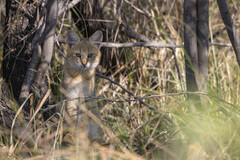
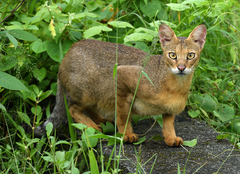
The jungle cat (Felis chaus), also called reed cat and swamp cat, is a medium-sized cat native from the Eastern Mediterranean region and the Caucasus to parts of Central, South and Southeast Asia. It inhabits foremost wetlands like swamps, littoral and riparian areas with dense vegetation. It is listed as Least Concern on the IUCN Red List, and is mainly threatened by destruction of wetlands, trapping and poisoning.

The jungle cat has a uniformly sandy, reddish-brown or grey fur without spots; melanistic and albino individuals are also known. It is solitary in nature, except during the mating season and mother–kitten families. Adults maintain territories by urine spraying and scent marking. Its preferred prey is small mammals and birds. It hunts by stalking its prey, followed by a sprint or a leap; the ears help in pinpointing the location of prey. Both sexes become sexually mature by the time they are one year old; females enter oestrus from January to March. Mating behaviour is similar to that in the domestic cat: the male pursues the female in oestrus, seizes her by the nape of her neck and mounts her. Gestation lasts nearly two months. Births take place between December and June, though this might vary geographically. Kittens begin to catch their own prey at around six months and leave the mother after eight or nine months.

The species was first described by Johann Anton Güldenstädt in 1776 based on a specimen caught in a Caucasian wetland. Johann Christian Daniel von Schreber gave the jungle cat its present binomial name and is therefore generally considered as binomial authority. Three subspecies are recognised at present. Wikipedia →

Sounds

Recording0:10

Türkiye · 2026

© Yekta Bilgili · iNaturalist · CC BY-NC 4.0

Global Distribution

Parks Where Found

# Park Country Daily sighting probability
1 Sundarbans National Park 🇮🇳 India
~40%
2 Wilpattu National Park 🇱🇰 Sri Lanka
~30%
3 Minneriya National Park 🇱🇰 Sri Lanka
~10%

Zoos & Centres Where Found

# Zoo / Centre Country
1 Bondla Zoo 🇮🇳 India In captivity
2 Nehru Zoological Park 🇮🇳 India In captivity
3 Tallinn Zoo 🇪🇪 Estonia In captivity
4 Novosibirsk Zoo 🇷🇺 Russia In captivity
5 Yerevan Zoo 🇦🇲 Armenia In captivity
6 Sajjangarh Biological Park 🇮🇳 India In captivity
7 Warangal Zoo 🇮🇳 India In captivity
8 Alipore Zoological Gardens 🇮🇳 India In captivity
9 Nahargarh Zoological Park 🇮🇳 India In captivity
10 Lithuanian Zoo 🇱🇹 Lithuania In captivity
11 Tbilisi Zoo 🇬🇪 Georgia In captivity
12 Kathmandu Zoo 🇳🇵 Nepal In captivity
13 Eram Zoo 🇮🇷 Iran In captivity
14 Zoo Koki (Parque zoológico y botánico) 🇪🇸 Spain In captivity
15 Bangkok Aquarium 🇹🇭 Thailand In captivity
16 Ogród zoologiczny w Spiskiej Nowej Wsi 🇸🇰 Slovakia In captivity

Before you go

What are the chances of seeing a Jungle Cat in Wilpattu National Park?

Possible

About 30% of wildlife watchers report a Jungle Cat sighting in Wilpattu National Park on a given day, based on 7 verified sightings from GBIF citizen-science data from 2019 to 2026. It is the 17th most-seen of the 19 mammals we can rate there. Over three days the chance rises to about 60%, and over a week to about 90%, if each day is a fresh chance.

When is the best time to see a Jungle Cat in Wilpattu National Park?

February

In that month about 50% of wildlife watchers report a Jungle Cat in Wilpattu National Park on a given day, against under 5% in January, June–July, September and November, the lowest months. That is one of Wilpattu National Park's driest months, with about 40 mm of rain against 320 mm in November.

What time of day is best to see a Jungle Cat?

Between noon and 3 pm

Across all the parks we cover, that three-hour window holds the most Jungle Cat sightings with a recorded time, and about 6 in 10 of them come between 6 am and 6 pm: it is most active around dawn and dusk.

Is Wilpattu National Park the best place to see a Jungle Cat?

2nd of 3

Of the 3 parks where we can rate Jungle Cat sightings, Wilpattu National Park ranks 2nd at about 30%. The best odds are in Sundarbans National Park (India, about 40%).

Where does the Jungle Cat sighting chance come from?

GBIF citizen-science records

It is estimated from how often the Jungle Cat is recorded against all the mammals logged in Wilpattu National Park (7 verified sightings from 2019 to 2026), calibrated against known sighting rates. Figures are rounded to the nearest 10% because citizen-science data supports honest approximations, not decimals, and months with records from fewer than five people show "—". How it works.

← Back to Wilpattu National Park