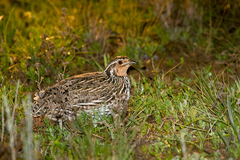
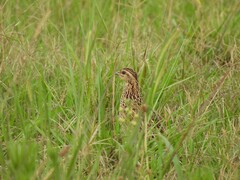
Stubble Quail

Stubble Quail

Coturnix pectoralis

Silhouette: Marie-Aimée ALLARD · PhyloPic

LCLeast ConcernNTVUENCR Endemic
Daily sighting probability <5% · Rare
at Wilsons Promontory National Park

In 3 days <5% in a week ~10%

7 Verified sightings at Wilsons Promontory National Park From 2019 to 2026
29 In all 3 parks
October Best month
☀️🌙 Day & Night When it's spotted

About the Stubble Quail

The stubble quail (Coturnix pectoralis), whose other common names include grey quail and pectoral quail, is a species of Old World quail native to Australia. The species is widespread in mainland Australia and is listed as least concern by the IUCN, and can be found throughout all states and territories of Australia except Tasmania. It is the only native upland game bird that can be legally hunted in Australia, though with strict game law restrictions.

The stubble quail is a member of the family Phasianidae. C. pectoralis has sometimes been considered conspecific with the extinct New Zealand quail, C. novaezealandiae. In this case, the latter species' name would have priority and the stubble quail would become Coturnix novaezelandiae pectoralis. Phylogenetic analysis of three separate mitochondrial control region sequences in 2009 showed a close phylogenetic relationship between the two birds and it was confirmed that they are separate species. Geographic isolation occurred between the Australian species and the New Zealand species when the Tasman Sea became too wide for the birds to fly the journey. This geographic isolation enabled genetic divergence to occur and two... Wikipedia →

Sounds

Song0:25

Australia · 2021

© Marc Anderson · XC688920 · CC BY-NC-ND 4.0

Call0:48

Australia · 2021

© Eddy Smith · XC683895 · CC BY-NC-SA 4.0

Call0:15

Australia · 2020

© Liam Manderson · XC605784 · CC BY-NC-SA 4.0

Global Distribution

Parks Where Found

# Park Country Daily sighting probability
1 Wilsons Promontory National Park 🇦🇺 Australia
<5%
2 Hattah-Kulkyne National Park 🇦🇺 Australia
<5%
3 Great Otway National Park 🇦🇺 Australia
<5%

Cities Where Found

# City Country Daily sighting probability
1 Melbourne 🇦🇺 Australia
<5%

Closest Relatives at Wilsons Promontory National Park

No species of the same family or order lives in Wilsons Promontory National Park, so these are its closest relatives here: other birds.

Before you go

What are the chances of seeing a Stubble Quail in Wilsons Promontory National Park?

Rare

Under 5% of wildlife watchers report a Stubble Quail sighting in Wilsons Promontory National Park on a given day, based on 7 verified sightings from GBIF citizen-science data from 2019 to 2026. It is the 132nd most-seen of the 138 birds we can rate there. Over three days the chance rises to under 5%, and over a week to about 10%, if each day is a fresh chance.

When is the best time to see a Stubble Quail in Wilsons Promontory National Park?

Any time of year

In every month with enough records, under 5% of wildlife watchers report a Stubble Quail in Wilsons Promontory National Park on a given day, so our monthly data shows no clear season.

What time of day is best to see a Stubble Quail?

Between 6 and 9 pm

Across all the parks we cover, that three-hour window holds the most Stubble Quail sightings with a recorded time, and about 6 in 10 of them come between 6 am and 6 pm: it is seen both by day and at night.

Is Wilsons Promontory National Park the best place to see a Stubble Quail?

Yes

Of the 3 parks where we can rate Stubble Quail sightings, Wilsons Promontory National Park has the highest daily chance: under 5%. Next come Hattah-Kulkyne National Park (Australia, under 5%) and Great Otway National Park (Australia, under 5%).

Where does the Stubble Quail sighting chance come from?

GBIF citizen-science records

It is estimated from how often the Stubble Quail is recorded against all the birds logged in Wilsons Promontory National Park (7 verified sightings from 2019 to 2026), calibrated against known sighting rates. Figures are rounded to the nearest 10% because citizen-science data supports honest approximations, not decimals, and months with records from fewer than five people show "—". How it works.

← Back to Wilsons Promontory National Park