Brown Thornbill

Brown Thornbill

Acanthiza pusilla

Silhouette: Matt Wilkins (photo by Patrick Kavanagh) · PhyloPic

LCLeast ConcernNTVUENCR Endemic
Daily sighting probability ~60% · Likely
at Wilsons Promontory National Park

In 3 days ~90% in a week >90%

469 Verified sightings at Wilsons Promontory National Park From 2019 to 2026
12,543 In all 14 parks
December Best month
☀️ Diurnal When it's spotted

About the Brown Thornbill

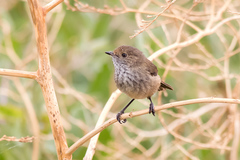
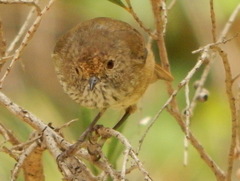
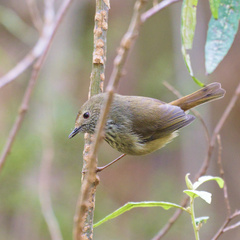
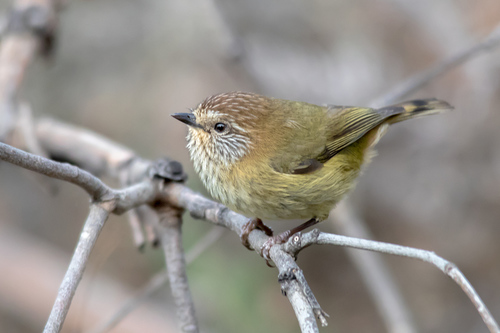
The brown thornbill (Acanthiza pusilla) is a passerine bird usually found in eastern and south-eastern Australia, including Tasmania. It can grow up to 10 cm (3.9 in) long, and feeds on insects. It is brown, grey and white. The species has five subspecies.

The brown thornbill is a member of the order Passeriformes, the family Acanthizidae, and the genus Acanthiza. The species was first described by George Shaw in 1790. The generic name Acanthiza derives from Ancient Greek akantheōn 'thorn-brake' and zaō 'to live, inhabit'. The specific epithet derives from Latin pusillus 'very small'.

A 2017 genetic study using both mitochondrial and nuclear DNA found the ancestor of the brown thornbill diverged from that of... Wikipedia →

Sounds

Call1:00

Australia · 2026

© Khristos Nizamis · XC1177589 · CC BY-NC-ND 4.0

Song1:14

Australia · 2024

© Romuald Mikusek · XC1173890 · CC BY-NC-SA 4.0

Alarm call0:33

Australia · 2026

© Marc Anderson · XC1085213 · CC BY-NC-ND 4.0

Global Distribution

Parks Where Found

# Park Country Daily sighting probability
1 Great Otway National Park 🇦🇺 Australia
~70%
2 Springbrook National Park 🇦🇺 Australia
~60%
3 Wilsons Promontory National Park 🇦🇺 Australia
~60%
4 Blue Mountains National Park 🇦🇺 Australia
~60%
5 Grampians National Park 🇦🇺 Australia
~60%
6 Lamington National Park 🇦🇺 Australia
~50%
7 Kosciuszko National Park 🇦🇺 Australia
~50%
8 Freycinet National Park 🇦🇺 Australia
~50%
9 Royal National Park 🇦🇺 Australia
~50%
10 Flinders Chase 🇦🇺 Australia
~40%
11 Booderee National Park 🇦🇺 Australia
~40%
12 Maria Island National Park 🇦🇺 Australia
~30%
13 Cradle Mountain-Lake St Clair National Park 🇦🇺 Australia
~30%
14 Noosa National Park 🇦🇺 Australia
~10%

Cities Where Found

# City Country Daily sighting probability
1 Melbourne 🇦🇺 Australia
~40%
2 Hobart 🇦🇺 Australia
~40%
3 Sydney 🇦🇺 Australia
~10%
4 Brisbane 🇦🇺 Australia
<5%

Before you go

What are the chances of seeing a Brown Thornbill in Wilsons Promontory National Park?

Likely

About 60% of wildlife watchers report a Brown Thornbill sighting in Wilsons Promontory National Park on a given day, based on 469 verified sightings from GBIF citizen-science data from 2019 to 2026. It is the 9th most-seen of the 138 birds we can rate there. Over three days the chance rises to about 90%, and over a week to over 90%, if each day is a fresh chance.

When is the best time to see a Brown Thornbill in Wilsons Promontory National Park?

February and December

In those months about 70% of wildlife watchers report a Brown Thornbill in Wilsons Promontory National Park on a given day, against about 40% in October, the lowest month.

What time of day is best to see a Brown Thornbill?

Between 11 am and 2 pm

Across all the parks we cover, that three-hour window holds the most Brown Thornbill sightings with a recorded time, and nearly all of them come between 6 am and 6 pm: it is a daytime animal.

Is Wilsons Promontory National Park the best place to see a Brown Thornbill?

3rd of 14

Of the 14 parks where we can rate Brown Thornbill sightings, Wilsons Promontory National Park ranks 3rd at about 60%. The best odds are in Great Otway National Park (Australia, about 70%) and Springbrook National Park (Australia, about 60%). All parks ranked.

Where does the Brown Thornbill sighting chance come from?

GBIF citizen-science records

It is estimated from how often the Brown Thornbill is recorded against all the birds logged in Wilsons Promontory National Park (469 verified sightings from 2019 to 2026), calibrated against known sighting rates. Figures are rounded to the nearest 10% because citizen-science data supports honest approximations, not decimals, and months with records from fewer than five people show "—". How it works.

← Back to Wilsons Promontory National Park