Blyth's Pipit

Blyth's Pipit

Anthus godlewskii

Silhouette: Susan Murphy (original photograph), T. Michael Keesey (vectorization) · PhyloPic

LCLeast ConcernNTVUENCR
Daily sighting probability <5% · Rare
at Yala National Park

In 3 days ~10% in a week ~20%

20 Verified sightings at Yala National Park From 2019 to 2026
123 In all 7 parks
February Best month
☀️ Diurnal When it's spotted

About the Blyth's Pipit

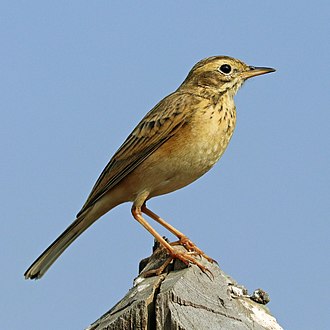
Blyth's pipit (Anthus godlewskii) is a medium-sized passerine bird which breeds in Mongolia and neighbouring areas of China, Tibet and India. It is a long distance migrant moving to open lowlands in Southern Asia. It is a very rare vagrant to western Europe.

This is a large pipit, but is an undistinguished looking species on the ground, mainly brown above and pale below. It is very similar to Richard's pipit, but is slightly smaller, shorter legs and a shorter dark bill. Its flight is strong and direct, and it gives a characteristic "pshee" call, higher pitched than Richard's.

In south Asia, in winter some care must be taken to distinguish this from other large pipits which winter or are resident in the area, including Richard's. This species is insectivorous. This bird was named after the English zoologist Edward Blyth. The genus name Anthus is the Latin name for a small bird of grasslands. The specific godlewskii commemorates Polish nobleman and field naturalist Victor Godlewski.

Heard, Chris (1995) Unravelling the mystery Birdwatch 41:20-24 Page, Doug (1997) From the Rarities Committee's files: problems presented... Wikipedia →

Sounds

Flight call0:31

Mongolia · 2026

© Ding Li Yong · XC1138202 · CC BY-NC-ND 4.0

Flight song0:52

Mongolia · 2025

© Richard E. Webster · XC1027083 · CC BY-NC-SA 4.0

Call0:15

Netherlands · 2020

© Michel Veldt · XC769164 · CC BY-NC-SA 4.0

Global Distribution

Parks Where Found

# Park Country Daily sighting probability
1 Gobi Gurvansaikhan National Park 🇲🇳 Mongolia
~10%
2 Yala National Park 🇱🇰 Sri Lanka
<5%
3 Bandhavgarh National Park 🇮🇳 India
<5%
4 Horton Plains National Park 🇱🇰 Sri Lanka
<5%
5 Manas National Park 🇮🇳 India
<5%
6 Kanha National Park 🇮🇳 India
<5%
7 Chitwan National Park 🇳🇵 Nepal
<5%

Cities Where Found

# City Country Daily sighting probability
1 Ulaanbaatar 🇲🇳 Mongolia
~10%
2 Kathmandu 🇳🇵 Nepal
<5%
3 Vasai-Virar 🇮🇳 India
<5%
4 Kozhikode 🇮🇳 India
<5%
5 Dhaka 🇧🇩 Bangladesh
<5%
6 Pune 🇮🇳 India
<5%
7 Kolkata 🇮🇳 India
<5%
8 Kochi 🇮🇳 India
<5%
9 Chennai 🇮🇳 India
<5%
10 Beijing 🇨🇳 China
<5%

Before you go

What are the chances of seeing a Blyth's Pipit in Yala National Park?

Rare

Under 5% of wildlife watchers report a Blyth's Pipit sighting in Yala National Park on a given day, based on 20 verified sightings from GBIF citizen-science data from 2019 to 2026. It is the 177th most-seen of the 220 birds we can rate there. Over three days the chance rises to about 10%, and over a week to about 20%, if each day is a fresh chance.

When is the best time to see a Blyth's Pipit in Yala National Park?

February

In that month about 10% of wildlife watchers report a Blyth's Pipit in Yala National Park on a given day, against under 5% in March to January, the lowest months. That is one of Yala National Park's driest months, with about 65 mm of rain against 340 mm in November.

What time of day is best to see a Blyth's Pipit?

Between 7 and 10 am

Across all the parks we cover, that three-hour window holds the most Blyth's Pipit sightings with a recorded time, and about 9 in 10 of them come between 6 am and 6 pm: it is a daytime animal.

Is Yala National Park the best place to see a Blyth's Pipit?

2nd of 7

Of the 7 parks where we can rate Blyth's Pipit sightings, Yala National Park ranks 2nd at under 5%. The best odds are in Gobi Gurvansaikhan National Park (Mongolia, about 10%).

Where does the Blyth's Pipit sighting chance come from?

GBIF citizen-science records

It is estimated from how often the Blyth's Pipit is recorded against all the birds logged in Yala National Park (20 verified sightings from 2019 to 2026), calibrated against known sighting rates. Figures are rounded to the nearest 10% because citizen-science data supports honest approximations, not decimals, and months with records from fewer than five people show "—". How it works.

← Back to Yala National Park