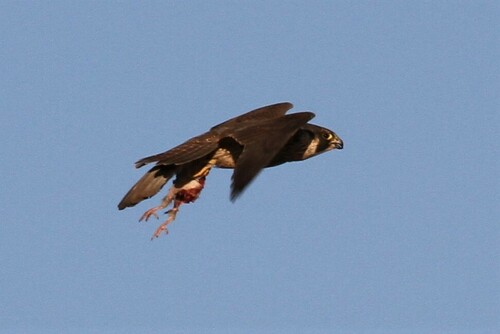
Black Caracara

Black Caracara

Daptrius ater

Silhouette: Kai Caspar · PhyloPic

LCLeast ConcernNTVUENCR
Daily sighting probability ~20% · Possible
at Yasuní National Park

In 3 days ~60% in a week ~90%

856 Verified sightings at Yasuní National Park From 2019 to 2026
2,664 In all 8 parks
May Best month
☀️ Diurnal When it's spotted

About the Black Caracara

The black caracara (Daptrius ater) is a bird of prey in the family Falconidae that is found in Amazonian and French Guianan lowlands, mainly occurring along rivers. It was formerly the only species placed in the genus Daptrius but based on genetic studies the genus now includes species that were formerly placed in the genera Milvago and Phalcoboenus.

Since migration has not been observed, they are considered resident, or sedentary, remaining in the tropics year round. The black caracara is a widespread and sociable raptor, often spotted in groups of 2–5 individuals in tall trees. Nests, built from sticks and usually containing 2–3 brown-spotted eggs, have been observed high in trees, yet little is known of their breeding habits or reproduction. Typical of caracaras, D. ater is an omnivore as well as an opportunist, known simultaneously as a predator, scavenger and a forager; together with other American raptors, particularly the Cathartidae (new world vultures) and the condors, the black caracara benefits the greater environment by consuming carrion.

The black caracara was formally described in 1816 by the French ornithologist Louis Vieillot under the binomial name Daptrius... Wikipedia →

Sounds

Call0:06

Brazil · 2026

© JAYRSON ARAUJO DE OLIVEIRA · XC1186089 · CC BY-NC-SA 4.0

Song0:07

Ecuador · 2021

© Leonardo Ordóñez-Delgado · XC672277 · CC BY-NC-ND 4.0

Flight call0:40

Brazil · 2019

© GABRIEL LEITE · XC456211 · CC BY-NC-SA 4.0

Global Distribution

Parks Where Found

# Park Country Daily sighting probability
1 Cuyabeno Wildlife Reserve 🇪🇨 Ecuador
~40%
2 Yasuní National Park 🇪🇨 Ecuador
~20%
3 Amacayacu National Natural Park 🇨🇴 Colombia
~20%
4 Tambopata National Reserve 🇵🇪 Peru
~20%
5 Manu National Park 🇵🇪 Peru
~10%
6 Sierra de la Macarena National Park 🇨🇴 Colombia
~10%
7 Anavilhanas National Park 🇧🇷 Brazil
~10%
8 Podocarpus National Park 🇪🇨 Ecuador
<5%

Zoos & Centres Where Found

# Zoo / Centre Country
1 Arequipa zoo 🇵🇪 Peru In captivity

Before you go

What are the chances of seeing a Black Caracara in Yasuní National Park?

Possible

About 20% of wildlife watchers report a Black Caracara sighting in Yasuní National Park on a given day, based on 856 verified sightings from GBIF citizen-science data from 2019 to 2026. It is the 52nd most-seen of the 533 birds we can rate there. Over three days the chance rises to about 60%, and over a week to about 90%, if each day is a fresh chance.

When is the best time to see a Black Caracara in Yasuní National Park?

May

In that month about 40% of wildlife watchers report a Black Caracara in Yasuní National Park on a given day, against about 20% in January, March–April, July–August and November, the lowest months.

What time of day is best to see a Black Caracara?

Between 7 and 10 am

Across all the parks we cover, that three-hour window holds the most Black Caracara sightings with a recorded time, and about 8 in 10 of them come between 6 am and 6 pm: it is a daytime animal.

Is Yasuní National Park the best place to see a Black Caracara?

2nd of 8

Of the 8 parks where we can rate Black Caracara sightings, Yasuní National Park ranks 2nd at about 20%. The best odds are in Cuyabeno Wildlife Reserve (Ecuador, about 40%). All parks ranked.

Which relatives of the Black Caracara live in Yasuní National Park?

Same family: Falconidae

The closest relatives of the Black Caracara that you can see in Yasuní National Park (family Falconidae, Falcons and Caracaras) are Red-throated Caracara (about 20%), Laughing Falcon (about 10%) and Bat Falcon (about 10%), with each one's daily chance of a sighting.

Where does the Black Caracara sighting chance come from?

GBIF citizen-science records

It is estimated from how often the Black Caracara is recorded against all the birds logged in Yasuní National Park (856 verified sightings from 2019 to 2026), calibrated against known sighting rates. Figures are rounded to the nearest 10% because citizen-science data supports honest approximations, not decimals, and months with records from fewer than five people show "—". How it works.

← Back to Yasuní National Park