Eastern Chipmunk

Eastern Chipmunk

Tamias striatus

Silhouette: Chloé Schmidt · PhyloPic

LCLeast ConcernNTVUENCR
Daily sighting probability ~30% · Possible
at Acadia National Park

In 3 days ~70% in a week ~90%

139 Verified sightings at Acadia National Park From 2019 to 2026
406 In all 7 parks
March Best month
☀️ Diurnal When it's spotted

About the Eastern Chipmunk

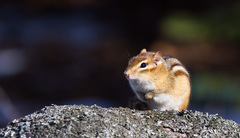
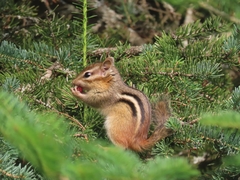
The eastern chipmunk (Tamias striatus) is a chipmunk species found in eastern North America. It is the only living member of the genus Tamias. The name "chipmunk" probably comes from the Ojibwe word ᐊᒋᑕᒨ ajidamoo (or possibly ajidamoonh, the same word in the Ottawa dialect of Ojibwe), which translates literally as "one who descends trees headlong." First described by Mark Catesby in his 1743 The Natural History of Carolina, Florida, and the Bahama Islands, the chipmunk was eventually classified as Sciurus striatus by Linnaeus, meaning "striped squirrel" in Latin. The scientific name was changed to Tamias striatus, meaning "striped steward", by Johann Illiger in 1811.

A small species, it reaches about 30 cm (12 in) in length including the tail, and a weight of 66–150 g (2.3–5.3 oz). It has reddish-brown fur on its upper body and five dark brown stripes contrasting with light brown stripes along its back, ending in a dark tail. It has lighter fur on the lower part of its body. It has a tawny stripe that runs from its whiskers to below its ears, and light stripes over its eyes. It has two fewer teeth than other chipmunks and four toes each on the front... Wikipedia →

Sounds

Recording0:11

United States · 2016

© Daniel Parker · XC335276 · CC BY-NC-SA 4.0

Call0:25

United States · 2026

© Scott Olmstead · XC1141324 · CC BY-NC-SA 4.0

Call0:35

United States · 2008

© Paul Driver · XC961817 · CC BY-NC-SA 4.0

Global Distribution

Parks Where Found

# Park Country Daily sighting probability
1 Voyageurs National Park 🇺🇸 United States
~50%
2 Cape Breton Highlands National Park 🇨🇦 Canada
~40%
3 Acadia National Park 🇺🇸 United States
~30%
4 Shenandoah National Park 🇺🇸 United States
~30%
5 Great Smoky Mountains National Park 🇺🇸 United States
~20%
6 Gros Morne National Park 🇨🇦 Canada
~20%
7 Riding Mountain National Park 🇨🇦 Canada
~10%

Cities Where Found

# City Country Daily sighting probability
1 Boston 🇺🇸 United States
~40%
2 Minneapolis [Saint Paul] 🇺🇸 United States
~30%
3 Toronto 🇨🇦 Canada
~30%
4 Detroit 🇺🇸 United States
~30%
5 Chicago 🇺🇸 United States
~30%
6 Montreal 🇨🇦 Canada
~20%
7 Philadelphia 🇺🇸 United States
~20%
8 Washington 🇺🇸 United States
~20%
9 New York City 🇺🇸 United States
~20%
10 Baltimore 🇺🇸 United States
~10%

Zoos & Centres Where Found

# Zoo / Centre Country
1 Brookfield Zoo 🇺🇸 United States In captivity
2 The Green Zoo Wuppertal 🇩🇪 Germany In captivity
3 Ralph Perkins II Wildlife Center and Woods Garden 🇺🇸 United States In captivity
4 Great Lakes Aquarium 🇺🇸 United States In captivity

Before you go

What are the chances of seeing an Eastern Chipmunk in Acadia National Park?

Possible

About 30% of wildlife watchers report an Eastern Chipmunk sighting in Acadia National Park on a given day, based on 139 verified sightings from GBIF citizen-science data from 2019 to 2026. It is the 5th most-seen of the 24 mammals we can rate there. Over three days the chance rises to about 70%, and over a week to about 90%, if each day is a fresh chance.

When is the best time to see an Eastern Chipmunk in Acadia National Park?

March, June and August–September

In those months about 40% of wildlife watchers report an Eastern Chipmunk in Acadia National Park on a given day, against under 5% in February, the lowest month.

What time of day is best to see an Eastern Chipmunk?

Between 1 and 4 pm

Across all the parks we cover, that three-hour window holds the most Eastern Chipmunk sightings with a recorded time, and about 9 in 10 of them come between 6 am and 6 pm: it is a daytime animal.

Which relatives of the Eastern Chipmunk live in Acadia National Park?

Same family: Sciuridae

The closest relatives of the Eastern Chipmunk that you can see in Acadia National Park (family Sciuridae, Squirrels) are American Red Squirrel (about 60%), Eastern Gray Squirrel (about 20%) and Woodchuck (about 10%), with each one's daily chance of a sighting.

Where does the Eastern Chipmunk sighting chance come from?

GBIF citizen-science records

It is estimated from how often the Eastern Chipmunk is recorded against all the mammals logged in Acadia National Park (139 verified sightings from 2019 to 2026), calibrated against known sighting rates. Figures are rounded to the nearest 10% because citizen-science data supports honest approximations, not decimals, and months with records from fewer than five people show "—". How it works.


← Back to Acadia National Park